
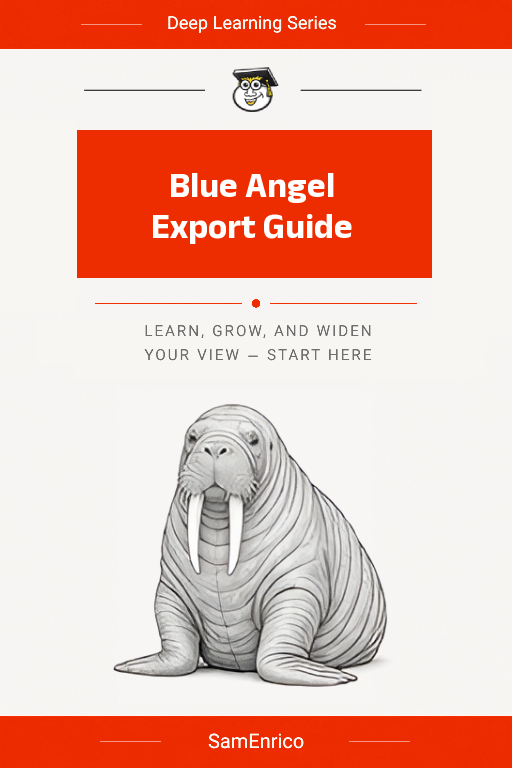
Non-FictionBusiness BriefBlue Angel
Blue Angel Export Guide eBook
Get Blue Angel German ecolabel for exports to envi
Get Blue Angel German ecolabel for exports to environmentally sensitive German buyers.
Formats
Free sample
Chapter 1: The €500 Billion Door--–- In a conference room overlooking the Rhine River in Cologne, a mid-sized Turkish furniture manufacturer named Mehmet watched his company’s €2.3 million bid for a Berlin school contract get rejected. The winning bidder—a Swedish competitor—had priced their desks 8 percent higher. Mehmet’s lower price, faster delivery, and superior quality meant nothing. The reason for his loss, printed in block letters on the rejection notice, was simple: Fehlen des Blauen Engels—Lack of the Blue Angel.Mehmet had never heard of the Blue Angel. Neither had his export manager, his German distributor, or his bank.
Within twelve months, however, Mehmet would become one of the 412 non-German companies holding active Blue Angel certificates. He would learn that this small blue logo, featuring a white angel circled by a laurel wreath, is not merely an environmental badge. It is a key. And the door it unlocks leads to approximately €500 billion in annual German public procurement spending—money that Mehmet had been unknowingly leaving on the table for seven years.This chapter establishes three foundational truths that every exporter must accept before proceeding further in this book. First, the Blue Angel is the world’s oldest and most trusted ecolabel, carrying legal weight that no private certification can match.
Second, for exporters targeting environmentally sensitive German buyers—which today means virtually all German government entities and a growing majority of corporate purchasers—this label functions as a non-tariff barrier. Without it, you are not merely disadvantaged. You are invisible. Third, and most importantly for your bottom line, foreign companies already hold 17 percent of all active Blue Angel certificates. The door is not locked.
You simply have not yet turned the key.This chapter will walk you through the history and authority of the Blue Angel, the staggering scale of German green procurement, the concrete financial benefits of certification, the evidence that international exporters succeed, and the cost of remaining uncertified. By the end, you will understand why the Blue Angel is not an optional marketing expense but a strategic investment with measured returns.The World’s Oldest Ecolabel: Born from Acid Rain and Dying Forests The Blue Angel was not born in a marketing department. It was born in crisis.In the late 1970s, West Germany faced an environmental catastrophe that captured the world’s attention. Acid rain—caused primarily by sulfur dioxide emissions from coal-fired power plants and industrial factories—was destroying the country’s forests. The phenomenon, known as Waldsterben (forest dieback), became a national obsession.
By 1983, more than half of Germany’s trees showed damage. Public outrage demanded action, and the government needed a way to help consumers and procurement officers identify products that were less harmful to the environment.On June 5, 1978—World Environment Day—the German Federal Minister of the Interior announced the creation of Der Blaue Engel, the Blue Angel. The logo was designed by the artist Karl Oskar Blase, who won a public competition. The angel depicted in the logo is the same figure that adorns the gates of the Bremen Town Hall, a symbol of protection and guardianship. The laurel wreath represents environmental protection.From its first certification—for a brand of low-emission toilet paper manufactured by the company Hakle—the Blue Angel established a radical principle that remains controversial even today: the label would be awarded not to companies but to specific products, and the criteria would be set by independent scientists, not by industry lobbyists.
This principle of scientific independence is what separates the Blue Angel from the thousands of self-declared “eco-labels” that have proliferated in the decades since.In 1986, oversight of the Blue Angel transferred to the newly created Federal Ministry for the Environment, Nature Conservation, and Nuclear Safety (BMUV). In 2001, the administrative responsibility moved to RAL g Gmb H (see Chapter 2 for the complete institutional map), while the scientific criteria development remained with the German Environment Agency (UBA) in Dessau.Today, more than 1,200 products across approximately 120 product categories carry the Blue Angel. The label has been awarded to everything from low-emission paints and recycled paper to energy-efficient printers and sustainably manufactured furniture. It has survived forty-seven years of political change, including reunification, the shift from coal to renewables, and the rise of the circular economy. Its longevity is not an accident.
It is a testament to trust.The Legal Backing That Commercial Labels Cannot Touch Here is what most exporters do not understand: the Blue Angel is not a voluntary marketing program. It is embedded in German law.The German Circular Economy Act (Kreislaufwirtschaftsgesetz or Kr WG), which implements the EU’s Circular Economy Package, explicitly references the Blue Angel as a preferred instrument for green public procurement. Section 45 of the German Procurement Regulation (Vergabeverordnung or Vg V) states that contracting authorities may require proof of environmental conformity and shall accept existing Type I ecolabels according to ISO 14024 as such proof. The Blue Angel is the oldest and most widely recognized Type I ecolabel in Germany.What does this mean for you as an exporter? It means that when a German government buyer—whether at the federal, state (Land), or municipal (Kommune) level—issues a tender for a product category covered by an existing Blue Angel criteria document, they are legally permitted to require the Blue Angel as proof of environmental performance.
In practice, according to a 2023 survey by the German Association of Cities and Municipalities (Deutscher Städtetag), 94 percent of German procurement officers do exactly that when the category is covered.This is not a suggestion. It is procurement law.Furthermore, the German government has committed to leading by example. In 2021, the Federal Cabinet adopted the “German Sustainable Development Strategy,” which mandates that all federal ministries prioritize products with the Blue Angel “wherever technically feasible and economically reasonable.” In plain language, this means that if your product category has a Blue Angel criteria document and your product does not have the label, you cannot win a federal contract.Consider the scale. The German federal government alone spends approximately €50 billion annually on procurement of goods and services. When you add the sixteen states (Bundesländer) and the approximately 11,000 municipalities, total German public procurement exceeds €500 billion per year, or roughly 15 percent of the country’s gross domestic product (GDP).
This is larger than the entire economy of Austria, Norway, or Ireland.Of that €500 billion, an estimated 30 to 40 percent—€150 to €200 billion—is spent on products and services where environmental criteria are relevant. And within that pool, the Blue Angel is the single most frequently cited ecolabel.The Price of Ignorance: A Concrete Financial Model Let us return to Mehmet, the Turkish furniture manufacturer whose €2.3 million bid was rejected because he lacked the Blue Angel.Mehmet’s company, which we will call West Anatolia Furniture, had been exporting to Germany for seven years. His primary customers were private office furniture retailers in Frankfurt and Munich. He had never pursued government tenders because he assumed they were too complicated and dominated by German incumbents.Then in 2022, a German procurement consultant contacted him. The city of Berlin was replacing furniture in twenty-three primary schools.
The tender value was €2.3 million. Mehmet’s product met all technical specifications. His pricing was aggressive. His delivery timeline was…
This is the end of the free sample. Get the eBook to keep going. Buy now
About this book
Details
- Author
- Chamberlain Sharron
- Publisher
- SamEnrico
- Language
- English
- Genre
- Non-Fiction, Business Brief, Blue Angel
- Released
- 2026-06-01
- Pages (approx.)
- 147
- Available as
- eBook, Audiobook

Read better in the ZLOADR app
Your eBooks on your phone or tablet. Sign in with your SamEnrico account and start reading.
More by Chamberlain Sharron
 Film Noir Improv StyleChamberlain Sharron$11.99
 F 15 Eagle PilotChamberlain Sharron$11.99
 Light Tunnel Relaxation GuideChamberlain Sharron$11.99
 Stroke Emotional BluntingChamberlain Sharron$11.99
 Music Memorization for PerformersChamberlain Sharron$11.99
 Menopause And Urinary HealthChamberlain Sharron$11.99
 Fear of Failure JournalChamberlain Sharron$11.99
 Difficult Conversation MistakesChamberlain Sharron$11.99
 The Siege of the USS Boxer: The Forgotten Carrier Hostage Crisis of 1898Chamberlain Sharron$11.99
 The Blacksmith’s Curse: How the Katana Forged a Nation’s Soul (1336 AD)Chamberlain Sharron$11.99
 Service Providers Guide to CartoonistsChamberlain Sharron$11.99
 A Collector's Handbook to the Lincoln Kv12Chamberlain Sharron$11.99
You may also like
 Hong Kong Handover 1997Dunn Johnnie$11.99
 Zumba For Postnatal Recovery CourseNeal Christian$11.99
 Zumba for BeginnersLadner Nikia$11.99
 YouTube Comment Mining GuideHumes Pandora$12.99
 Worry Box MeditationCarlin Rudy$11.99
 Workplace Stress MeditationNguyen Lynn$11.99
 Workplace Stress and Sleep RepairHawley Ivory$11.99
 Workplace Perfectionism CureDelaney Jeffry$11.99
 Workplace Injustice Anger GuideWallen Isabelle$11.99
 Work Addiction and Burnout LinkGreenwood Ester$11.99
 Women in Yoga and WellnessBeattie Galina$11.99
 Women in Stand Up ComedyChun Evangeline$11.99