
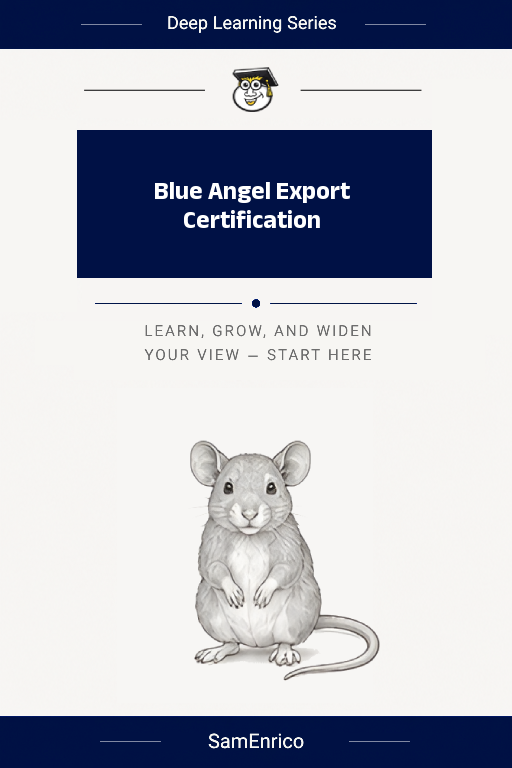
Blue Angel Export Certification eBook
Meet Germany's Blue Angel ecolabel for low-emissio
Meet Germany's Blue Angel ecolabel for low-emission products, accessing government procurement and environmentally conscious European B2B buyers.
Formats
Free sample
Chapter 1: The €500 Billion Blindspot...--–- It was 3:47 PM on a gray Tuesday in Düsseldorf when Stefan Wagner, a procurement officer for the city’s public works department, deleted the last seven emails from his inbox without opening them. His screen displayed a spreadsheet of bids for a €4.2 million school renovation project. Three suppliers had submitted offers. Only one had attached a single PDF that made Stefan stop deleting and start reading.That PDF was a Blue Angel certificate.The other two suppliers had written lengthy paragraphs about being “eco-conscious,” “sustainable,” and “low-emission.” They used words like “green” and “clean” and “responsible.” Stefan had seen those words thousands of times before. He had also seen the audits.
The fines. The scandals where a supplier claimed “low-VOC” but delivered products that made teachers complain about chemical smells for six months.He deleted those emails without a second thought.The supplier with the Blue Angel certificate? Stefan forwarded their bid to the approval committee within ninety minutes. Not because they were the cheapest. They weren’t.
But because the Blue Angel meant Stefan didn’t have to become a chemist, a toxicologist, and a lawyer to do his job. The label had already done that work for him. His only remaining task was to verify that the certificate was active on the RAL public registry. It was. He clicked approve.This is not an exception.
This is how German public procurement works. And if you are an exporter reading this book, you have probably been losing tenders you never even knew existed to competitors who understood this system before you did.This chapter is about why that happens and how you will stop it from ever happening again.The Invisible Wall That Exporters Hit Let us begin with an uncomfortable truth. Most exporters outside Germany believe that selling to the German government or to environmentally conscious German B2B buyers is primarily a competition of price, quality, and delivery speed. They believe that if their product is genuinely good and genuinely cleaner than alternatives, the market will reward them.They are wrong.Germany operates on a procurement logic that is fundamentally different from almost any other major economy. Where American procurement might prioritize lowest upfront cost, and Chinese procurement might prioritize speed to delivery, German public procurement prioritizes one thing above all others: verifiable, third-party, auditable proof of compliance.This is not a cultural quirk.
It is the direct result of decades of legal evolution, scandals, and a deeply embedded risk aversion that runs through every level of German public administration. Understanding this logic is the single most important competitive advantage you can develop as an exporter.The Procurement Officer’s Nightmare To understand why the Blue Angel matters so much, you first need to understand the person on the other side of your bid. The German procurement officer.These individuals operate under a legal framework that is extraordinarily unforgiving. The German Public Procurement Law (Vergaberecht), recently updated to incorporate the 2014 EU Procurement Directives, places a legal obligation on contracting authorities to consider environmental criteria. But here is the critical detail that most exporters miss: the procurement officer is personally responsible for verifying those criteria.If Stefan buys a floor covering that claims to be “low-emission” and that floor covering later fails emissions testing, Stefan can be held personally liable for negligence.
He can face disciplinary action. He can be required to personally repay costs. He can even face criminal charges under certain circumstances involving false declarations.This is not theoretical. In 2019, a procurement officer in North Rhine-Westphalia was suspended for six months after accepting a supplier’s self-declared “low-formaldehyde” certification that turned out to be fabricated. The supplier had simply printed a logo that looked official.
The officer had not verified it. The court ruled that his failure to demand a recognized Type I ecolabel constituted gross negligence.Now you understand why Stefan deleted those seven emails. He was not being lazy. He was being safe. And safety, in the world of German procurement, means one thing: third-party certification from a recognized, independent, multi-criteria ecolabel.The Rise of Green Public Procurement The legal mandate for green purchasing in Germany is not new, but it has accelerated dramatically in the past five years.
In 2020, the German government adopted the National Program for Sustainable Consumption, which explicitly required federal authorities to give preference to products bearing Type I ecolabels, with the Blue Angel named as the primary standard. In 2021, the EU’s Green Public Procurement criteria were updated to make third-party certification a presumptive compliance mechanism for twenty-one product categories. In 2023, the German Procurement Modernization Act (Vergabemodernisierungsgesetz) went even further, requiring contracting authorities to consider lifecycle costs rather than just purchase prices.The numbers tell the story. According to the European Commission’s 2024 GPP monitoring report, Germany now has the highest rate of green procurement adoption among major EU economies. Approximately 55% of all federal tenders now explicitly require or give substantial preference to Type I ecolabels.
For product categories covered by the Blue Angel, that number rises to 70%. And the total value of these tenders? Over €500 billion annually across the European Union, with Germany accounting for roughly €180 billion of that total.But here is where most exporters get lost. The headline figure of €500 billion is often reported without context. The full addressable market for products that could plausibly carry the Blue Angel is approximately €80 billion annually.
That includes office supplies, flooring, paints, textiles, printers, computers, servers, furniture, cleaning products, construction materials, heat pumps, bicycles, and dozens of other categories. For an exporter in any of these categories, the Blue Angel is not a nice-to-have marketing badge. It is the admission ticket to the world’s largest and most stable green procurement market.The 90% Solution Why the Blue Angel specifically? Why not the EU Ecolabel? Why not a private certification?
Why not a self-declared statement signed by the CEO?The answer lies in a single statistic: 90% brand recognition among German consumers. No other ecolabel comes close. The EU Ecolabel (the “EU Flower”) has approximately 35% recognition. The Nordic Swan has near-zero recognition outside Scandinavia. Private labels like Green Seal or Cradle to Cradle have less than 10% recognition among German procurement officers.This matters because procurement officers are not environmental experts.
They are generalists. They need a shortcut. And the Blue Angel is the only label that has been continuously marketed to the German public since 1978. Every German citizen over the age of thirty has grown up seeing that blue-and-white circle on products ranging from printers to paint to recycled paper. They trust it because they have been taught to trust it for forty-five years.But recognition alone is not enough.
The Blue Angel also has legal status that no other label can claim. German procurement law specifically references the Blue Angel as an example of a Type I ecolabel that meets the requirements of ISO 14024. This means that a procurement officer who accepts the Blue Angel is operating on firm legal ground. Accepting a private label or a self-declared claim requires the officer to independently verify that the certification meets Type I standards. Most will not take that risk.The Cost of Staying Uncertified…
This is the end of the free sample. Get the eBook to keep going. Buy now
About this book
Details
- Author
- Albert Kanisha
- Publisher
- SamEnrico
- Language
- English
- Genre
- Non-Fiction, Business Brief
- Released
- 2026-06-01
- Pages (approx.)
- 130
- Available as
- eBook, Audiobook

Read better in the ZLOADR app
Your eBooks on your phone or tablet. Sign in with your SamEnrico account and start reading.
More by Albert Kanisha
 Negative State Relief GuideAlbert Kanisha$11.99
 Breaking the Casino Loyalty ProgramAlbert Kanisha$11.99
 Energy Sector Transaction AnalysisAlbert Kanisha$11.99
 Ayurvedic Heart HealthAlbert Kanisha$11.99
 The Neighbor TraffickerAlbert Kanisha$11.99
 Birthday Spending AddictionAlbert Kanisha$11.99
 Riptide Escape SkillsAlbert Kanisha$11.99
 Cannabis BipolarAlbert Kanisha$11.99
 The Last Stand of the Ball Boys: The Untold Story of the 1972 ABA FinalsAlbert Kanisha$11.99
 The Clockmaker of Leiden: Huygens and the Birth of PrecisionAlbert Kanisha$11.99
 How to Produce Horse and Livestock TrailersAlbert Kanisha$11.99
 Service Providers Guide to Fireplace Installation & RepairAlbert Kanisha$11.99
You may also like
 Hong Kong Handover 1997Dunn Johnnie$11.99
 Zumba For Postnatal Recovery CourseNeal Christian$11.99
 Zumba for BeginnersLadner Nikia$11.99
 YouTube Comment Mining GuideHumes Pandora$12.99
 Worry Box MeditationCarlin Rudy$11.99
 Workplace Stress MeditationNguyen Lynn$11.99
 Workplace Stress and Sleep RepairHawley Ivory$11.99
 Workplace Perfectionism CureDelaney Jeffry$11.99
 Workplace Injustice Anger GuideWallen Isabelle$11.99
 Work Addiction and Burnout LinkGreenwood Ester$11.99
 Women in Yoga and WellnessBeattie Galina$11.99
 Women in Stand Up ComedyChun Evangeline$11.99