
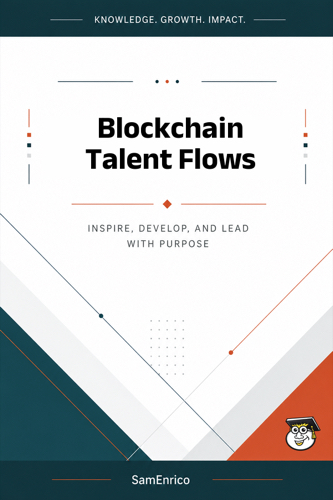
Non-FictionForecast & OutlookBlockchain Workforce
Blockchain Talent Flows eBook
Forecasts movement of crypto and Web3 developers.
by Whitlock Ali
Forecasts movement of crypto and Web3 developers.
Formats
Free sample
Chapter 1: The Great Unbundling...--–- The last time the geography of work changed this dramatically, the wheel had just been invented. Not literally, of course, but the shift we are living through now—the unbundling of labor from location—hasn't happened since the factory replaced the field, and then the office replaced the factory. For three hundred years, the rule was simple: you moved to where the work was. Coal miners went to Pennsylvania, not because they loved the winters, but because the coal was there. Coders moved to San Francisco, not because they loved the rent, but because the servers were there.
The work had a physical address. You went to it.That rule is now dying. And blockchain is holding the knife.This is a book about movement. Not the movement of capital—though that will appear in these pages—and not the movement of information, which has been borderless for decades. This is a book about the movement of people.
Specifically, the people who build the decentralized web: the developers, the cryptographers, the protocol designers, the DAO operators, the hardware engineers, and the mercenaries of code who shift allegiances as quickly as they shift time zones. They are the most consequential workforce you have never tracked, and their migration patterns are about to become the single most reliable leading indicator of value in the crypto economy.But before we map where they are going, we have to understand how we got here. And that story begins with a quiet collapse: the collapse of the assumption that talent belongs to place.The Old Map: Silicon Valley as the Singularity For the better part of thirty years, the geography of technology talent was a heat map with exactly one bright spot. Silicon Valley was not just a hub; it was the hub. If you wanted to build the next great software company, you moved to Palo Alto, Mountain View, or San Francisco.
You did this not because the weather was pleasant—though it was—and not because the venture capital was concentrated—though it was—but because the people were there. The network effects of talent were brutal and self-reinforcing. The best engineers wanted to work with the best engineers, so they all crowded into the same fifty square miles. Startups hired from Google; Google hired from Stanford; Stanford accepted students who had already built companies. The flywheel spun so fast that by 2015, a full 40 percent of all venture capital dollars in the United States went to companies headquartered in three Bay Area counties.This was not a bug.
It was the feature. Venture capital, for all its mythology of disruption, is a profoundly conservative industry when it comes to geography. Partners wanted to invest in companies they could drive to. Board meetings happened in person. The due diligence ritual required coffee, whiteboards, and eye contact.
So the money clustered where the talent clustered, and the talent clustered where the money clustered, and everyone pretended this was the natural order of things.Then something strange happened. The internet, which had spent twenty years unbundling media, retail, and communication, finally turned its attention to the last remaining physical bottleneck: the office itself.The Remote Work Prequel (Before Crypto)The first crack in the old map appeared long before Bitcoin. By 2010, a small but vocal minority of software developers were already working remotely—for Basecamp, for Automattic, for a scattering of startups that had realized that commuting was a tax on creativity. But these were exceptions. The mainstream view, articulated by Yahoo!
CEO Marissa Mayer in 2013 when she banned remote work, was that "people are more collaborative and innovative when they're together." The data never really supported this, but the cultural inertia was immense. Offices were where culture happened. Offices were where promotions happened. Offices were where the accidental hallway conversation that saved the company happened.The pandemic of 2020 shattered this assumption overnight. Not because it proved that remote work was possible—we already knew that—but because it proved that the world would not end if everyone stayed home.
Billions of dollars of office real estate became stranded assets overnight. Managers who had insisted that productivity would collapse watched in confusion as Git Hub commit counts stayed flat or rose. The great remote experiment was not a failure. It was, by almost every measure, a qualified success.But here is what is crucial to understand: the pandemic-era remote work boom was still tethered to the old corporate structure. People worked from home, but they worked for the same companies, on the same products, paid in the same fiat currency, subject to the same employment laws.
The location changed. The relationship did not.Blockchain breaks that tether entirely.Token Compensation: The Great Decoupling The single most important structural difference between a Web3 developer and a traditional remote worker is not where they sleep. It is how they are paid.A software engineer at Google receives a salary in dollars (or local equivalent), plus restricted stock units that vest over four years. The RSUs are nice, but they are denominated in Google stock, which moves with Google's performance. The engineer's economic fate is tied to a single corporation, which is tied to a single headquarters, which is tied to a single jurisdiction.
Even if the engineer works from Bali, their wealth is still Californian.A developer contributing to Uniswap, by contrast, may receive no salary at all. They might be paid in UNI tokens, which trade on global exchanges 24 hours a day, seven days a week. Those tokens are not tied to any geography. They are not tied to any corporate entity. They are tied to a protocol—a piece of software that runs on thousands of computers across dozens of countries.
The developer's economic fate is tied to code, not to a company. And that changes everything about where they choose to live.Token compensation creates what we might call location arbitrage. A developer who is paid in ETH or SOL or UNI can cash out those tokens in any jurisdiction with an internet connection. They can choose to live in a country with zero capital gains tax (like the UAE), a country with a low flat tax (like Georgia), or a country that simply doesn't ask questions (like El Salvador before its Bitcoin experiment drew scrutiny). The developer is no longer a Californian employee who happens to work from home.
They are a global economic actor who happens to write code.This shift is not minor. It is foundational. It means that for the first time in modern history, a significant class of high-value knowledge workers can choose their place of residence based entirely on lifestyle preferences, cost of living, and tax treatment—without regard to where their employer is incorporated. The employer, if it exists at all, is a DAO with no physical address, no HR department, and no ability to enforce a return-to-office mandate.The Illusion of the Crypto Office To be clear: there are still crypto companies with offices. Coinbase has offices.
Binance has had offices (though their locations are famously hard to pin down). Consen Sys has offices. But these are the exceptions that prove…
This is the end of the free sample. Get the eBook to keep going. Buy now
About this book
Details
- Author
- Whitlock Ali
- Publisher
- SamEnrico
- Language
- English
- Genre
- Non-Fiction, Forecast & Outlook, Blockchain Workforce
- Released
- 2026-06-07
- Pages (approx.)
- 130
- Available as
- eBook, Audiobook

Read better in the ZLOADR app
Your eBooks on your phone or tablet. Sign in with your SamEnrico account and start reading.
More by Whitlock Ali
 Phobia Treatment Success RateWhitlock Ali$11.99
 Oil Spill Responder Stress GuideWhitlock Ali$11.99
 Parent Transportation GuideWhitlock Ali$11.99
 Anxious Student Study GuideWhitlock Ali$11.99
 Research Proposal Word Limit StrategiesWhitlock Ali$11.99
 Agricultural Market CyclesWhitlock Ali$11.99
 Loving Kindness For AngerWhitlock Ali$11.99
 Jacksepticeye JoyWhitlock Ali$11.99
 Thelonious Monk: Round Midnight, Straight GeniusWhitlock Ali$11.99
 The Iron Serpent’s Fall: When a 19th-Century Bridge Betrayed Its BuildersWhitlock Ali$11.99
 Blood and Dust: The Siege of Ladysmith - A Boer War Epic (1899-1900)Whitlock Ali$11.99
 Financial Modelling for Decision MakingWhitlock Ali$11.99
You may also like
 Hong Kong Handover 1997Dunn Johnnie$11.99
 Zumba For Postnatal Recovery CourseNeal Christian$11.99
 Zumba for BeginnersLadner Nikia$11.99
 YouTube Comment Mining GuideHumes Pandora$12.99
 Worry Box MeditationCarlin Rudy$11.99
 Workplace Stress MeditationNguyen Lynn$11.99
 Workplace Stress and Sleep RepairHawley Ivory$11.99
 Workplace Perfectionism CureDelaney Jeffry$11.99
 Workplace Injustice Anger GuideWallen Isabelle$11.99
 Work Addiction and Burnout LinkGreenwood Ester$11.99
 Women in Yoga and WellnessBeattie Galina$11.99
 Women in Stand Up ComedyChun Evangeline$11.99