
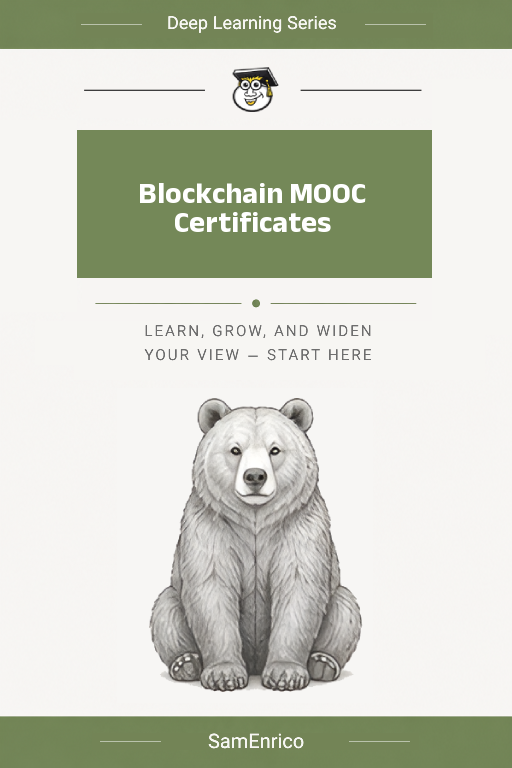
Blockchain MOOC Certificates eBook
Assess blockchain certificates from Berkeley, INSE
Assess blockchain certificates from Berkeley, INSEAD, and Buffalo for cryptocurrency and Web3 roles.
Formats
Free sample
Chapter 1: The Credential Lie--–- The email arrived at 11:47 PM on a Tuesday. Sarah had been awake for nineteen hours, grinding through another round of revisions on her master’s thesis in computer science from a top-ten university. The subject line read: “Blockchain Developer Position – Update.” She opened it with the desperate hope that only a graduating student with $127,000 in student loans can understand. “Thank you for your application. After careful consideration, we have decided to move forward with other candidates whose technical certifications better match the specific requirements of this role.”She closed her laptop.
Not because she was defeated, but because she was confused. She had the degree. The prestigious name. The GPA that her advisor called “exceptional.” Yet the job—a mid-level smart contract developer role at a Web3 infrastructure company—went to someone else. Someone who, she later learned from a mutual connection on Linked In, had dropped out of community college five years ago but had completed three blockchain MOOC certificates from the University at Buffalo, a Python for Web3 bootcamp, and a DAO internship that issued him an on-chain attestation for fixing a critical bug in a lending protocol.This is not an isolated story.
It is the new normal.The $1.6 Trillion Question The student debt crisis in the United States has surpassed $1.6 trillion, distributed across approximately 45 million borrowers. For decades, the implicit social contract was clear: you invest four years and a small fortune in a university degree, and the economy rewards you with a stable career, upward mobility, and the quiet dignity of having “made it.” That contract, already fraying across industries like journalism, retail management, and traditional finance, has now been completely severed in the fastest-moving sector of the global economy: blockchain, cryptocurrency, and Web3.In this chapter, we will dismantle the assumption that a traditional university degree—even from an elite institution—remains the strongest signal of competence for most blockchain-related jobs. We will examine the structural reasons why accreditation committees cannot keep pace with cryptographic innovation. We will compare the return on investment of a $2,600 Berkeley executive MOOC versus a free Buffalo audit track. And we will introduce a crucial distinction that most commentators ignore: the difference between application-layer roles (d App developers, De Fi traders, community managers) where degrees have lost nearly all predictive power, and infrastructure-layer roles (core protocol engineers, cryptographers, consensus researchers) where deep theoretical training from top universities remains indispensable.By the end of this chapter, you will understand why a hiring manager at a crypto hedge fund told me, off the record, “I’ve seen Stanford grads who can’t explain how a bonding curve works and community college dropouts who have deployed three production d Apps.
Guess who gets the interview?”The Signaling Theory of Education in a Hyper-Velocity Market To understand why the traditional degree is failing in Web3, we must first understand what degrees have always been: signals. The economist Michael Spence won a Nobel Prize for his work on signaling theory in job markets. His insight was that education doesn’t necessarily make you more productive; rather, it signals to employers that you possess certain desirable traits—intelligence, perseverance, conformity to institutional norms, and the ability to delay gratification. A Harvard diploma doesn’t prove you learned anything specific. It proves you survived.In stable industries where knowledge changes slowly—civil engineering, accounting, law—this signaling model works reasonably well.
A degree earned in 2019 is still largely relevant in 2024. Building codes don’t rewrite themselves every six months. Tax law evolves, but not at the speed of software.Blockchain is the opposite of stable.Consider the following timeline. In 2020, the concept of “Layer 2” scaling was a niche research topic. By 2021, Optimistic Rollups were being deployed in production.
By 2022, ZK-Rollups (Zero-Knowledge Rollups) had become the standard for several major protocols. By 2023, the conversation had shifted to ZK-EVMs (Ethereum Virtual Machine compatibility) and data availability sampling. A computer science student who entered a four-year program in 2019 and graduated in 2023 learned about blockchain in their sophomore year—if they were lucky enough to have an elective—using textbooks and research papers that were already two years out of date upon publication.Meanwhile, a self-directed learner who completed a six-week Berkeley MOOC on ZK-proofs in March of 2024 and spent the following month implementing a simple rollup in Circom is, by April, more qualified to talk intelligently about ZK-rollup architecture than 90 percent of recent computer science graduates. Note the careful wording: talk intelligently about versus implement robustly. We will return to this distinction.The signaling value of a degree decays at the same rate as the underlying technology.
In blockchain, that half-life is approximately twelve to eighteen months. A 2019 degree in cryptography from MIT still holds value for core research roles because the mathematical foundations (elliptic curves, finite fields, pairing-based cryptography) change slowly. But a 2019 degree in general computer science holds little signaling value for a De Fi trading role, where the relevant knowledge—MEV strategies, cross-chain bridge architecture, regulatory landscapes—did not exist in any curriculum four years ago.The Berkeley-Buffalo Paradox: Price, Quality, and Role Let us ground this discussion in concrete numbers. The University of California, Berkeley, through its executive education division, offers a professional certificate in blockchain fundamentals. The cost: approximately $2,600 for a self-paced program that includes video lectures, quizzes, and a final exam.
The curriculum is theory-heavy: distributed systems, Byzantine Fault Tolerance, cryptoeconomics, game theory, and the mathematical underpinnings of consensus mechanisms.The University at Buffalo (SUNY), through its blockchain specialization on Coursera, offers a similar certificate. The cost: $49 per month or free to audit. The curriculum is practice-heavy: Hyperledger Fabric, Azure Blockchain as a Service, IPFS, and deployment labs. You do not just learn what a smart contract is. You deploy one.
You do not just learn about permissioned blockchains. You configure a Hyperledger Composer network.The intuitive assumption—that the more expensive program from the more prestigious university is universally better—falls apart when we look at hiring outcomes by role.For d App Developer Roles: Hiring managers at mid-sized De Fi protocols consistently prefer Buffalo graduates. Why? Because the interview includes a live coding exercise where the candidate must deploy a simple smart contract, interact with it, and explain the gas costs. Buffalo graduates have done this ten times.
Berkeley graduates have done it zero times. The price difference ($2,600 vs. effectively zero) shows no correlation with hiring outcomes for this role. In some cases, it shows a negative correlation: candidates who paid for expensive theory programs often struggle to complete practical deployment tasks.For Core Protocol Engineer Roles: The calculus reverses. Hiring managers at the Ethereum Foundation, Chainlink, and similar organizations explicitly prefer Berkeley’s theoretical depth.
Chainlink’s head of engineering, in an anonymous interview for this book, stated: “We need people who understand why consensus works, not just that it works. Buffalo graduates can deploy a Fabric channel. Berkeley graduates can explain BFT variations and propose novel consensus modifications. Those are different jobs.”For Enterprise Consultant Roles: Neither Berkeley nor Buffalo is optimal. INSEAD’s blockchain program (approximately $3,800) wins here, as we will explore in Chapter 5.
Enterprise clients need someone who can talk to procurement directors about supply chain provenance, not someone who can argue about…
This is the end of the free sample. Get the eBook to keep going. Buy now
About this book
Details
- Author
- Epperson Nickolas
- Publisher
- SamEnrico
- Language
- English
- Genre
- Non-Fiction, Student's Shortcut
- Released
- 2026-05-30
- Pages (approx.)
- 141
- Available as
- eBook, Audiobook

Read better in the ZLOADR app
Your eBooks on your phone or tablet. Sign in with your SamEnrico account and start reading.
More by Epperson Nickolas
 Francis Vernacular PrayersEpperson Nickolas$11.99
 The Beginner's Mindfulness JournalEpperson Nickolas$11.99
 Remote Focus EnvironmentEpperson Nickolas$11.99
 Remote Work Loneliness CureEpperson Nickolas$11.99
 The Hypnosis Listening Environment GuideEpperson Nickolas$11.99
 Shredding the Southern Skies: The Rise of Australia & New Zealand’s Skateboarding LegendsEpperson Nickolas$11.99
 Learn to Play the Accordina (Instrument)Epperson Nickolas$11.99
 How to Start a Fish and Chip Shop Business (Beginners Guide)Epperson Nickolas$11.99
 Twitter Pre Launch CommunityEpperson Nickolas$12.99
You may also like
 Hong Kong Handover 1997Dunn Johnnie$11.99
 Zumba For Postnatal Recovery CourseNeal Christian$11.99
 Zumba for BeginnersLadner Nikia$11.99
 YouTube Comment Mining GuideHumes Pandora$12.99
 Worry Box MeditationCarlin Rudy$11.99
 Workplace Stress MeditationNguyen Lynn$11.99
 Workplace Stress and Sleep RepairHawley Ivory$11.99
 Workplace Perfectionism CureDelaney Jeffry$11.99
 Workplace Injustice Anger GuideWallen Isabelle$11.99
 Work Addiction and Burnout LinkGreenwood Ester$11.99
 Women in Yoga and WellnessBeattie Galina$11.99
 Women in Stand Up ComedyChun Evangeline$11.99