
Non-FictionInformativeEducational
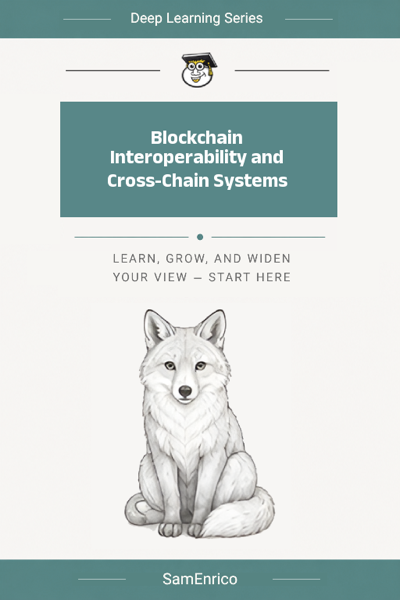
Blockchain Interoperability and Cross-Chain Systems eBook
A Coursebook on Blockchain Interoperability and Cr
by Leung Thea
A Coursebook on Blockchain Interoperability and Cross-Chain Systems
Formats
Free sample
Chapter 1: The Digital Archipelago...--The year is 2026. You hold in your hand a device that connects you to the global internet—a seamless web of information, communication, and commerce. You can send an email from Gmail to Outlook, video call from a i Phone to an Android, and transfer money from a bank in New York to one in London using SWIFT. The internet was built on open protocols (TCP/IP, HTTP, SMTP) that explicitly prioritize interoperability. A website in Tokyo loads on a browser in Buenos Aires without either party signing a bilateral agreement.Now imagine a different world.
Imagine that Gmail could only send emails to other Gmail addresses. Imagine that Verizon phones could only call Verizon phones. Imagine that a dollar in a Chase bank account could only be spent at Chase ATMs. That world would be fragmented, inefficient, and absurd. Yet that is precisely the world of blockchain today.Welcome to the Digital Archipelago.A Landscape of Isolated Islands Blockchain technology has delivered a remarkable promise: decentralized, trust-minimized, censorship-resistant digital value.
Bitcoin proved that money could exist without banks. Ethereum proved that programmable contracts could run without servers. Solana, Avalanche, Polygon, and dozens of others have pushed the boundaries of speed, cost, and functionality. Each of these chains is a technical marvel. Each has passionate communities.
Each has billions of dollars of value secured within its borders.But they do not talk to each other.Not really. Not natively. Not without significant friction, trust assumptions, or centralized intermediaries.The current blockchain ecosystem resembles an archipelago of isolated islands. Each island has its own language (consensus mechanism), its own currency (native gas token), its own customs (smart contract standards), and its own governance. Ethereum Island speaks Solidity, uses ETH for gas, and follows ERC standards.
Solana Island speaks Rust, uses SOL for gas, and follows a completely different account model. Bitcoin Island speaks Script, uses BTC, and doesn't support smart contracts at all.If you live on Ethereum Island and want to use an application on Solana Island, you cannot simply sail across. You must go through a third-party bridge—a makeshift ferry operated by a federation of validators, often with opaque security guarantees. Or you must deposit your assets on a centralized exchange (a foreign airport hub), trade for the local currency, and withdraw on the destination island. In both cases, you have abandoned the very principle that makes blockchains valuable: trust minimization.This fragmentation is not a temporary bug.
It is a structural feature of how blockchains were designed. Satoshi Nakamoto solved the double-spend problem for a single chain. Vitalik Buterin extended programmability to a single chain. But no founder solved the problem of many chains. They assumed, perhaps naively, that one chain would win.
Instead, we have hundreds.The Scalability Trilemma and Its Consequences To understand why we have so many chains, we must first understand the Scalability Trilemma, a concept articulated by Ethereum co-founder Vitalik Buterin. The trilemma states that blockchain systems can achieve at most two of three desirable properties simultaneously:Decentralization: The system should not rely on a small set of trusted intermediaries. A decentralized blockchain allows anyone to validate transactions, propose blocks, and participate in consensus. Bitcoin's thousands of independent nodes exemplify decentralization.Security: The system should be resistant to attacks. A secure blockchain requires that an attacker cannot reliably reverse transactions or censor activity without expending prohibitive resources (e.g., 51% of hash power or staked tokens).Scalability: The system should process a high volume of transactions per second (TPS) at low cost.
Visa processes ~1,700 TPS. Bitcoin processes 3-7 TPS. Ethereum processes 12-15 TPS on its base layer.The trilemma is not a mathematical proof but an observed engineering reality. Attempts to optimize one dimension inevitably degrade at least one other.Consider Bitcoin. It maximizes decentralization and security at the cost of scalability.
Anyone can run a full node. The proof-of-work consensus has proven remarkably secure over 15+ years. But Bitcoin processes only a handful of transactions per second, and fees spike during congestion.Consider a highly optimized proof-of-stake chain with a small validator set of 21 nodes. It can process thousands of transactions per second (scalability) and achieve fast finality (security if the 21 are honest). But it sacrifices decentralization—21 entities control the chain.
This is closer to a traditional database with a rotating set of permissioned operators.No chain has solved the trilemma. Every chain represents a different trade-off. Ethereum prioritizes decentralization and security but scales poorly on-chain, leading to the development of Layer-2 rollups (which introduce their own interoperability challenges). Solana prioritizes scalability and security by using a novel proof-of-history mechanism and a larger but still limited validator set (approximately 2,000). Avalanche uses a subnet architecture that delegates scalability to application-specific chains.The result of these trade-offs is fragmentation by design.Vendor Lock-In: The Hidden Tax of the Multi-Chain World Beyond the technical trilemma lies an economic reality: vendor lock-in.
Once a user or developer commits to a blockchain, moving to another chain carries significant switching costs.For a user, those costs include:Wallet fragmentation: You need a different wallet (or at least a different network configuration) for each chain. Meta Mask for Ethereum, Phantom for Solana, Keplr for Cosmos. Each wallet holds different private keys, manages different addresses, and interacts with different d Apps. A user with assets on three chains maintains three separate identities.Gas token acquisition: To do anything on Ethereum, you need ETH. On Solana, you need SOL.
On Avalanche C-Chain, you need AVAX. Each gas token must be purchased, often on a centralized exchange, and transferred into the appropriate wallet. If you hold value on Ethereum and want to use a Solana application, you cannot spend your ETH directly. You must first acquire SOL, incurring exchange fees, network fees, and tax events.Bridge risk: Moving assets between chains typically requires a bridge. As we will explore extensively in later chapters, bridges are the single largest source of blockchain hacks.
The Ronin bridge lost 625million.The Wormholebridgelost625 million. The Wormhole bridge lost 625million.The Wormholebridgelost325 million. The Nomad bridge lost $190 million. Users who attempt to move assets across chains expose themselves to smart contract bugs, validator corruption, and oracle manipulation. The safest way to move value between chains today is still a centralized exchange—ironic for an ecosystem built on decentralization.For a developer, lock-in is even more severe:Smart contract language: Ethereum uses Solidity.
Solana uses Rust. Bitcoin uses Script (extremely limited). NEAR uses Rust or Assembly Script. Tezos uses Michelson. Learning a new language for each chain is a significant investment.Virtual machine architecture: Ethereum's Ethereum Virtual Machine (EVM) is the dominant standard, but it is not universal.
Solana's Sealevel VM processes transactions in parallel, requiring a different mental model. The Fuel VM uses an UTXO-based architecture. Rebuilding a d App for a different VM often requires a complete rewrite, not just a recompile.Tooling and infrastructure: Each chain has its own set of development tools (Hardhat vs. Anchor), indexers (The Graph vs. Solana-specific indexers), RPC providers (Infura vs.
Quick Node vs. Helius), and testing frameworks. A developer proficient in the Ethereum stack cannot immediately be productive on Solana.Liquidity fragmentation: A decentralized exchange that launches…
This is the end of the free sample. Get the eBook to keep going. Buy now
About this book
Details
- Author
- Leung Thea
- Publisher
- SamEnrico
- Language
- English
- Genre
- Non-Fiction, Informative, Educational
- Released
- 2026-05-11
- Pages (approx.)
- 160
- Available as
- eBook, Audiobook

Read better in the ZLOADR app
Your eBooks on your phone or tablet. Sign in with your SamEnrico account and start reading.
More by Leung Thea
 Nicotine Vaccine Hopeful GuideLeung Thea$11.99
 TM for Medical StudentsLeung Thea$11.99
 Dream Journaling for Chronic PainLeung Thea$11.99
 Talking About Death and WillsLeung Thea$11.99
 Pituitary Tumor HGH GuideLeung Thea$11.99
 Student Suicidal Ideation SafetyLeung Thea$11.99
 Adult Onset HGH DeficiencyLeung Thea$11.99
 Language Gender PegsLeung Thea$11.99
 Austrian Green Tax HandbookLeung Thea$11.99
 The Last Great Train Robbers: How a Billion-Dollar Heist Went Down in Broad DaylightLeung Thea$11.99
 Ravens' Whisper: Loki’s Forgotten GambitLeung Thea$11.99
 Nephthys' Veil: The Forgotten Goddess of MourningLeung Thea$11.99
You may also like
 Hong Kong Handover 1997Dunn Johnnie$11.99
 Zumba For Postnatal Recovery CourseNeal Christian$11.99
 Zumba for BeginnersLadner Nikia$11.99
 YouTube Comment Mining GuideHumes Pandora$12.99
 Worry Box MeditationCarlin Rudy$11.99
 Workplace Stress MeditationNguyen Lynn$11.99
 Workplace Stress and Sleep RepairHawley Ivory$11.99
 Workplace Perfectionism CureDelaney Jeffry$11.99
 Workplace Injustice Anger GuideWallen Isabelle$11.99
 Work Addiction and Burnout LinkGreenwood Ester$11.99
 Women in Yoga and WellnessBeattie Galina$11.99
 Women in Stand Up ComedyChun Evangeline$11.99