
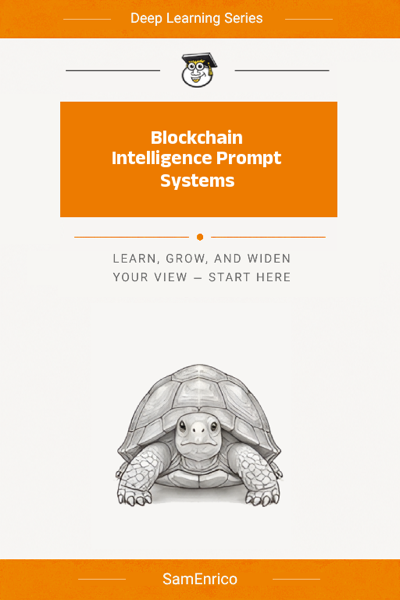
Non-FictionInformativeEducational
Blockchain Intelligence Prompt Systems eBook
A Coursebook on Blockchain Intelligence Prompt Sys
by Lamb Ross
A Coursebook on Blockchain Intelligence Prompt Systems
Formats
Free sample
Chapter 1: The Silent Database--Every day, billions of dollars move across a global network of computers that no single person controls, yet the vast majority of financial professionals cannot ask this network a simple question like "How much money did this address send last Tuesday?" without writing thousands of lines of code. This is the paradox of blockchain technology: it promises radical transparency while delivering radical inaccessibility. The data is all there, perfectly preserved, cryptographically secured, and replicated across thousands of nodes. But the blockchain cannot speak. It cannot answer your questions, summarize its contents, or warn you about risks.
It sits there, silent and patient, waiting for someone to build the bridge between its world of hexadecimal and hashes and our world of natural language and intention.Consider what happens when a traditional bank customer wants to check their transaction history. They log into a mobile app, click a few buttons, and a neatly formatted list appears showing dates, amounts, and counterparties. The database behind that interface is centralized, controlled by the bank, and designed specifically for human querying. Every piece of data has been indexed, labeled, and prepared for retrieval. The bank has invested millions of dollars in making their data accessible because accessible data generates value.
Now contrast that with a blockchain user who wants to answer the exact same question about their own crypto wallet. They must either use a block explorer website which shows raw data but offers no summarization, write a script using a library like Web3.py, or manually trace through dozens or hundreds of transactions, copying and pasting addresses into search boxes. The blockchain has the data. The blockchain is, in fact, a more perfect record than any bank ledger because it cannot be altered, deleted, or hidden. But the blockchain cannot talk.This book is about teaching blockchains to talk.
More precisely, it is about building systems that act as translators between human language and cryptographic truth. We call these systems Blockchain Intelligence Prompt Systems, or BIPS, and they represent one of the most important yet underdeveloped frontiers in modern technology. A BIPS is not a single piece of software but an architecture that combines large language models, blockchain data pipelines, validation layers, and optional execution components to allow humans to interact with decentralized networks using natural language. Instead of writing Solidity code or crafting complex RPC calls, a user can simply ask: "Show me all transactions from this address that look like wash trading," or "Execute a swap of one ETH for the best available USDC price on Arbitrum, but only if slippage is under half a percent." The system handles the translation, the retrieval, the validation, and the execution. The blockchain finally gets a voice.The Core Problem: Why Your AI Cannot Read the Blockchain Before we can build solutions, we must understand why the problem exists.
At first glance, the combination of artificial intelligence and blockchain seems obvious. AI excels at pattern recognition, natural language understanding, and generating human-like responses. Blockchain excels at providing tamper-proof, verifiable, and transparent data. Together, they should form a perfect partnership. Yet most attempts to merge these technologies fail spectacularly, and the reasons reveal deep insights about both domains.
Understanding these failures is the first step toward engineering success.The first reason is that large language models are fundamentally disconnected from live data. Every LLM, from GPT-4 to Claude to Llama, is trained on a static snapshot of the internet. The model learns patterns, facts, and relationships from that snapshot, but it cannot see anything that happened after its training cutoff date. A blockchain, by contrast, produces new blocks every few seconds, each containing hundreds or thousands of transactions. A model trained on data from six months ago has no knowledge of yesterday's massive De Fi hack, last week's NFT mint, or even the current price of Ethereum.
When a user asks "What is the balance of this wallet right now?" the LLM cannot answer unless it is given live data as part of the prompt. The model does not know that it does not know. It will confidently generate an answer based on its outdated training data, and that answer will almost certainly be wrong.The second reason is hallucination, a term that in the context of AI refers to models generating confident-sounding statements that are completely false. In most applications, hallucinations are merely annoying. An LLM might invent a biographical detail about a historical figure or misstate the publication date of a scientific paper.
In blockchain applications, hallucinations are catastrophic. If an LLM hallucinates a transaction hash and a user acts on that hash, they could send funds to the wrong address, verify a non-existent payment, or build a trading strategy on phantom data. The cryptographic verification layer that makes blockchain trustworthy is completely absent from current LLMs. The model cannot prove that a hash exists because it has no access to the blockchain. It cannot verify that an address holds funds because it cannot query the state.
It is blind, and blindness in crypto leads to loss.The third reason is format incompatibility. Blockchains speak hexadecimal, RLP encoding, Merkle proofs, and binary-packed data structures. LLMs speak natural language, JSON, markdown, and token sequences. Translating between these worlds requires careful engineering that most developers never consider. A raw Ethereum transaction, for example, is a string of hex characters that looks like 0xf86c0a8504a817c80082520894d8d A6BF26964a F9D7e Ed9e03E53415D37a A96045880de0b6b3a7640000801ba0d9c3b6c...
This is not something a human can read, nor is it something an LLM can generate reliably. The system must decode this hex into structured data, feed it to the model in a understandable format, and then encode the model's response back into hex for execution. Every step of this translation introduces opportunities for error, and errors in transaction construction can make funds unrecoverable.The fourth reason is contextual blindness. Blockchains are not just databases of transactions; they are networks of relationships, histories of interactions, and ecosystems of smart contracts. An intelligent system needs to understand that a particular address belongs to a known exchange, that a pattern of transactions resembles a common attack vector like a sandwich attack or a rug pull, or that a smart contract has a history of being upgraded with malicious code after audits.
LLMs, by default, see each request in isolation. They have no memory of previous interactions unless that memory is explicitly provided in the prompt context. Providing the full context of a complex blockchain interaction can easily exceed the token limits of even the most advanced models. You cannot simply dump an entire wallet's transaction history into a prompt and expect the model to make sense of it. You need intelligent retrieval, summarization, and prioritization.The fifth reason, which follows from the previous four, is the absence of verification as a design principle.
Most LLM applications assume that the model's output is the final answer. In blockchain intelligence, the model's output must be treated as a hypothesis that requires cryptographic verification. Did the model correctly extract the timestamp from that transaction? Check the block header.…
This is the end of the free sample. Get the eBook to keep going. Buy now
About this book
Details
- Author
- Lamb Ross
- Publisher
- SamEnrico
- Language
- English
- Genre
- Non-Fiction, Informative, Educational
- Released
- 2026-05-23
- Pages (approx.)
- 47
- Available as
- eBook, Audiobook

Read better in the ZLOADR app
Your eBooks on your phone or tablet. Sign in with your SamEnrico account and start reading.
More by Lamb Ross
 My 600 Lb JourneyLamb Ross$11.99
 MMO Addiction RecoveryLamb Ross$11.99
 Cynophobia Dog Fear ReliefLamb Ross$11.99
 The Bank Vault HostageLamb Ross$11.99
 Sex Addiction and Intimacy AnorexiaLamb Ross$11.99
 Finding Purpose After Retirement GuideLamb Ross$11.99
 Bedtime Meditation For CalmLamb Ross$11.99
 Physical Health Work ImpactLamb Ross$11.99
 Anubis: The Weigher of SoulsLamb Ross$11.99
 Ticketmaster and the Third-Party TrapLamb Ross$11.99
 The Mineral Guide to AubertiteLamb Ross$11.99
 How to Start a Hobby in Gardening and PlantsLamb Ross$11.99
You may also like
 Hong Kong Handover 1997Dunn Johnnie$11.99
 Zumba For Postnatal Recovery CourseNeal Christian$11.99
 Zumba for BeginnersLadner Nikia$11.99
 YouTube Comment Mining GuideHumes Pandora$12.99
 Worry Box MeditationCarlin Rudy$11.99
 Workplace Stress MeditationNguyen Lynn$11.99
 Workplace Stress and Sleep RepairHawley Ivory$11.99
 Workplace Perfectionism CureDelaney Jeffry$11.99
 Workplace Injustice Anger GuideWallen Isabelle$11.99
 Work Addiction and Burnout LinkGreenwood Ester$11.99
 Women in Yoga and WellnessBeattie Galina$11.99
 Women in Stand Up ComedyChun Evangeline$11.99