

Non-FictionForecast & OutlookBlockchain Logistics
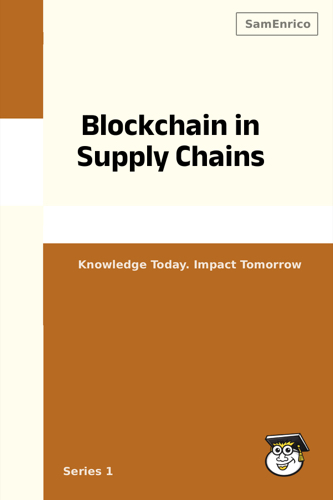
Blockchain in Supply Chains eBook
Track provenance and automate contracts with distr
by Gilson Dara
Track provenance and automate contracts with distributed ledger technology using this forecast guide.
Formats
Free sample
Chapter 1: The Invisible Handshake--–- Every global supply chain begins and ends with the same fragile act: a handshake between strangers. The cocoa farmer in Ghana has never met the chocolate executive in Zurich. The lithium miner in Australia has never spoken to the battery engineer in Shanghai. The garment worker in Bangladesh will never see the customer in Paris who buys the shirt they sewed. And yet, these strangers must coordinate with precision.
They must trust—without evidence—that promises will be kept, that payments will arrive, that quality will be maintained, and that no one is lying. This is the invisible handshake. It is the foundational contract of global trade. And for most of human history, it has been dangerously easy to break.Modern supply chains are engineering marvels. A single smartphone contains materials from six continents, assembled in three countries, shipped through four ports, and delivered to your hand within weeks of the final component being manufactured.
The physical movement of goods has been optimized to near perfection. Ships arrive on schedules measured in hours. Warehouses are automated with robotic precision. Trucks are routed by algorithms that account for traffic, weather, and fuel prices in real time. But beneath this physical marvel lies a crumbling foundation of paper, spreadsheets, emails, and handshake agreements that have not fundamentally changed since the Silk Road.This book is about rebuilding that foundation.
Not by replacing the physical infrastructure—the ships, the trucks, the warehouses, the robots—but by replacing the invisible handshake with something far more reliable: a shared, tamper-evident digital ledger that allows strangers to trust each other without intermediaries, without lawyers, and without months of reconciliation. That technology is called blockchain. And despite the hype, the crashes, the cryptocurrency speculation, and the eye-rolling from supply chain veterans who have seen one too many vendor presentations, blockchain is uniquely suited to solve the oldest problem in trade: how to know, with certainty, what really happened.This chapter lays the groundwork for everything that follows. It begins by exposing the hidden costs of the invisible handshake—the waste, fraud, and delay that supply chain professionals have learned to accept as normal. It then introduces the core problem that blockchain solves: not speed, not cost, not efficiency (though those improve), but trust.
It concludes with a roadmap for the rest of the book and a promise that every subsequent chapter will honor: no jargon without explanation, no hype without evidence, and no theory without practical application.The Hidden Cost of Distrust Let us begin with a simple experiment. Take out your phone. Open any delivery tracking app. Look at a package that is supposedly in transit. Now ask yourself: do you actually know where that package is?
The tracking data says it is in Louisville, scanned at 3:47 AM. But that scan is just a data point entered by someone who might have made a mistake, or by a system that might have been gamed, or by a device that might have malfunctioned. The package could be in Louisville. It could also be on a truck to Nashville, sitting in a lost-and-found bin in Dallas, or stolen and replaced with a counterfeit. You have no way to verify.
You are trusting. And most of the time, that trust is justified. But when it fails—when the package never arrives, when the product is fake, when the supplier claims they shipped but you never received—the cost of that failed trust is enormous.Economists call this the “trust tax.” It is the premium we pay to protect ourselves from the possibility that others are lying. In supply chains, the trust tax appears everywhere. Companies maintain safety stock—extra inventory that sits in warehouses costing money—because they do not trust their suppliers to deliver on time.
They hire auditors to inspect factories because they do not trust the factory’s own quality reports. They pay banks to issue letters of credit because they do not trust that a buyer in another country will pay after receiving the goods. They spend weeks reconciling invoices because they do not trust that their trading partner’s records are accurate. Add it all up, and the trust tax consumes an estimated 15 to 20 percent of global logistics costs. That is roughly $1.5 trillion annually.Blockchain does not eliminate the need for trust.
It eliminates the need to trust blindly. Instead of believing that a supplier delivered on time, you can verify it on a shared ledger that no single party controls. Instead of accepting a factory’s quality report, you can see the immutable record of inspections conducted by independent sensors. Instead of waiting for a bank to verify a letter of credit, you can execute a smart contract that automatically releases payment when GPS data shows the ship has arrived. The trust tax does not disappear; it is reallocated from human reconciliation to cryptographic verification.
And cryptographic verification is effectively free.The Three Failures of Traditional Systems Why cannot we solve these problems with existing technology? After all, we already have ERP systems, cloud databases, EDI (electronic data interchange), and sophisticated tracking platforms. Surely, one of these could serve as the shared ledger we need.They cannot. And understanding why is essential to understanding what blockchain actually adds.The first failure is the single point of trust. Any centralized database—whether run by a company, a government, or a consortium—requires a central authority that all participants trust.
In a competitive supply chain, that authority does not exist. A database owned by Walmart cannot be trusted by Procter & Gamble because Walmart might alter records to favor itself. A database owned by a neutral third party is expensive and still requires participants to hand over sensitive commercial data. A blockchain, by contrast, is decentralized. No single party controls it.
Every transaction is verified by consensus among the participants, and once recorded, no one—not even the original submitter—can alter it. Trust is not placed in a person or company. It is embedded in the protocol.The second failure is the auditability gap. When disputes arise—and they always arise—the traditional response is to launch an audit. Auditors request records from each participant, compare them, and attempt to reconstruct what happened.
This process is slow, expensive, and fundamentally reactive. By the time the audit concludes, the damage has been done. Blockchain flips this model. Instead of auditing after the fact, blockchain provides continuous, real-time verification. Every transaction is recorded immutably as it happens.
When a dispute arises, the ledger is the authoritative source of truth. No phone calls. No email attachments. No “our system shows something different.” The ledger is the system.The third failure is the reconciliation burden. In a typical supply chain, every participant keeps their own records of transactions.
The buyer records a purchase order. The seller records a sales order. The shipper records a bill of lading. The receiver records a receipt. These records never match perfectly because of timing differences, data entry errors, and honest disagreements about what happened.
Reconciling them—making them match—consumes countless hours of accountant and analyst time. Blockchain eliminates reconciliation because there is only one ledger. The buyer and seller…
This is the end of the free sample. Get the eBook to keep going. Buy now
About this book
Details
- Author
- Gilson Dara
- Publisher
- SamEnrico
- Language
- English
- Genre
- Non-Fiction, Forecast & Outlook, Blockchain Logistics
- Released
- 2026-06-07
- Pages (approx.)
- 150
- Available as
- eBook, Audiobook

Read better in the ZLOADR app
Your eBooks on your phone or tablet. Sign in with your SamEnrico account and start reading.
More by Gilson Dara
 Road Rage Breathing TechniquesGilson Dara$11.99
 Growth Mindset Language ShiftGilson Dara$11.99
 Collaborative Problem SolvingGilson Dara$11.99
 The Wage Garnishment GuideGilson Dara$11.99
 The OKR for Startups GuideGilson Dara$11.99
 Mindfulness for Insomnia BeginnersGilson Dara$11.99
 Outsourcing for Data ScientistsGilson Dara$11.99
 Lutfi Hashim: Iraq's Forgotten Olympic PioneerGilson Dara$11.99
 Embers of the Forgotten: The Last Pyromancers of PompeiiGilson Dara$11.99
 The Essential Guide to Gangsta RapGilson Dara$11.99
 Satsuma: Seedless MandarinGilson Dara$11.99
 How to Produce Electronics ManualsGilson Dara$11.99
You may also like
 Hong Kong Handover 1997Dunn Johnnie$11.99
 Zumba For Postnatal Recovery CourseNeal Christian$11.99
 Zumba for BeginnersLadner Nikia$11.99
 YouTube Comment Mining GuideHumes Pandora$12.99
 Worry Box MeditationCarlin Rudy$11.99
 Workplace Stress MeditationNguyen Lynn$11.99
 Workplace Stress and Sleep RepairHawley Ivory$11.99
 Workplace Perfectionism CureDelaney Jeffry$11.99
 Workplace Injustice Anger GuideWallen Isabelle$11.99
 Work Addiction and Burnout LinkGreenwood Ester$11.99
 Women in Yoga and WellnessBeattie Galina$11.99
 Women in Stand Up ComedyChun Evangeline$11.99