
Non-FictionInformativeEducational
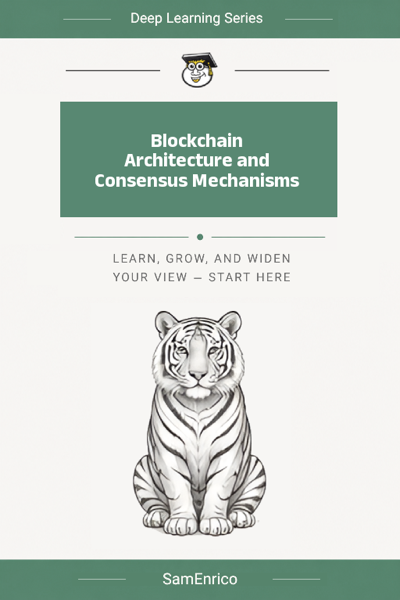
Blockchain Architecture and Consensus Mechanisms
A Coursebook on Blockchain Architecture and Consen
by Leone Dee
A Coursebook on Blockchain Architecture and Consensus Mechanisms
Formats
About this book
Free sample
Chapter 1: The Trust Deficit--–- In the summer of 2008, a small team of engineers at a regional bank in North Carolina discovered something that would have been obvious to any first-year computer science student, yet had somehow been ignored by the entire financial industry for decades. Their internal audit revealed that the bank's transaction database—the same system that moved billions of dollars annually—could be altered by any of the thirty-seven database administrators who had root access. Not hacked. Not breached. Simply modified by employees who were supposed to be trustworthy.
The bank's response was not to fire anyone. It was to hire more auditors. And those auditors, in turn, needed access to the same database. The problem was not malicious actors; the problem was a system architecture that conflated authorization with trust.This is not a story about banking. It is a story about a deeper, more fundamental problem that touches every centralized system ever built.
When you rely on a single source of truth—whether that source is a bank, a social media company, a voting machine manufacturer, or a cloud provider—you are not making a technical decision. You are making a trust decision. You are deciding that the entity controlling that source will always act honestly, will never be compromised, will never face legal pressure to alter records, and will never make a mistake. And for most of human history, that was the only option available.Then, in October 2008, a person or group using the pseudonym Satoshi Nakamoto published a nine-page white paper that proposed something radical: a system where no single entity controls the ledger, where trust is replaced by mathematics, and where agreement emerges from competition rather than authority. That system, which we now call Bitcoin, did not solve the Byzantine Generals Problem—it worked around it using economic incentives.
But more importantly, it revealed a new way of thinking about distributed systems. This book is about that way of thinking. It is about the architectures that make decentralized agreement possible and the consensus mechanisms that animate them.Before we can understand how blockchains…
This is the end of the free sample. Get the eBook to keep going. Buy now
Contents
- Chapter 1
- Chapter 2
- Chapter 3
- Chapter 4
- Chapter 5
- Chapter 6
- Chapter 7
- Chapter 8
- Chapter 9
- Chapter 10
- Chapter 11
- Chapter 12
Details
- Author
- Leone Dee
- Publisher
- SamEnrico
- Language
- English
- Genre
- Non-Fiction, Informative, Educational
- Released
- 2026-06-02
- Pages (approx.)
- 150
- Available as
- eBook, Audiobook

Read better in the ZLOADR app
Your eBooks on your phone or tablet. Sign in with your SamEnrico account and start reading.
More by Leone Dee
 CrossFit Hero WODs ExplainedLeone Dee$11.99
 Stress Respiratory Health GuideLeone Dee$11.99
 The Age Discrimination ShieldLeone Dee$11.99
 Mentorship for Church LeadersLeone Dee$11.99
 Wholesaling Social Media GuideLeone Dee$11.99
 Elevator Pitch Networking ToolLeone Dee$11.99
 The Staircase in the ForestLeone Dee$11.99
 Breath Before Texting BackLeone Dee$11.99
 Wings of the Arctic: The Great Snow Goose Miracle of 1992Leone Dee$11.99
 The Phantom of Montmartre: Toulouse-Lautrec and the Birth of Modern ArtLeone Dee$11.99
 The First Light: How a Soviet Dog Became the First Living Creature in SpaceLeone Dee$11.99
 The Mineral Guide to SpheneLeone Dee$11.99
You may also like
 Hong Kong Handover 1997Dunn Johnnie$11.99
 Zumba For Postnatal Recovery CourseNeal Christian$11.99
 Zumba for BeginnersLadner Nikia$11.99
 YouTube Comment Mining GuideHumes Pandora$12.99
 Worry Box MeditationCarlin Rudy$11.99
 Workplace Stress MeditationNguyen Lynn$11.99
 Workplace Stress and Sleep RepairHawley Ivory$11.99
 Workplace Perfectionism CureDelaney Jeffry$11.99
 Workplace Injustice Anger GuideWallen Isabelle$11.99
 Work Addiction and Burnout LinkGreenwood Ester$11.99
 Women in Yoga and WellnessBeattie Galina$11.99
 Women in Stand Up ComedyChun Evangeline$11.99