
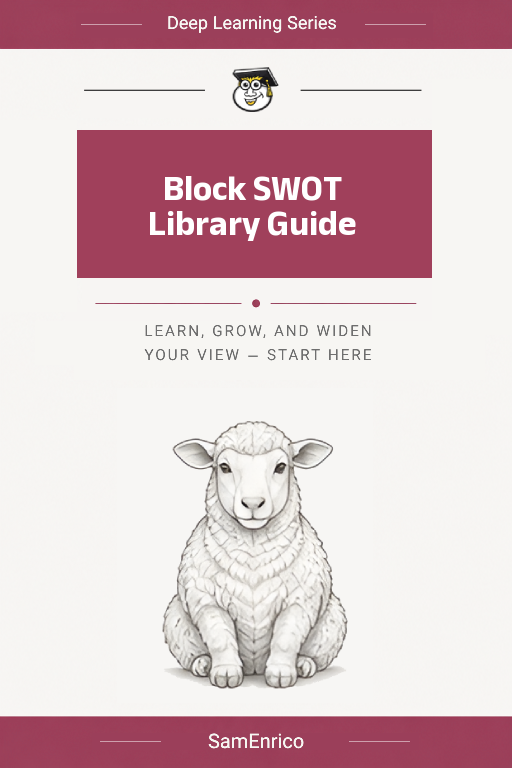
Non-FictionStrategic AtlasFintech
Block SWOT Library Guide eBook
Evaluate Square ecosystem, Cash App growth, Bitcoi
Evaluate Square ecosystem, Cash App growth, Bitcoin exposure, and competition from fintechs and banks.
Formats
Free sample
Chapter 1: The Dorsey Doctrine--The first time Jim Larkin swiped a credit card through a white plastic dongle attached to his i Phone, he was standing inside a food truck parked on a rainy Austin street. It was 2010, and Jim had just sold his last breakfast taco of the morning. The transaction took three seconds. The customer signed the screen with a finger. The receipt arrived via email before the customer had finished wiping salsa off his chin.
Jim did not know it at the time, but that three-second swipe was the opening salvo in a war that would, sixteen years later, reshape the entire architecture of global finance. The company that made that dongle was called Square. Today, it is called Block, and it is no longer just a payments company. It is a bank, a lender, a stockbroker, a Bitcoin treasury, a hardware manufacturer, an artificial intelligence lab, and arguably the most controversial bet in the history of fintech.This book is about Block, but it is also about something larger. It is about the collision of three worlds that were never supposed to meet: the ruthless efficiency of Big Tech, the regulatory gravity of traditional banking, and the anarchic promise of decentralized cryptocurrency.
Block sits at the exact intersection of these three forces, which makes it the perfect case study for anyone who wants to understand where money is going in the next decade. But understanding Block is not simple. The company is a bundle of contradictions. It serves mom-and-pop food trucks and multinational chain stores. It enables Bitcoin maximalism and fiat stablecoins.
It is led by a founder who preaches fifteen-year time horizons but manages a public company that reports earnings every ninety days. It is loved by retail investors and distrusted by Wall Street analysts. Its stock has swung from a hero of the pandemic bubble to a value trap and back again.The purpose of this book is to cut through the noise. We will use a structured analytical framework called SWOT—Strengths, Weaknesses, Opportunities, Threats—applied systematically to every layer of Block’s business. This is not a biography of Jack Dorsey, though we will spend considerable time on his influence.
It is not a cheerleading manifesto for Bitcoin, though we will take cryptocurrency seriously. It is not a warning against fintech disruption, though we will catalog the very real risks. Instead, this book is a library guide: a reference manual for investors, product managers, students, and anyone else who needs to make a decision about Block. By the time you finish the final chapter, you will not only understand Block but also possess a reusable framework for analyzing any fintech company.Let us begin at the beginning. Before Block was a conglomerate, it was a simple idea: what if anyone could accept credit cards, not just established businesses with merchant accounts and bulky terminals?
That idea came from Jim Mc Kelvey, a glassblower who lost a sale because he could not accept American Express. He called his friend Jack Dorsey, who had recently been fired from Twitter, and together they built a prototype. The rest is history, but history has a way of repeating itself in unexpected forms. The same entrepreneurial energy that created the white dongle now powers a company that holds eight thousand Bitcoin on its balance sheet and dreams of banking the unbanked through a peer-to-peer payment network called Lightning. The scale has changed.
The ambition has changed. But the core tension—between open protocols and closed systems, between decentralization and control, between idealism and profit—has remained remarkably constant.That tension is the central theme of this book. Jack Dorsey calls it the "open protocol" philosophy. He believes that the future of finance should be built on permissionless, censorship-resistant networks like Bitcoin, not on the proprietary rails of Visa, Mastercard, and the traditional banking system. This is a profoundly radical position for the CEO of a publicly traded company whose primary revenue still comes from processing payments on those very proprietary rails.
It is like the head of Exxon Mobil advocating for solar panels while drilling for oil. And yet, Dorsey has not been fired. He has not been forced out by a board demanding short-term profits. Instead, he has been given the freedom to pursue a dual strategy: milk the cash cow of Square’s merchant ecosystem while investing heavily in the speculative future of Bitcoin. Whether this makes Dorsey a visionary or a distraction is one of the questions we will answer in the chapters ahead.To answer it, we need a framework.
SWOT analysis is not new. It has been taught in business schools for decades. But its power lies in its simplicity. By separating a company’s situation into internal factors (Strengths and Weaknesses) and external factors (Opportunities and Threats), we can avoid the common mistake of conflating what the company controls with what the environment imposes upon it. For example, Block’s Bitcoin holdings are a weakness not because Bitcoin is bad, but because the concentration risk is internally chosen and internally manageable.
By contrast, a recession that crushes discretionary spending is a threat because it is external and largely outside Block’s control. Keeping these categories distinct is essential for clear thinking.This book applies the SWOT model to six layers of Block’s business. We start with the two core Strengths: the Square seller ecosystem (Chapter 2) and the Cash App consumer platform (Chapter 3). These are the engines that generate predictable revenue and user growth. Then we turn to the two major Weaknesses: the Bitcoin balance sheet (Chapter 4) and the Jack Dorsey management factor (Chapter 5).
These are the internal risks that could derail the company even if external conditions remain favorable. Next, we examine the Opportunities: the stablecoin dilemma (Chapter 6), the Lightning Network (Chapter 7), and the moats of hardware, AI, and international expansion (Chapter 11). These are the pathways to growth beyond Block’s current businesses. Finally, we analyze the Threats: consumer competitors like Pay Pal, Venmo, and Zelle (Chapter 8) and institutional threats from banks and regulators (Chapter 9). We then apply valuation tools (Chapter 10) and synthesize everything into three scenarios (Chapter 12).Before we dive into that analysis, however, we need to understand the man at the center of it all.
Jack Dorsey is not a typical CEO. He is a minimalist who wears the same uniform of black t-shirt and jeans every day. He is a meditator who practices two hours of silent sitting each morning. He is a polyglot who has run two public companies simultaneously, a feat that has been attempted by almost no one else in modern business history. He is a Bitcoin maximalist who believes that the cryptocurrency will eventually become the single global currency, rendering the US dollar, the euro, and every other fiat currency obsolete.
And he is a contrarian who has publicly criticized his own industry, his own peers, and at times his own company’s products.Dorsey’s philosophy is best summarized in a single phrase: "Back on Offense." He coined this term during a 2023 company-wide memo following a round of layoffs. The previous year had been brutal for Block. The stock had fallen over seventy percent from…
This is the end of the free sample. Get the eBook to keep going. Buy now
About this book
Details
- Author
- Furman Fletcher
- Publisher
- SamEnrico
- Language
- English
- Genre
- Non-Fiction, Strategic Atlas, Fintech
- Released
- 2026-05-30
- Pages (approx.)
- 124
- Available as
- eBook, Audiobook

Read better in the ZLOADR app
Your eBooks on your phone or tablet. Sign in with your SamEnrico account and start reading.
More by Furman Fletcher
 Poverty Survival HandbookFurman Fletcher$11.99
 Assertive Communication for EntrepreneursFurman Fletcher$11.99
 Imposter Syndrome In RetirementFurman Fletcher$11.99
 Static Stretching Cool Down GuideFurman Fletcher$11.99
 The Mindfulness Bingo ChallengeFurman Fletcher$11.99
 Client Services ExecutiveFurman Fletcher$11.99
 MLA Citation Rules DemystifiedFurman Fletcher$12.99
 How to Start a Musical Box Business (Beginners Guide)Furman Fletcher$11.99
You may also like
 Hong Kong Handover 1997Dunn Johnnie$11.99
 Zumba For Postnatal Recovery CourseNeal Christian$11.99
 Zumba for BeginnersLadner Nikia$11.99
 YouTube Comment Mining GuideHumes Pandora$12.99
 Worry Box MeditationCarlin Rudy$11.99
 Workplace Stress MeditationNguyen Lynn$11.99
 Workplace Stress and Sleep RepairHawley Ivory$11.99
 Workplace Perfectionism CureDelaney Jeffry$11.99
 Workplace Injustice Anger GuideWallen Isabelle$11.99
 Work Addiction and Burnout LinkGreenwood Ester$11.99
 Women in Yoga and WellnessBeattie Galina$11.99
 Women in Stand Up ComedyChun Evangeline$11.99