
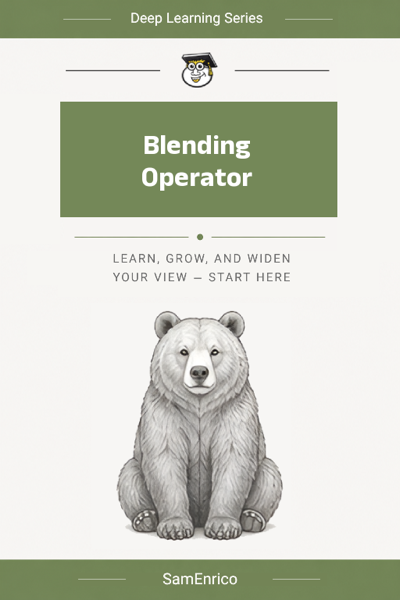
Blending Operator eBook
A Coursebook on Blending Operator
by Wang Hayley
A Coursebook on Blending Operator
Formats
Free sample
Chapter 1: The Universal Solvent...--Chapter 1: The Universal Solvent Imagine for a moment that you could dissolve the boundaries between industries. That you could take the precision of a pharmaceutical engineer, the physical intuition of a cement plant operator, the visual artistry of a Hollywood compositor, and the real-time problem-solving of a video game graphics programmer—and blend them all into a single professional. That professional would not be a jack-of-all-trades, master of none. Rather, they would be a master of a single, powerful way of thinking that applies across all these domains. They would be a Blending Operator.This chapter introduces you to that way of thinking.
Blending is not just a set of machines or software tools. It is a fundamental human activity—combining distinct things to create something new and uniform. We have been blending for as long as we have been making things: paints, bread, concrete, medicine, music, images, and even data. Yet only in the last century has blending become a true engineering discipline, with its own body of knowledge, mathematical models, and professional standards.What makes blending fascinating is its universality. Whether you are mixing two powders or two pixels, you face the same core challenge: you must transform separate inputs into a homogeneous output that meets specifications.
You must decide how long to mix, what equipment or algorithm to use, how to verify uniformity, and what to do when the output is wrong. The answers differ across domains—a cement mixer is not a Photoshop layer—but the questions are identical.This book is a coursebook for the Blending Operator. It will teach you the principles, practices, and applications of blending across multiple industries. But before we dive into equipment specifications, statistical formulas, and shader code, we must establish a common language. What exactly is blending?
Who is the Blending Operator? What does it mean for a blend to be "good enough"? And why has blending become so critical to modern manufacturing, medicine, and media?Let us begin.1.1 The Blending Operator: A New Kind of Professional In most industries, the person who runs a blender is not called a "Blending Operator." They have domain-specific titles: Mixing Technician, Compounding Specialist, Homogenization Engineer, Compositing Artist, Shader Programmer, Batch Maker. These titles reflect the unfortunate siloing of knowledge. The pharmaceutical technician rarely speaks to the game developer, even though both solve blending problems.
The compositor never visits a cement plant, even though both worry about segregation.This book argues that these silos are artificial. The underlying science of blending—the physics of mixing, the statistics of uniformity, the economics of optimization—transcends the medium. A Blending Operator is anyone who professionally combines inputs to achieve a uniform output. They may work with dry powders, liquids, gases, minerals, images, sounds, or data streams. The medium changes, but the operator's mindset remains constant.Core Responsibilities of the Blending Operator Across all industries, Blending Operators perform five core functions:1.
Process Selection. The operator chooses the right equipment or algorithm for the job. For powders, this might mean a V-cone blender for fragile crystals or a ribbon blender for abrasive minerals. For images, this might mean the Porter-Duff "Over" operator for transparency or a Screen blend mode for highlights. The choice depends on the materials' properties, the desired output characteristics, and the production scale.2.
Parameter Determination. Every blending process has adjustable parameters: mixing time, rotational speed, temperature, pressure, feed rates, alpha values, blend modes. The operator must determine the correct settings, often through experimentation and statistical validation. There is no universal recipe; what works for one material may fail for another.3. Monitoring and Sampling.
Once the process is running, the operator must verify that it remains in control. This requires real-time monitoring (sensors, sight glasses, visual feedback) and periodic sampling to measure uniformity. Sampling is deceptively difficult; drawing a sample from the wrong location or at the wrong time can produce dangerously misleading results.4. Troubleshooting. When the output deviates from specifications, the operator must diagnose the cause.
Is the equipment malfunctioning? Has the incoming material changed? Are the parameters still correct? Is the sampling method biased? Troubleshooting requires systematic thinking and a deep understanding of failure modes.5.
Optimization. Finally, the operator seeks to improve the process over time. Can we reduce mixing time without sacrificing quality? Can we switch from batch to continuous blending to increase throughput? Can we lower energy consumption or reduce waste?
Great operators save their organizations thousands or millions of dollars through incremental improvements.The Human Element Despite increasing automation, the human Blending Operator remains essential. Machines execute blending equations perfectly, but they cannot decide which equation to use, when to stop, or what to do when the unexpected occurs. Only a human can look at a partially mixed batch and judge whether it needs another five minutes or whether it has already been over-mixed. Only a human can recognize that a strange odor or an unusual pixel artifact signals a deeper problem. Only a human can balance quality, safety, cost, and throughput in real-time.This book will teach you to be that human.1.2 The Mathematics of Blending: One Equation to Rule Them All At the heart of every blending operation lies a simple mathematical idea: combine inputs according to weights that sum to one.
The most general form is the weighted sum:Output=w1⋅Input1+w2⋅Input2+w3⋅Input3+⋯+wn⋅Inputn Output = w_1 \cdot Input_1 + w_2 \cdot Input_2 + w_3 \cdot Input_3 + \dots + w_n \cdot Input_n Output=w1⋅Input1+w2⋅Input2+w3⋅Input3+⋯+wn⋅Inputnwhere all weights wiw_iwi are non-negative and sum to 1 (for normalized blends) or to a value less than 1 (with a background term filling the remainder). This equation appears in virtually every blending context, though it is often disguised by domain-specific notation.The Two-Input Case: Linear Interpolation When blending exactly two inputs, the weighted sum reduces to linear interpolation:Output=(1−α)⋅Input1+α⋅Input2Output = (1 - \alpha) \cdot Input_1 + \alpha \cdot Input_2Output=(1−α)⋅Input1+α⋅Input2Here, α\alphaα (alpha) is a mixing factor between 0 and 1. When α=0\alpha = 0α=0, the output is entirely Input₁. When α=1\alpha = 1α=1, the output is entirely Input₂. When α=0.5\alpha = 0.5α=0.5, the output is an equal mix.This equation is the universal solvent of blending—it dissolves the apparent differences between industries.
Consider:Pharmaceutical blending: Input₁ and Input₂ are drug substances; α\alphaα is the mass fraction of Input₂. A 70/30 blend means α=0.3\alpha = 0.3α=0.3.Digital compositing: Input₁ is the background image; Input₂ is the foreground image; α\alphaα is the foreground's opacity (alpha channel). When the foreground is semi-transparent (α=0.5\alpha = 0.5α=0.5), the background shows through.Audio cross-fading: Input₁ is the outgoing track; Input₂ is the incoming track; α\alphaα increases from 0 to 1 over time, creating a smooth transition.Chemical dilution: Input₁ is a concentrated solution; Input₂ is pure solvent; α\alphaα is the dilution factor. A 10x dilution means α=0.1\alpha = 0.1α=0.1.Data ensemble modeling: Input₁ and Input₂ are predictions from two models; α\alphaα is the weight given to the second model. An ensemble that averages both models equally uses α=0.5\alpha = 0.5α=0.5.The equation is so simple that we often take it for granted.
But its simplicity is its power. Once you understand linear interpolation—its properties, its limitations, its extensions—you understand the mathematical foundation of all blending.Properties of Linear Interpolation Linear interpolation…
This is the end of the free sample. Get the eBook to keep going. Buy now
About this book
Details
- Author
- Wang Hayley
- Publisher
- SamEnrico
- Language
- English
- Genre
- Non-Fiction, Informative, Educational
- Released
- 2026-05-09
- Pages (approx.)
- 153
- Available as
- eBook, Audiobook

Read better in the ZLOADR app
Your eBooks on your phone or tablet. Sign in with your SamEnrico account and start reading.
More by Wang Hayley
 BRCA Gene Mutation GuideWang Hayley$11.99
 The Pain Mindfulness GuideWang Hayley$11.99
 Meeting Facilitation ScriptsWang Hayley$11.99
 Pinterest VA Idea Pin ExplosionWang Hayley$11.99
 Data Leak Email Auto Reply TemplatesWang Hayley$11.99
 Deep Work Scheduling GuideWang Hayley$12.99
 The Harlem Renaissance: A Revolution in Ink and SoundWang Hayley$11.99
 The Frozen Compass: Ethics and Empire in the Arctic's First Scientific ExpeditionsWang Hayley$11.99
 Understanding Coeliac DiseaseWang Hayley$17.99
 Tappi YC Application TipsWang Hayley$12.99Deep Work Scheduling GuideWang Hayley$12.99
 How to Start a Hobby in Lincoln Douglas DebateWang Hayley$11.99