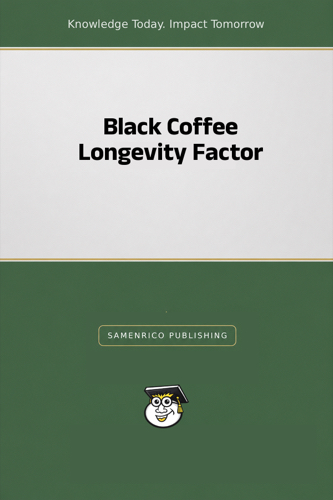
Black Coffee Longevity Factor eBook
Drink up to four cups daily, a habit linked to red
by Marr Myong
Drink up to four cups daily, a habit linked to reduced mortality in Blue Zones.
Formats
Free sample
Chapter 1: Beyond the Headlines--The first time I heard that coffee might actually be good for me, I almost laughed my doctor out of the room.It was 2019, and I was sitting in a sterile examination room at a prestigious university hospital, clutching a paper cup of lukewarm black coffee that I had hidden in my jacket pocket like a criminal. For ten years, I had been drinking coffee in secret—sneaking sips between meetings, pouring travel mugs behind closed doors, and lying to my primary care physician about my "occasional" caffeine consumption. I had internalized the warnings. Coffee dehydrates you. Coffee spikes your cortisol.
Coffee is addictive. Coffee will give you heart palpitations. Coffee will stain your teeth and ruin your sleep and, somewhere along the line, probably shorten your life.My doctor that day was a thin, energetic woman in her early sixties named Dr. Helen Voss. She had the kind of calm, knowing demeanor that made you feel both deeply comfortable and slightly exposed.
After reviewing my blood work—which was, by most measures, excellent—she asked an unexpected question."How much coffee do you actually drink?"I hesitated. "A cup. Maybe two."She tilted her head. "Your ferritin is on the low side, your liver enzymes are excellent, and your HDL is higher than I'd expect for someone who doesn't exercise aggressively. That pattern usually tracks with regular coffee consumption.
Three or four cups a day, usually."I felt caught. "Fine. Three. Sometimes four."She nodded, unsurprised. "Good.
Keep going."I stared at her. "Keep going? I thought coffee was supposed to be bad for you."Dr. Voss leaned back in her chair and said something that would fundamentally alter the trajectory of my life and career. "That's what we told patients for thirty years because we confused correlation with causation.
The truth is, coffee is one of the most powerful, accessible, and underprescribed interventions for long-term health that exists. And we're only now beginning to understand why."The Silent Revolution Brewing in Plain Sight What Dr. Voss told me that day sent me down a rabbit hole that would consume the next four years of my life. I read hundreds of peer-reviewed studies. I traveled to three continents.
I interviewed epidemiologists, molecular biologists, cardiologists, neurologists, and centenarians. I drank coffee in mountainside villages in Costa Rica, in smoky cafés in Sardinia, and on the sun-baked patios of Ikarian homes where people over ninety still tended their own olive trees.And what I discovered shattered everything I thought I knew about this ancient beverage.Consider this: In 2022, the American Heart Association published a massive analysis of nearly 450,000 participants followed for an average of fifteen years. The researchers wanted to know whether coffee consumption was associated with mortality from all causes—heart disease, cancer, respiratory illness, stroke, and diabetes. The results were so striking that the lead author, Dr. Peter Kistler, held an unusual press conference to announce them.People who drank two to three cups of coffee per day had a 12 to 15 percent lower risk of death during the study period compared to non-coffee drinkers.
Those who drank four cups had an even more pronounced benefit. And crucially, the benefit held whether the coffee was caffeinated or decaffeinated—a clue that something other than caffeine was driving the effect.This was not an isolated finding. A 2017 meta-analysis published in the BMJ pooled data from over two hundred studies and more than 2.5 million participants. The conclusion: moderate coffee consumption (three to four cups daily) was consistently associated with reduced risk of death from all causes, with the strongest protections observed against cardiovascular disease, liver disease, and certain cancers. The authors noted that coffee drinkers had a 17 percent lower risk of death from heart disease, a 15 percent lower risk of death from respiratory disease, and a 20 percent lower risk of death from stroke.Let me pause here and let those numbers sink in.We spend billions of dollars on statins, blood pressure medications, supplements, and elaborate wellness protocols—many of which have proven benefits but also side effects, costs, and compliance challenges.
Meanwhile, a beverage that costs pennies per cup, requires no prescription, has virtually no side effects when consumed properly, and is already enjoyed by billions of people worldwide has been quietly demonstrating effects that rival or exceed those of many pharmaceutical interventions.So why haven't you heard about this? Or if you have heard something, why has the message been so muddled—coffee is good, coffee is bad, coffee is good again, but only if it's organic/shade-grown/light-roast/single-origin/drunk before noon?The answer lies in the peculiar history of coffee science, which has been plagued by three persistent problems: confounding variables (coffee drinkers also tend to smoke more, at least in older studies), reverse causation (people who feel unwell often stop drinking coffee, making coffee look dangerous), and a deep misunderstanding of the difference between association and causation. When we finally controlled for these factors—particularly smoking and illness-related avoidance—the picture became unmistakably clear. Coffee, consumed in the right way and in the right amounts, is not merely neutral. It is actively protective.The Great Misunderstanding: Why We Got Coffee Wrong for So Long To understand how deeply coffee was misunderstood, we have to go back to the mid-twentieth century.
Early epidemiological studies consistently showed that coffee drinkers had higher rates of heart disease and death. But these studies had a fatal flaw: they failed to adequately control for smoking. In the 1950s, 60s, and 70s, coffee drinking and cigarette smoking were tightly linked behaviors. People who drank multiple cups of coffee per day were far more likely to smoke a pack of cigarettes. When researchers failed to separate the two variables, coffee appeared guilty by association.When later studies controlled for smoking, the association between coffee and heart disease vanished—and then reversed.
Suddenly, coffee drinkers appeared healthier than non-drinkers. But a new problem emerged: reverse causation. People with chronic illness, particularly gastrointestinal conditions, liver disease, and anxiety disorders, were often advised to stop drinking coffee or naturally reduced their consumption because it exacerbated their symptoms. These sicker individuals populated the "non-coffee drinking" group in observational studies, making it appear that coffee conferred a benefit when the true effect was that sick people drank less coffee.Modern epidemiology has largely solved these problems through rigorous statistical methods, long follow-up periods, and prospective designs that measure coffee consumption before disease develops. The consensus today, reflected in the dietary guidelines of virtually every developed nation, is that moderate coffee consumption is safe for most adults and likely beneficial for many.But "likely beneficial" is a cautious phrase that obscures a more remarkable truth.
Coffee is not just safe. It is, gram for gram, one of the most antioxidant-rich substances in the average human diet. And those antioxidants—a class of compounds called polyphenols—are the true stars of this story.The Polyphenol Powerhouse: Coffee's Secret Weapon The word "antioxidant" gets thrown around so casually in wellness marketing that it has lost much of its meaning. But the reality of oxidative stress is stark. Every cell in your body is under constant attack from free radicals—unstable molecules produced…
This is the end of the free sample. Get the eBook to keep going. Buy now
About this book
Details
- Author
- Marr Myong
- Publisher
- SamEnrico
- Language
- English
- Genre
- Non-Fiction, Health & Wellness, Caffeine Science
- Released
- 2026-06-10
- Pages (approx.)
- 139
- Available as
- eBook, Audiobook

Read better in the ZLOADR app
Your eBooks on your phone or tablet. Sign in with your SamEnrico account and start reading.
More by Marr Myong
 Stress Antioxidant DemandMarr Myong$11.99
 Follower Count ObsessionMarr Myong$11.99
 Deep Core Connection GuideMarr Myong$11.99
 The Engagement Survey GuideMarr Myong$11.99
 Lights of Reason: The Enlightenment's Brightest MindsMarr Myong$11.99
 How to Become a Gettering-filament-machine OperatorMarr Myong$11.99
 The Breeder's Guide to Bourbon Red TurkeysMarr Myong$11.99
 Campaign Scaling StrategiesMarr Myong$12.99
 Cape Town vs Kigali GuideMarr Myong$12.99
 Client Accounting AssociateMarr Myong$11.99