
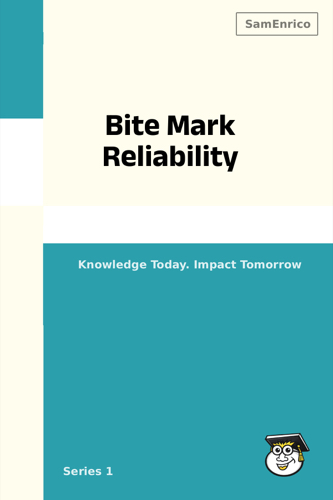
Non-FictionTrue Crime / Science
Bite Mark Reliability eBook
undefined
by Maddox Roni
undefined
Formats
Free sample
Chapter 1: The Cheese Conviction...--–- On a humid Texas morning in 1954, a burglary suspect sat handcuffed in a small county courtroom, unaware that his fate would be decided not by a confession, not by a fingerprint, not by an eyewitness, but by a piece of dairy. The evidence that would send him to prison was a block of cheese, gnawed at the scene, and a dentist who claimed he could identify teeth marks the way a hunter identifies animal tracks. That moment—obscure, almost absurd—marked the birth of one of the most controversial forensic disciplines in American history: bite mark analysis. It was a discipline born not in a laboratory, not from peer-reviewed research, but inside a courtroom, where the rules of science bend to the demands of conviction.For nearly seven decades, forensic odontologists have testified with confidence that human teeth leave unique, identifiable patterns on skin. They have used those opinions to send men to death row, to life in prison, and, in some cases, to the execution chamber.
Yet from the very beginning, skeptics warned that the emperor had no clothes. The cheese in that Texas courtroom was not the beginning of a rigorous science. It was the beginning of a long, slow tragedy of overconfidence, cognitive bias, and the dangerous allure of expert certainty.This chapter tells the story of how bite mark evidence went from a bizarre curiosity to a staple of forensic prosecution. It traces the origins of the discipline, the legal standards that allowed it to flourish, and the early warnings—ignored for decades—that should have stopped it before it ever reached a jury. By the end of this chapter, you will understand that bite mark analysis was never a science that gradually improved over time.
It was a courtroom creation, retrofitting scientific language onto a foundation of sand, and the cracks began to show almost immediately.The Strange Case of Texas v. Doyle The year was 1954. The place was Wichita Falls, Texas. A local man named Doyle was accused of burglarizing a home, and the evidence against him was thin: circumstantial at best, nonexistent at worst. But the prosecutor had an unusual piece of physical evidence.
At the scene of the crime, the intruder had bitten into a block of cheese found in the kitchen. The cheese bore a set of indentations—teeth marks, unmistakably human. The prosecutor called a dentist to the stand.That dentist, whose name has largely been lost to history, testified that the marks in the cheese matched Doyle’s teeth. He used calipers, photographs, and the kind of confident language that jurors trust. He did not cite population statistics.
He did not provide an error rate. He did not reference any peer-reviewed validation study, because none existed. He simply declared a match, and the jury believed him. Doyle was convicted.The case was not widely reported at the time. It did not set a legal precedent in the way that landmark Supreme Court decisions do.
But within the small world of forensic odontology, it was a revelation. If a dentist could match teeth to a bite mark in cheese, why not match teeth to a bite mark on skin? If cheese could hold a reliable impression, why not a victim’s arm, shoulder, or breast? The leap was seductive, and it happened quickly.Within a decade, forensic odontologists were testifying in homicide cases, matching bite marks on human skin to the teeth of accused killers. The discipline spread from Texas to California, from Florida to New York.
By the 1970s, bite mark analysis had become a standard tool in the prosecutor’s arsenal, despite the fact that virtually no research supported its accuracy.The Toolmark Fallacy To understand how bite mark analysis gained credibility, you must understand the forensic discipline it mimicked: toolmark examination. For decades, forensic experts had matched tools—knives, screwdrivers, crowbars—to the marks they left on surfaces like wood, metal, or plastic. The logic was straightforward. Manufacturing processes leave microscopic imperfections on tool surfaces. When a tool is used, it transfers those imperfections to the surface it contacts.
A skilled examiner can compare the two and declare a match.Toolmark analysis has its own controversies, but at least it rests on a physical reality. Metal and wood do not change shape after a mark is made. They do not swell, bruise, heal, or decompose. The impression is static, stable, and measurable. Bite mark analysis borrowed the language of toolmark examination—uniqueness, individualization, match—but applied it to human skin, which behaves nothing like wood or metal.Skin is alive.
It stretches under pressure, then slowly returns to its original shape. It swells in response to trauma, filling with fluid that distorts the pattern of the bite. It bruises, turning the border of each tooth mark into a diffuse, irregular stain. Over the course of hours and days, the bite mark changes color, shape, and size. If the victim is deceased, post-mortem changes—skin slippage, bloating, drying—further distort the pattern.
A bite mark photographed at the crime scene looks different from a bite mark photographed at the autopsy, which looks different from a bite mark photographed two weeks later.Despite these obvious problems, forensic odontologists insisted that the principles of toolmark examination applied. They argued that teeth, like tools, have unique microscopic and macroscopic characteristics. A rotated tooth, a gap, a chip, a filling—all could be compared to a mark on skin. The problem, which should have been obvious from the start, is that the mark on skin is not a direct impression. It is a bruise.
And bruises are not photographs.The Frye Standard and the Courtroom Birth of Bite Marks Why did courts allow bite mark evidence to be admitted with so little scientific backing? The answer lies in the legal standard that governed expert testimony for most of the 20th century: the Frye standard. In Frye v. United States (1923), the D.C. Circuit Court of Appeals ruled that scientific evidence is admissible if it is “generally accepted” within its relevant scientific community.
That was it. No requirement for error rates, no requirement for validation studies, no requirement for peer-reviewed research. Just general acceptance.General acceptance is a low bar. It does not require proof. It requires consensus, and consensus can be manufactured.
A small group of forensic odontologists could gather at conferences, agree among themselves that bite mark analysis worked, and then testify in court that the technique was generally accepted. Defense attorneys, who rarely had their own expert witnesses, could not effectively challenge this circular reasoning. The judge would ask the prosecution’s expert, “Is bite mark analysis generally accepted among forensic odontologists?” The expert would say yes, and the evidence would come in.This is precisely what happened for decades. The American Board of Forensic Odontology (ABFO) was formed in 1976, and its diplomates became the gatekeepers of the discipline. They wrote manuals, established protocols, and certified new practitioners.
All of this created the appearance of a mature, self-regulating science. But appearances are not evidence. The ABFO’s protocols were based on expert opinion, not empirical research. The certification exams tested knowledge of procedure, not accuracy…
This is the end of the free sample. Get the eBook to keep going. Buy now
About this book
Details
- Author
- Maddox Roni
- Publisher
- SamEnrico
- Language
- English
- Genre
- Non-Fiction, True Crime / Science
- Released
- 2026-06-06
- Pages (approx.)
- 125
- Available as
- eBook, Audiobook

Read better in the ZLOADR app
Your eBooks on your phone or tablet. Sign in with your SamEnrico account and start reading.
More by Maddox Roni
 Prolonged Anticipatory Grief GuideMaddox Roni$11.99
 Aging with Self Worth WorkbookMaddox Roni$11.99
 LBO Vendor Financing GuideMaddox Roni$11.99
 Treadmill Incline TrainingMaddox Roni$11.99
 Empathy for TeachersMaddox Roni$11.99
 Bite Mark ReconstructionMaddox Roni$11.99
 Self Hypnosis for Sleep JournalMaddox Roni$11.99
 Lens of Rebellion: The Fashion Photographers Who Defied DictatorsMaddox Roni$11.99
 Love and Loyalty at Fort Laramie: The Romance That Saved the FrontierMaddox Roni$11.99
 How to Produce Cutter AccessoriesMaddox Roni$11.99
 One Page Marketing PrimerMaddox Roni$12.99
 Canadian Job Offer LMIA GuideMaddox Roni$12.99
You may also like
 Hong Kong Handover 1997Dunn Johnnie$11.99
 Zumba For Postnatal Recovery CourseNeal Christian$11.99
 Zumba for BeginnersLadner Nikia$11.99
 YouTube Comment Mining GuideHumes Pandora$12.99
 Worry Box MeditationCarlin Rudy$11.99
 Workplace Stress MeditationNguyen Lynn$11.99
 Workplace Stress and Sleep RepairHawley Ivory$11.99
 Workplace Perfectionism CureDelaney Jeffry$11.99
 Workplace Injustice Anger GuideWallen Isabelle$11.99
 Work Addiction and Burnout LinkGreenwood Ester$11.99
 Women in Yoga and WellnessBeattie Galina$11.99
 Women in Stand Up ComedyChun Evangeline$11.99