
Non-FictionTrue Crime / Photography
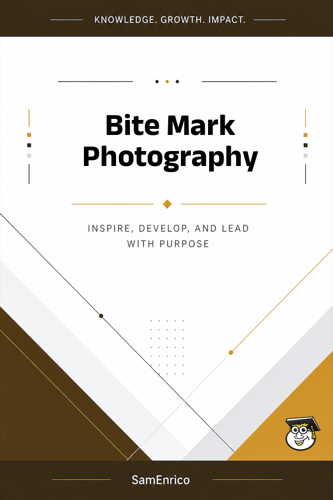
Bite Mark Photography eBook
undefined
by Spear Pilar
undefined
Formats
Free sample
Chapter 1: The Photograph That Hung a Man...--–- The call came in at 2:17 on a Tuesday afternoon. The homicide detective on the line didn't say "bite mark." He said, "We've got teeth marks on the victim's shoulder, and the suspect's dentures just became our best friend or our worst enemy. Get here with every macro lens you own, and don't forget the gray card." That detective, twenty years on the job, knew something that most crime scene investigators learn the hard way: a bite mark photograph is either the key that unlocks a confession or the mistake that haunts a courtroom for decades. There is no middle ground.This book exists because of that phone call, and because of hundreds like it. Bite mark photography is not a sub-specialty.
It is not an afterthought taught on the last day of a forensic photography workshop. It is the single most scrutinized, most challenged, and most consequential genre of evidentiary imaging in the modern criminal justice system. A fingerprint can be lifted, swabbed, and digitized. DNA can be extracted, amplified, and matched. But a bite mark?
A bite mark is fleeting. It bruises, swells, fades, and vanishes. The only permanent record of that bite—the only evidence that will ever exist—is the photograph you take. Get it right, and a predator goes to prison. Get it wrong, and an innocent person dies behind bars.This is the story of why that weight rests on your shoulders, and how the history of forensic photography has prepared you—or failed to prepare you—for the task.The Wrongful Conviction That Changed Everything In 1991, a Phoenix postal worker named Ray Krone was convicted of first-degree murder.
He had no criminal record. He had no motive. He had no DNA evidence linking him to the crime. What he had was a bite mark. The victim, Kim Ancona, a bartender at a local comedy club, had been found murdered in the restroom.
On her body, investigators found a bite mark on her left breast. A forensic odontologist photographed the mark, created an overlay from a dental cast of Krone's teeth, and testified that the bite matched Krone "to a reasonable scientific certainty." The jury deliberated. Krone was sentenced to death.He spent ten years on death row. Ten years of appeals, of waiting, of watching other men walk to the execution chamber. Then came DNA testing—technology that had not existed at the time of his trial.
The DNA under the victim's fingernails and on her clothing did not belong to Ray Krone. It belonged to another man, Kenneth Phillips, who later confessed. Krone was exonerated in 2002. He walked out of prison a free man, his life stolen by evidence that a jury had been told was "scientific."What went wrong? The bite mark itself was real.
The photographs, however, were not taken with the ABFO scale placed on the same plane as the mark. The scaling was off. The overlay comparison used by the prosecution's expert had not accounted for the curvature of the breast. The so-called "match" was an artifact of distorted photography, not a reflection of anatomical reality. Krone's case became a cornerstone of the Innocence Project's campaign against bite mark evidence—not because bite marks are inherently unreliable, but because the photography that preserved them was.This is the central argument of this book: bite mark evidence is only as reliable as the photograph that captures it.
A poorly photographed bite mark is worse than no evidence at all. It is a lie waiting to be told.The ABFO Standards: Your Only Lifeline In the aftermath of cases like Krone's, the American Board of Forensic Odontology (ABFO) did something remarkable. Rather than abandon bite mark analysis, they codified it. The ABFO Standards and Guidelines for Dental Evidence are the definitive protocol for every aspect of bite mark documentation, from the moment the victim arrives at the examination room to the moment the expert witness steps down from the stand. These standards are not suggestions.
They are not best practices open to interpretation. They are the floor beneath your feet. Deviate from them, and your evidence will be excluded under the Daubert standard, the 1993 Supreme Court ruling that requires expert testimony to be both relevant and reliable.Let me be explicit about what the ABFO requires of photographers:First, every bite mark must be photographed with a scale that is placed on the same anatomical plane as the mark. That scale must be an ABFO No. 2 Scale, an L-shaped device containing gray-scale bars, reference circles, and a unique case identifier.
The scale cannot be held in place by a gloved hand, which introduces angle and pressure artifacts. It must be placed flat against the skin, or if the skin is curved, secured with medical tape at the edges only, never over the scale's surface.Second, every bite mark must be photographed from a minimum of three distances: orientation (full body), intermediate (anatomical landmark context), and close-up (scale and mark filling the frame). Each of these distances requires its own exposure and focus calibration. You cannot simply zoom in. You must move the camera.Third, every bite mark must be photographed with at least two different lighting techniques: cross-polarization to reveal subsurface bruising, and oblique lighting to reveal surface indentation.
No single lighting condition captures the full evidentiary value of a bite mark.Fourth, every photograph must be captured in RAW format, not JPEG. The chain of custody must begin at the moment of capture, with the memory card sealed in a tamper-evident bag and logged in a signed chain of custody form before the camera leaves the examination room.These are not optional. They are not "guidelines" in the casual sense. They are the difference between evidence that a judge admits and evidence that a judge excludes. And as Ray Krone learned, the difference between admission and exclusion is often the difference between life and death.Daubert, Frye, and the Shifting Sands of Admissibility Before we go any further, we need to talk about the legal standards that will determine whether your photographs ever see a courtroom.
The Daubert standard, established in Daubert v. Merrell Dow Pharmaceuticals (1993), governs federal courts and most state courts. It requires that expert testimony—including bite mark comparisons based on your photographs—meet five criteria: testing, peer review, error rate, standards, and general acceptance. The Frye standard, from Frye v. United States (1923), is older and simpler: it requires only that the scientific technique be "generally accepted" by the relevant scientific community.Why does this matter to a photographer?
Because the admissibility of your photographs is not automatic. A defense attorney will challenge every technical decision you made. Did you use the ABFO scale? Was it on the same plane? Did you calibrate white balance with a gray card?
Did you capture RAW files? Did you document your chain of custody? If you answer "no" to any of these questions, the defense will file a Daubert motion to exclude your evidence. And they will likely win.Consider the case of State v. Harden (Ohio, 2015).
The prosecution's bite mark photographs were excluded because the photographer had not used a gray card. The judge ruled that…
This is the end of the free sample. Get the eBook to keep going. Buy now
About this book
Details
- Author
- Spear Pilar
- Publisher
- SamEnrico
- Language
- English
- Genre
- Non-Fiction, True Crime / Photography
- Released
- 2026-06-07
- Pages (approx.)
- 147
- Available as
- eBook, Audiobook

Read better in the ZLOADR app
Your eBooks on your phone or tablet. Sign in with your SamEnrico account and start reading.
More by Spear Pilar
 Truck Driver Nap GuideSpear Pilar$11.99
 Team Brainstorming Workshop GuideSpear Pilar$11.99
 EQ For Engineers GuideSpear Pilar$11.99
 Aerospace and Defense MultiplesSpear Pilar$11.99
 Ramadan Student LifeSpear Pilar$11.99
 Craniosacral TherapySpear Pilar$11.99
 Panic Attack Hypnosis GuideSpear Pilar$11.99
 Jörmungandr and the Jade Serpent: A Norse-Dragon’s LamentSpear Pilar$11.99
 Galahad’s Lost Grail: The Knight’s Forbidden RevelationSpear Pilar$11.99
 Robins: Backyard BirdSpear Pilar$11.99
 How to Become a Salvage EngineerSpear Pilar$11.99
 A Collector's Handbook to the Volkswagen Type 1 Karmann-ghia CoupèSpear Pilar$11.99
You may also like
 Hong Kong Handover 1997Dunn Johnnie$11.99
 Zumba For Postnatal Recovery CourseNeal Christian$11.99
 Zumba for BeginnersLadner Nikia$11.99
 YouTube Comment Mining GuideHumes Pandora$12.99
 Worry Box MeditationCarlin Rudy$11.99
 Workplace Stress MeditationNguyen Lynn$11.99
 Workplace Stress and Sleep RepairHawley Ivory$11.99
 Workplace Perfectionism CureDelaney Jeffry$11.99
 Workplace Injustice Anger GuideWallen Isabelle$11.99
 Work Addiction and Burnout LinkGreenwood Ester$11.99
 Women in Yoga and WellnessBeattie Galina$11.99
 Women in Stand Up ComedyChun Evangeline$11.99