
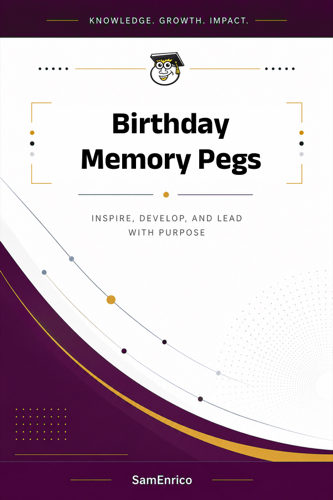
Non-FictionSelf-HelpSocial Memory
Birthday Memory Pegs eBook
Use number shape system to remember birthdays and
by Loomis Gena
Use number shape system to remember birthdays and anniversaries.
Formats
Free sample
Chapter 1: The Emotional Ledger--–- The voicemail from your spouse arrives at 7:43 PM. You are still at work, staring at a spreadsheet, and the little red notification sits there for twenty minutes before you tap it. Her voice sounds strange. Not angry. Flat.
"Hey. Just checking in. It’s been a long day. Call me when you get this." You call back immediately. The conversation is short.
She asks, "Do you know what today is?" Your mind races. It’s not your anniversary. That’s in October. It’s not her birthday. That’s in March.
It’s not a holiday. You say, "Tuesday?" She hangs up. You check the calendar. It is the fourth anniversary of the day you adopted your dog. She has been planning a small celebration for two weeks.
She mentioned it four times. You nodded each time. Now you are eating takeout alone on the couch, and she is upstairs, and neither of you is speaking.This is not a trivial problem. It is not a quirk of personality or a sign that you don’t care. It is a failure of technique.
And it is costing you more than you realize.The Myth of Being "Bad with Dates"Let’s start with a confession. I wrote this book because I was the worst person I knew at remembering birthdays. I forgot my mother’s sixtieth birthday until 11:00 PM, when Facebook surfaced a notification that someone else had posted a photo of her as a child. I called her at 11:15. She was already in bed.
She said, "It’s fine, honey," in the exact tone that meant it was not fine. I forgot my best friend’s wedding anniversary three years in a row. The third time, he stopped sending reminders. I forgot my own niece’s birthday twice. My sister stopped inviting me to the parties.I told myself the same story that millions of people tell themselves every day: "I’m just not good with dates.
It’s how my brain works. My strengths are elsewhere." That story is a lie. It is a comfortable, self-protective lie, but a lie nonetheless.Here is the truth that memory researchers have known for decades: there is no such thing as being "bad with dates." There is only having inadequate systems. The human brain did not evolve to remember calendar positions. Our ancestors did not need to know that June 14th was Aunt Mabel’s birthday.
They needed to know which berries were poisonous, where the river was, and who in the tribe could be trusted. The part of your brain that processes numbers—the intraparietal sulcus, if you want the neuroscience term—is not defective in people who forget dates. It is simply undertrained.Harry Lorayne, one of the most influential memory trainers of the twentieth century, made this argument repeatedly in his best-selling book How to Develop a Super-Power Memory. He taught that memory is not a genetic gift. It is a skill.
Like playing the piano, like learning a language, like cooking, it requires technique and practice. No one is born knowing how to remember a string of sixty random digits. But anyone can learn.The problem is that we have built an entire culture around the excuse of forgetfulness. Think about how often you have heard someone say, with a shrug, "Sorry, I’m terrible with names," or "You know me, I can’t remember birthdays to save my life." We treat these statements as self-deprecating humor, but they are actually performance reviews. And the grade is failing.The Emotional Ledger: Why One Forgotten Birthday Costs More Than Ten Remembered Let me introduce a concept that will run through every chapter of this book: the Emotional Ledger.Imagine that every relationship in your life—your spouse, your children, your parents, your friends, your coworkers—operates on a hidden points system.
This is not a cynical or manipulative framework. It is simply a description of how human beings track trust and care. Every positive interaction adds points. Every negative interaction subtracts points. The goal is not to keep a literal spreadsheet.
The goal is to understand that not all points are equal.Here is the asymmetry that ruins relationships: forgetting a birthday subtracts far more points than remembering one adds.Let me give you numbers so you can feel the weight. Forgetting your spouse’s birthday subtracts approximately one hundred points from the Emotional Ledger. That is not a typo. One hundred. Forgetting your child’s birthday subtracts eighty points.
Forgetting a close friend’s birthday subtracts thirty points. Forgetting a coworker’s birthday subtracts ten points.Now, how many points do you gain for remembering a birthday? For your spouse, remembering adds approximately one point. For your child, one point. For a close friend, one point.
For a coworker, one point. Sometimes less. Sometimes it adds nothing at all because the person simply expects you to remember—they don’t give you credit for meeting the minimum bar.Do you see the problem? You can remember your spouse’s birthday ten years in a row, gaining ten points, and then forget once, losing one hundred points. You are net negative ninety points.
The relationship has been damaged more by one failure than it has been helped by ten successes.This is not fair. But it is real.The Emotional Ledger explains why forgetting feels catastrophic. It is not just a missed date. It is a signal. When you forget someone’s birthday, you are unconsciously telling them: You are not important enough for me to build a system that works.
The person on the other end hears: I don’t matter to you. They may not say it that way. They may say, "Oh, it’s fine, you’re busy." But inside, the ledger subtracts.I have seen this play out in marriages. I have seen it in workplaces where a manager forgot an employee’s birthday for the third year in a row, and the employee quietly started looking for another job. I have seen it in friendships that drifted apart not because of any major fight but because one person consistently forgot and the other person consistently felt forgotten.The good news is that the Emotional Ledger is not destiny.
You can change it. You can stop the bleeding. And you can start adding points so consistently that the occasional subtraction—and there will be occasional subtractions, because you are human—does not matter. But to do that, you need a system that works without constant effort.The Neuroscience of Forgetting (And Why You Are Not Broken)Before we build the system, let’s take a quick tour of your brain. You do not need a medical degree to understand this.
You just need to know about two parts: the hippocampus and the prefrontal cortex.The hippocampus is your brain’s file clerk. It takes incoming information—a new fact, a new face, a new date—and decides whether to store it for the long term. But the hippocampus is lazy. It only files something away if that information seems important. How does it decide importance?
Two ways: repetition and emotion.If you see a date once, the hippocampus says, "Probably not important. Delete." If you see…
This is the end of the free sample. Get the eBook to keep going. Buy now
About this book
Details
- Author
- Loomis Gena
- Publisher
- SamEnrico
- Language
- English
- Genre
- Non-Fiction, Self-Help, Social Memory
- Released
- 2026-06-09
- Pages (approx.)
- 131
- Available as
- eBook, Audiobook

Read better in the ZLOADR app
Your eBooks on your phone or tablet. Sign in with your SamEnrico account and start reading.
More by Loomis Gena
 Growth Hormone Receptor GeneticsLoomis Gena$11.99
 TM for Police OfficersLoomis Gena$11.99
 Nicotine Withdrawal Anger ManagementLoomis Gena$11.99
 Neurodivergent Workplace StressLoomis Gena$11.99
 Diamond Heist Prison EscapeLoomis Gena$11.99
 The Creative TimeboxingLoomis Gena$11.99
 HGH And Hair GrowthLoomis Gena$11.99
 Tulip Mania: The First Financial FrenzyLoomis Gena$11.99
 French Green Tax Credits GuideLoomis Gena$11.99
 Hastings: The Last Saxon King's StandLoomis Gena$11.99
 Hannibal's Gambit: The Carthaginian Strategist Who Shaped RomeLoomis Gena$11.99
 The Dancer's Guide to LavoltaLoomis Gena$11.99
You may also like
 Hong Kong Handover 1997Dunn Johnnie$11.99
 Zumba For Postnatal Recovery CourseNeal Christian$11.99
 Zumba for BeginnersLadner Nikia$11.99
 YouTube Comment Mining GuideHumes Pandora$12.99
 Worry Box MeditationCarlin Rudy$11.99
 Workplace Stress MeditationNguyen Lynn$11.99
 Workplace Stress and Sleep RepairHawley Ivory$11.99
 Workplace Perfectionism CureDelaney Jeffry$11.99
 Workplace Injustice Anger GuideWallen Isabelle$11.99
 Work Addiction and Burnout LinkGreenwood Ester$11.99
 Women in Yoga and WellnessBeattie Galina$11.99
 Women in Stand Up ComedyChun Evangeline$11.99