
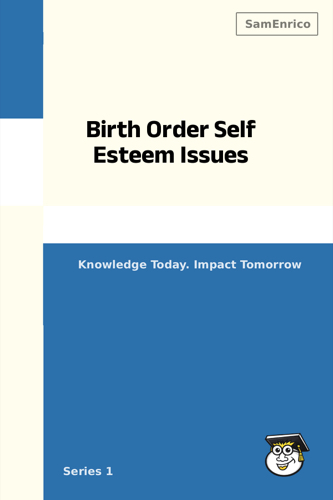
Birth Order Self Esteem Issues eBook
Heal from firstborn pressure, middle child invisib
Heal from firstborn pressure, middle child invisibility, or youngest infantilization.
Formats
Free sample
Chapter 1: The Unwritten Script...--You were assigned a role before you could speak. Before you had words for “unfair” or “lonely” or “exhausted,” your family had already decided who you were. The responsible one. The easy one. The difficult one.
The one who doesn’t need much. The one who needs too much. These were not descriptions of your inherent nature. They were instructions. And you have been following them your entire life without ever seeing the page.This is the central paradox of birth order self-esteem issues: the traits you think are your personality are often just survival strategies that worked in your childhood home.
You are not fundamentally anxious because of your DNA. You learned anxiety because vigilance kept you safe. You are not fundamentally a people-pleaser because you were born without boundaries. You learned that agreement earned you the only attention available. You are not fundamentally irresponsible or “the baby.” You learned that helplessness was the only way to be held.The problem is that these strategies worked brilliantly on your family’s stage.
And then you carried them into adulthood, where they stopped working. Where they started costing you. Where the very behaviors that earned you love in your childhood home began to erode your self-esteem, your relationships, and your sense of who you actually are beneath the script.This chapter is about seeing that script for the first time. Not to blame your family. Not to rewrite history.
But to recognize that you have been performing a role so long that you forgot it was a performance. And once you see the script, you have a choice you never had as a child: you can keep it, revise it, or set it down entirely.The Theater of Your Origin Every family is a theater, though no one calls it that. The stage is set before you arrive—existing dynamics between your parents, perhaps older siblings, the economic and cultural context that shapes what your family values. When you enter, the other actors (your parents, your siblings) immediately begin assigning you a role based not on who you are but on where you fit into their existing production.If you are the firstborn, you are cast as the pioneer, the surrogate adult, the one who will carry the family’s ambitions. If you are a middle child, you are cast as the negotiator, the forgotten one, or sometimes the rebel who will do anything for a spotlight.
If you are the lastborn, you are cast as the baby, the mascot, the one who never quite needs to grow up. If you are an only child, you are cast as the entire audience—the sole recipient of every hope, every fear, every expectation.Here is what no one tells you: these roles are not chosen. They are imposed. And they are imposed so early that you internalize them as identity rather than assignment.The firstborn does not wake up one day and decide to be perfectionistic. She learns that her parents’ approval comes when she performs well, when she helps with the younger siblings, when she does not add to the family’s burden.
By the time she is five, “being good” and “being loved” have fused into a single, unbreakable chain. She is not anxious because she was born anxious. She is anxious because her role required constant vigilance, and her nervous system never received the memo that the requirement ended.The middle child does not decide to become invisible. He learns that his older sibling already occupies the “achiever” slot and his younger sibling occupies the “needy” slot. The only remaining territory is compromise, mediation, or eccentricity.
He becomes the easy one because easy is the only role that gets any positive response. Or he becomes the problem child because negative attention is better than none. Either way, his “personality” is a solution to a problem he did not create.The lastborn does not choose learned helplessness. She learns that everyone else is faster, stronger, more capable. Why tie your shoes when an older sibling will do it faster?
Why speak up when the family already assumes they know what you need? Her charm is real, but it is also a tool. If she cannot be competent, she will be delightful. If she cannot be taken seriously, she will be loved. The cage of infantilization is built from the very tenderness that was supposed to be freedom.The only child does not wake up desperate to be perfect.
He learns that there is no one else to absorb any of the family’s attention, any of its anxiety, any of its expectations. If he fails, there is no sibling to share the disappointment. If he succeeds, there is no sibling to share the pride. The spotlight never moves, and a spotlight that never moves eventually burns.None of this is your fault. And none of this is fixed.The Distinction That Changes Everything Before we go any further, we need to make a distinction that will serve as the foundation for every chapter that follows.
It is simple to state but difficult to internalize:Your birth order position is fixed. Your birth order strategies are not.Your position means you will always have been born first, second, third, fourth, or as an only child. No amount of therapy, success, or self-help will change the chronological fact of where you landed in your family. That fact matters. It shaped your early environment in ways that cannot be undone.But the strategies you developed because of that position—the perfectionism, the people-pleasing, the charm, the hyper-independence, the learned helplessness—those are not fixed.
They are adaptations. And adaptations can change when the environment changes.This is where most birth order books get stuck. They describe the patterns beautifully. They make you feel seen. But they accidentally imply that your firstborn anxiety is permanent, that your middle-child invisibility is a life sentence, that your lastborn helplessness is just who you are.
That is not true. That is the script speaking.You cannot change that you were the oldest. You can absolutely change that you panic when you rest.You cannot change that you had an older sibling who overshadowed you. You can absolutely change that you still shrink in meetings expecting to be overlooked.You cannot change that you were treated as the baby. You can absolutely change that you wait for someone else to solve your problems.You cannot change that you grew up without siblings.
You can absolutely change that you struggle to share attention in your adult relationships.The position is history. The strategies are habits. History is permanent. Habits are malleable.The Strategic Self vs. The Authentic Self If the strategies are not your true identity, then who are you beneath them?
This chapter introduces a second distinction that will run through the entire book: the difference between your strategic self and your authentic self.Your strategic self is the persona you developed to survive your family system. It is the mask you learned to wear, the lines you learned to deliver, the emotional posture that kept you safe. The strategic self is not fake…
This is the end of the free sample. Get the eBook to keep going. Buy now
About this book
Details
- Author
- Naquin Elidia
- Publisher
- SamEnrico
- Language
- English
- Genre
- Non-Fiction, Self-Help
- Released
- 2026-06-10
- Pages (approx.)
- 152
- Available as
- eBook, Audiobook

Read better in the ZLOADR app
Your eBooks on your phone or tablet. Sign in with your SamEnrico account and start reading.
More by Naquin Elidia
 E Commerce Persuasion GuideNaquin Elidia$11.99
 The First Five Minutes ManualNaquin Elidia$11.99
 Bereavement Leave GuideNaquin Elidia$11.99
 Nightmare Processing Art TherapyNaquin Elidia$11.99
 Presentation Skills Dubai GuideNaquin Elidia$11.99
 Perfectionism Anger TriggersNaquin Elidia$11.99
 Composite Sketch FallibilityNaquin Elidia$11.99
 The Silk Rebellion: How Shanghai's Fashion Revolution Defied Colonial Rule (1920s)Naquin Elidia$11.99
 Filarete and the Golden Gates of Florence: A Renaissance Vision in BronzeNaquin Elidia$11.99
 A Collector's Handbook to the Daimler Es24Naquin Elidia$11.99
 Variable vs Fixed Rate Loan Decision GuideNaquin Elidia$12.99
 SMS Based Freemium ExtensionsNaquin Elidia$12.99
You may also like
 Hong Kong Handover 1997Dunn Johnnie$11.99
 Zumba For Postnatal Recovery CourseNeal Christian$11.99
 Zumba for BeginnersLadner Nikia$11.99
 YouTube Comment Mining GuideHumes Pandora$12.99
 Worry Box MeditationCarlin Rudy$11.99
 Workplace Stress MeditationNguyen Lynn$11.99
 Workplace Stress and Sleep RepairHawley Ivory$11.99
 Workplace Perfectionism CureDelaney Jeffry$11.99
 Workplace Injustice Anger GuideWallen Isabelle$11.99
 Work Addiction and Burnout LinkGreenwood Ester$11.99
 Women in Yoga and WellnessBeattie Galina$11.99
 Women in Stand Up ComedyChun Evangeline$11.99