
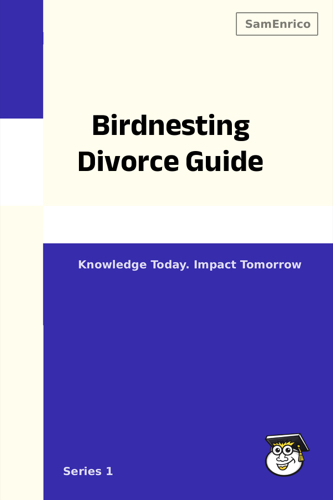
Non-FictionSelf-HelpBirdnesting
Birdnesting Divorce Guide eBook
Alternative living arrangement where children stay
by See Donita
Alternative living arrangement where children stay in one home.
Formats
Free sample
Chapter 1: The Litmus Test--Every year, over one million children in the United States experience the divorce of their parents. For most of them, the first thing they lose is not their father's daily presence or their mother's morning smile. The first thing they lose is their bedroom. Then their school. Then their friends.
Then their soccer field. Then the tree they climbed last Tuesday. Then the crack in the sidewalk where they tripped and scraped their knee. Then everything.You picked up this book because you want to prevent that. You want your children to lose as little as possible.
You have heard about a strange arrangement called birdnesting—where the kids stay in the family home and the parents take turns living there—and you are wondering if it could work for your family. Perhaps a friend mentioned it. Perhaps you saw an article about a celebrity doing it. Perhaps your therapist suggested it as a possibility. Whatever brought you here, you are asking the right question: Is there a way to separate from my partner without separating my children from their entire world?The answer is yes.
But not for everyone. And not without significant preparation.This chapter will give you something most divorce books never offer: permission to stop. Before we spend a single page on schedules, agreements, or communication strategies, you need to know whether birdnesting is even safe or appropriate for your specific family. Because the worst possible outcome is not failing at nesting. The worst possible outcome is succeeding at nesting when you should never have started.What Is Birdnesting, Exactly?Let us begin with a clear, consistent definition that will serve as the foundation for every chapter that follows.
Birdnesting—also called nesting or bird's nest custody—is a temporary, child-centered living arrangement in which the children remain in the family home full-time while the parents take turns living there and staying elsewhere during their off-duty time.The metaphor comes from nature. In a bird's nest, the baby birds stay put. The parent birds come and go, bringing food and warmth, but the nest itself never moves. Your children are the baby birds. The family home is the nest.
You and your co-parent are the adult birds, rotating in and out on a predictable schedule.Here is what birdnesting is not. It is not a permanent custody solution. It is not a cheaper alternative to divorce. It is not a way to avoid telling your children that you are separating. It is not a strategy for high-conflict couples who cannot be in the same room without arguing.
And it is certainly not a way to keep one foot in the marriage while pretending to leave.Birdnesting is a bridge. A temporary bridge that typically lasts between six and twelve months. Its sole purpose is to protect your children from the immediate trauma of shuttling between two homes during the most vulnerable period of the separation. It gives everyone time to adjust. It gives you and your co-parent time to establish new living situations without forcing your children to pack a suitcase every weekend.
And then it ends.The Primary Goal: Eliminating the Trauma of Shuttling Before we go any further, we need to be honest about what children actually experience during a traditional divorce. When parents separate and immediately establish two separate households, the children become nomads. They pack a bag every Thursday night or Sunday afternoon. They forget their favorite stuffed animal at Dad's apartment. They leave their math homework at Mom's house.
They celebrate Thanksgiving in a rental kitchen and Christmas in a living room that smells like someone else's candles.Research consistently shows that this constant shuttling is one of the most stressful aspects of divorce for children. It is not the absence of the non-custodial parent that causes the most daily distress. It is the logistics. It is the back-and-forth. It is the feeling of never being fully home anywhere.Birdnesting eliminates that stress entirely because the children never move.
Their bedroom is always their bedroom. Their toothbrush is always in the same bathroom. Their school bus picks them up from the same corner. Their friends knock on the same door. The only thing that changes is which parent is there to answer it.This stability is the entire point.
When parents choose to nest, they are saying to their children: Your world will not explode. Your room will not disappear. Your routines will continue. We, the adults, will absorb the disruption so you do not have to.But here is the hard truth that many books gloss over. Nesting is not gentle on the parents.
You will become nomadic. You will live out of duffel bags. You will eat dinner in a quiet apartment while your children eat in the family home with your ex. You will feel like a visitor in your own life. And if you and your co-parent have unresolved conflict, nesting will amplify it rather than resolve it.That is why the next section of this chapter is the most important part of this entire book.The Co-Parenting Litmus Test: A Brutally Honest Self-Assessment Before you read another page, you need to take the Co-Parenting Litmus Test.
This is not a suggestive questionnaire. This is a diagnostic tool designed to identify whether birdnesting is safe, appropriate, and likely to succeed for your specific family.Answer each question honestly. Do not answer based on how you wish things were. Answer based on how things actually are right now, in this moment, during this separation.Section A: Safety and Non-Negotiables Question 1: Has there ever been physical violence between you and your co-parent, including pushing, shoving, hitting, or throwing objects?If yes, stop reading. Birdnesting is not safe for you.
Do not proceed.Question 2: Has there ever been sexual coercion or assault within your relationship?If yes, stop reading. Birdnesting is not safe for you. Do not proceed.Question 3: Does either parent currently struggle with untreated substance abuse (alcohol, prescription drugs, or illegal substances) that impairs their ability to parent?If yes, stop reading. Birdnesting is not safe for your children. Do not proceed.Question 4: Has either parent been diagnosed with a severe personality disorder (such as borderline, narcissistic, or antisocial personality disorder) that remains untreated or poorly managed?If yes, stop reading.
Birdnesting is unlikely to succeed and may cause significant harm. Do not proceed.If you answered yes to any of the four questions above, this book is not for you. Not because you are a bad parent, but because birdnesting requires a baseline level of safety and emotional regulation that these situations preclude. Please close this book and seek guidance from a domestic violence advocate, addiction specialist, or mental health professional who can help you create a safe separation plan that prioritizes your children's physical and emotional safety above all else.Section B: Conflict and Communication If you answered no to all four safety questions, proceed to Section B.Question 5: On a scale of 1 to 10, with 1 being "we never argue" and 10 being "every conversation becomes a screaming match," where would you rate your current conflict level?If your answer is 7 or higher…
This is the end of the free sample. Get the eBook to keep going. Buy now
About this book
Details
- Author
- See Donita
- Publisher
- SamEnrico
- Language
- English
- Genre
- Non-Fiction, Self-Help, Birdnesting
- Released
- 2026-06-06
- Pages (approx.)
- 144
- Available as
- eBook, Audiobook

Read better in the ZLOADR app
Your eBooks on your phone or tablet. Sign in with your SamEnrico account and start reading.
More by See Donita
 The Creative FamineSee Donita$11.99
 Pomodoro Technique Distraction Control WorkbookSee Donita$11.99
 Psychology Essay PromptsSee Donita$11.99
 The Sleep Chronotype Memory GuideSee Donita$11.99
 The Hydaspes Gambit: Alexander’s Last Stand in IndiaSee Donita$11.99
 Retail Strategic BuyersSee Donita$12.99
 QuickBooks Accountant AccessSee Donita$12.99
 Understanding Placenta NeoplasmSee Donita$17.99
 How to Start a Operation of Recreational Transport Facilities E.g. Marinas Business (Beginners GuideSee Donita$11.99
 AstronomerSee Donita$11.99
You may also like
 Hong Kong Handover 1997Dunn Johnnie$11.99
 Zumba For Postnatal Recovery CourseNeal Christian$11.99
 Zumba for BeginnersLadner Nikia$11.99
 YouTube Comment Mining GuideHumes Pandora$12.99
 Worry Box MeditationCarlin Rudy$11.99
 Workplace Stress MeditationNguyen Lynn$11.99
 Workplace Stress and Sleep RepairHawley Ivory$11.99
 Workplace Perfectionism CureDelaney Jeffry$11.99
 Workplace Injustice Anger GuideWallen Isabelle$11.99
 Work Addiction and Burnout LinkGreenwood Ester$11.99
 Women in Yoga and WellnessBeattie Galina$11.99
 Women in Stand Up ComedyChun Evangeline$11.99