
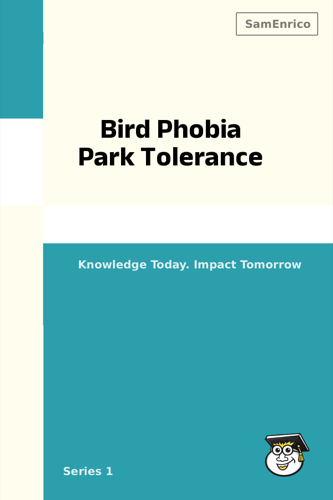
Bird Phobia Park Tolerance eBook
Walk near pigeons and waterfowl without panic usin
Walk near pigeons and waterfowl without panic using distance-based hierarchies.
Formats
Free sample
Chapter 1: The Hidden Geometry--–- Every phobia has a secret architecture. Most people never see it because they are too busy running away. They cross streets, switch sidewalks, decline picnic invitations, and pretend they do not mind taking the long way home. But beneath every panic attack, every flinch, every sudden detour around a strutting pigeon or a placid duck, there is a hidden geometry of fear—measured in feet, inches, and the precise distance at which your brain decides that a five-ounce bird has become a lethal threat.This book is not about loving birds. It is not about holding them, feeding them, or learning to appreciate the delicate iridescence of a pigeon's neck feathers.
You do not need to become a bird watcher. You do not need to name the ducks at your local pond or feel a warm glow when a goose waddles past your bench. What you need—and what this book will give you—is the ability to walk through a park without your heart trying to escape your ribcage. You need to sit on a bench without scanning the horizon for approaching flocks. You need to stop calculating escape routes every time you see a wing flap.This is a book about tolerance, not love.
And tolerance begins with understanding the hidden geometry of your fear.The Six Percent Let us start with a number: six. According to clinical research compiled in Overcoming Animal and Insect Phobias by Antony and Mc Cabe, approximately six percent of the global population suffers from a diagnosed animal phobia. Among those, birds—specifically pigeons, geese, ducks, and seagulls—consistently rank in the top five most common triggers. That means if you are reading this sentence, you are one of roughly 480 million people worldwide who share this specific neurological wiring. You are not strange.
You are not broken. You are not the only person who has ever crossed a street to avoid a pigeon.Yet despite how common this fear is, it remains one of the most stigmatized phobias. Tell someone you are afraid of spiders, and they nod sympathetically. Tell someone you are afraid of snakes, and they recall Indiana Jones. But tell someone you are afraid of pigeons, and they laugh.
They point out that pigeons are everywhere. They remind you that pigeons cannot hurt you. They may even chase a pigeon toward you as a joke, believing they are helping you by demonstrating how harmless the bird truly is.This laughter is not cruelty. It is ignorance. People who do not have a bird phobia cannot understand what it feels like because the trigger seems so absurdly small.
A pigeon weighs less than a pound. A mallard duck rarely exceeds three pounds. A Canada goose, the largest common waterfowl in most urban parks, tops out at around fourteen pounds—less than a small housecat. From the outside, the fear looks ridiculous. From the inside, it feels like survival.The Uncanny Valley of Feathers To understand why birds trigger such an intense response, we have to look beyond the rational mind and into the ancient, pre-verbal parts of the brain.
The human amygdala—two almond-shaped clusters of neurons deep within the temporal lobes—does not care about logic. It does not care that pigeons have never killed a human being in recorded history. It does not care that ducks are more likely to be eaten by you than to eat you. What the amygdala cares about is pattern recognition, speed, and survival.The chapter introduces a concept we will return to throughout this book: the Uncanny Valley of Avian Movement. You may have heard of the uncanny valley in robotics—the unsettling feeling people get when a humanoid robot looks almost but not quite human.
Birds produce a similar effect, but with movement instead of appearance.Consider how a dog moves. A dog walking toward you follows a predictable trajectory. Its head stays relatively stable. Its legs move in a consistent rhythm. Even a growling dog gives you warning signs: bared teeth, raised hackles, a stiff tail.
Your brain can read these signals because they follow rules.Now consider a pigeon. A pigeon does not walk. It struts, bobbing its head forward and backward with each step—a motion that evolved to stabilize its visual field but appears jerky and unnatural to the human eye. A pigeon does not turn its head like a mammal. It rotates it in sharp, mechanical increments, sometimes nearly 180 degrees, as if its neck contains gears instead of vertebrae.
And a pigeon does not take off like an airplane. It explodes upward without warning, wings clapping against air, often directly away from a perceived threat—which, if you are standing nearby, means directly toward you.Ducks are no better. A duck floating on water appears peaceful, almost hypnotic. Then it vanishes beneath the surface without a ripple, resurfacing seconds later in a completely different location. To your primitive brain, this looks exactly like a predator ambush.
Something was there. Then it was not. Then it was somewhere else. Threat detected.Geese add hissing to the equation. A hissing goose triggers the same auditory alarm as a snake—one of the oldest fear responses in the mammalian brain.
Never mind that a goose hisses for the same reason a cat hisses: to scare you away without actually fighting. Your amygdala does not make that distinction. It hears the hiss and floods your system with cortisol before you have time to think.This is the hidden geometry of bird phobia. It is not about the bird itself. It is about the unpredictability of the bird's movement, the suddenness of its transitions, and the primitive cues (hissing, sudden disappearance, explosive takeoff) that tap directly into evolutionary alarm circuits.The False Alarm Let us be precise about what is happening in your brain during a phobic reaction.
We will explore the full biology in Chapter 3, but for now, understand this: a phobia is not a broken brain. It is a brain that is working exactly as designed—but in the wrong context.Your ancestors who jumped at sudden movements survived. Your ancestors who remained calm when something rustled in the grass did not pass on their genes. Evolution selected for a hair-trigger startle response because the cost of a false alarm (wasting energy, feeling embarrassed) was far lower than the cost of a missed alarm (being eaten). You are descended from the jumpers, the flinchers, the people who ran first and asked questions later.That evolutionary logic made perfect sense on the savanna.
It makes no sense in a city park. There are no predators lurking in the shrubbery of Central Park. The pigeon on the bench is not assessing your nutritional value. The duck in the pond has never attacked a human being in its entire genetic lineage. Your brain is running ancient software in a modern environment, and the result is a series of false alarms.A false alarm is still real.
The panic you feel is genuine. Your heart really is racing. Your palms really are sweating. Your legs really are trembling. The physiological response is identical to a true threat.
The only difference is the cause. And that difference matters because it means you can retrain your brain to stop…
This is the end of the free sample. Get the eBook to keep going. Buy now
About this book
Details
- Author
- Mccurdy Ailene
- Publisher
- SamEnrico
- Language
- English
- Genre
- Non-Fiction, Health & Wellness
- Released
- 2026-06-09
- Pages (approx.)
- 134
- Available as
- eBook, Audiobook

Read better in the ZLOADR app
Your eBooks on your phone or tablet. Sign in with your SamEnrico account and start reading.
More by Mccurdy Ailene
 The Senior Technology Confidence CourseMccurdy Ailene$11.99
 Sexual Addiction Relapse DrillsMccurdy Ailene$11.99
 Gaming and Physical HealthMccurdy Ailene$11.99
 The Anxiety Sound MeditationMccurdy Ailene$11.99
 The School Hostage CrisisMccurdy Ailene$11.99
 Music for Study FocusMccurdy Ailene$11.99
 The Silk Road's Shadow Brokers: How Spices Shaped EmpiresMccurdy Ailene$11.99
 Bankruptcy Mediation ParticipationMccurdy Ailene$11.99
 Dino Detectives: The Secret of the Crystal TeethMccurdy Ailene$11.99
 The Mineral Guide to Anyolite (Metamorphic Rock Zoisite, Ruby, and Hornblende)Mccurdy Ailene$11.99
 Capital Allocation for TradersMccurdy Ailene$11.99
 Growing Darwinia (Scent Myrtle)Mccurdy Ailene$11.99
You may also like
 Hong Kong Handover 1997Dunn Johnnie$11.99
 Zumba For Postnatal Recovery CourseNeal Christian$11.99
 Zumba for BeginnersLadner Nikia$11.99
 YouTube Comment Mining GuideHumes Pandora$12.99
 Worry Box MeditationCarlin Rudy$11.99
 Workplace Stress MeditationNguyen Lynn$11.99
 Workplace Stress and Sleep RepairHawley Ivory$11.99
 Workplace Perfectionism CureDelaney Jeffry$11.99
 Workplace Injustice Anger GuideWallen Isabelle$11.99
 Work Addiction and Burnout LinkGreenwood Ester$11.99
 Women in Yoga and WellnessBeattie Galina$11.99
 Women in Stand Up ComedyChun Evangeline$11.99