
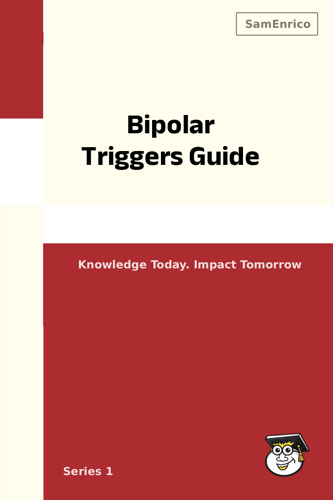
Non-FictionHealth & Wellness / Triggers
Bipolar Triggers Guide eBook
undefined
by Barrett Tina
undefined
Formats
Free sample
Chapter 1: The Kindling Point--–- The first time my patient Sarah landed in the psychiatric emergency room, she had been awake for seventy-two hours. She had painted her entire apartment ceiling gold, called seventeen friends before 3 AM to announce her new business selling handmade dreamcatchers, and genuinely believed she had discovered a hidden algorithm that would solve climate change. The attending psychiatrist diagnosed mania with psychotic features, prescribed lithium, and sent her home with a referral. Sarah took the medication for three months, felt “back to normal,” and stopped.The second time Sarah landed in the ER, she had been awake for only thirty-six hours. The trigger was smaller: a last-minute deadline at her graphic design job, three cups of coffee after 2 PM, and an argument with her sister about holiday plans.
The episode was identical in intensity to the first—gold ceiling paint, 3 AM phone calls, climate change algorithms. But the trigger had been weaker. Sarah did not understand why her brain seemed to be getting more sensitive. She felt like she was failing at stability.The third time, she had slept only five hours instead of her usual seven—a single night of mild sleep loss. No caffeine after noon.
No major argument. Just one slightly short night of sleep. She woke up the next morning convinced she could fly. Not metaphorically. She lived on the fourteenth floor.Sarah’s story is not rare.
It is the rule.This chapter introduces the single most important concept in trigger management: the kindling theory. Understanding this mechanism transforms trigger identification from a vague self-help exercise into a neurological necessity. By the end of this chapter, you will understand why your brain becomes more sensitive to triggers over time, why medication alone cannot solve this problem, how to distinguish between a fleeting mood and a clinical episode, and what to do when a medication side effect masquerades as a mood swing. Most critically, you will learn that identifying triggers is not a moral failing or a sign of weakness—it is basic neurological self-defense.The Kindling Theory: Why Your Brain Learns to Burn The term “kindling” comes from epilepsy research. If you stimulate a mouse’s brain with a small electrical charge—too small to cause a seizure—nothing happens.
Do it again the next day. Still nothing. But if you repeat that same sub-threshold stimulation daily for weeks, something changes. Eventually, that same tiny charge triggers a full seizure. The brain has learned to seize.
The seizure threshold has lowered permanently.Bipolar disorder follows the same logic.Every mood episode—even a mild one, even a brief one, even one you barely notice—leaves a trace on your brain. That trace is called synaptic potentiation, which is a fancy way of saying that the neural pathways involved in that episode become stronger and more efficient. Your brain is a learning machine. When you have a manic or depressive episode, your brain learns to have that episode more easily the next time.This is not a metaphor. Neuroscientists have observed this phenomenon using functional MRI scans in people with bipolar disorder.
Compared to healthy controls, individuals with bipolar show increased activation in the amygdala (the brain’s threat and emotion center) and decreased activation in the prefrontal cortex (the brain’s braking system) in response to emotional stimuli. Each episode widens this imbalance.Here is what this means for your daily life.Let us say your first manic episode was triggered by a major life event: a divorce, a death, a job loss, a cross-country move. The trigger was enormous. You needed that much stress to push your brain over the threshold. After that episode, your threshold lowered slightly.
Now, a moderately stressful event—a fight with your partner, a financial setback, a week of poor sleep—could trigger a second episode. After the second episode, your threshold lowers further. Eventually, a minor inconvenience—a rude email, a skipped meal, a single night of five hours of sleep—can trigger a full episode.This is why Sarah’s triggers got smaller while her episodes stayed equally severe. Her brain had kindled.The kindling theory explains three mysteries that baffle many people with bipolar disorder. First, it explains why your episodes might seem to come “out of nowhere” despite years of stability.
They are not coming from nowhere. They are coming from episodes you had five or ten years ago that permanently lowered your threshold. Second, it explains why early intervention is so critical. Every episode you prevent is not just a good month—it is a permanent protection of your future threshold. Third, it explains why trigger management becomes more important, not less, over time.
As your threshold lowers, the margin for error shrinks.A critical clarification is needed here. Kindling does not mean you are doomed. It means you are informed. Knowing that your brain has become more sensitive is not a life sentence; it is a user manual. You now know that small triggers matter.
You now know that skipping one night of sleep is not a minor indulgence. You now know that the work of trigger management is not overreaction—it is proportional to your brain’s current sensitivity.Mood Versus Episode: The Most Important Distinction You Will Ever Make Before we go any further, we need to establish a distinction that will appear in every subsequent chapter of this book. It is the difference between a mood and an episode.A mood is a fleeting emotional state that lasts hours, responds to distraction or comfort, and does not significantly impair your ability to function. You feel sad because you received bad news. An hour later, you watch a funny video and feel better.
That is a mood. You feel irritable because you are hungry. You eat lunch and feel better. That is a mood. You feel elated because you got a promotion.
The feeling fades by dinner. That is a mood.An episode is a sustained clinical state that lasts days or weeks, does not respond to simple distraction or comfort, and significantly impairs your ability to function in work, relationships, or self-care. You feel sad every day for two weeks. Nothing helps—not funny videos, not comforting words from friends, not your favorite activities. You stop showering.
You stop eating. That is a depressive episode. You feel elated and energetic for four days. You sleep only three hours per night but feel fully rested. You start five new projects.
You spend money you do not have. Friends tell you to slow down, but you feel they are the ones with the problem. That is a hypomanic or manic episode depending on severity and duration.Why does this distinction matter for trigger management?Because triggers push you from mood to episode. The trigger is the spark. The episode is the fire.
Your goal is to identify and extinguish the spark before it becomes a fire. This requires you to notice the difference between a normal mood fluctuation (which does not require intervention beyond basic self-care) and a prodromal symptom (which requires immediate action).Here is a practical rule of thumb that we will expand in Chapter 9. A…
This is the end of the free sample. Get the eBook to keep going. Buy now
About this book
Details
- Author
- Barrett Tina
- Publisher
- SamEnrico
- Language
- English
- Genre
- Non-Fiction, Health & Wellness / Triggers
- Released
- 2026-06-10
- Pages (approx.)
- 157
- Available as
- eBook, Audiobook

Read better in the ZLOADR app
Your eBooks on your phone or tablet. Sign in with your SamEnrico account and start reading.
More by Barrett Tina
 Daycare Toxin Prevention GuideBarrett Tina$11.99
 Arthritis Cycling BenefitsBarrett Tina$11.99
 PFAS Forever Chemicals PreventionBarrett Tina$11.99
 Gluten And Skin Rashes GuideBarrett Tina$11.99
 Dream Drawing MethodBarrett Tina$11.99
 Transcendental Meditation for First RespondersBarrett Tina$11.99
 Exfoliation Anti Aging Routine HandbookBarrett Tina$11.99
 Crisis PR Consultant StressBarrett Tina$11.99
 The Hollow Shield: Thermopylae's Forgotten Brothers (480 BC)Barrett Tina$11.99
 The Great Wall of China: A Brick-by-Brick AdventureBarrett Tina$11.99
 The Druids of the Waves: Celtic Mariners and the Birth of Atlantic NavigationBarrett Tina$11.99
 The Dancer's Guide to TecktonikBarrett Tina$11.99
You may also like
 Hong Kong Handover 1997Dunn Johnnie$11.99
 Zumba For Postnatal Recovery CourseNeal Christian$11.99
 Zumba for BeginnersLadner Nikia$11.99
 YouTube Comment Mining GuideHumes Pandora$12.99
 Worry Box MeditationCarlin Rudy$11.99
 Workplace Stress MeditationNguyen Lynn$11.99
 Workplace Stress and Sleep RepairHawley Ivory$11.99
 Workplace Perfectionism CureDelaney Jeffry$11.99
 Workplace Injustice Anger GuideWallen Isabelle$11.99
 Work Addiction and Burnout LinkGreenwood Ester$11.99
 Women in Yoga and WellnessBeattie Galina$11.99
 Women in Stand Up ComedyChun Evangeline$11.99