
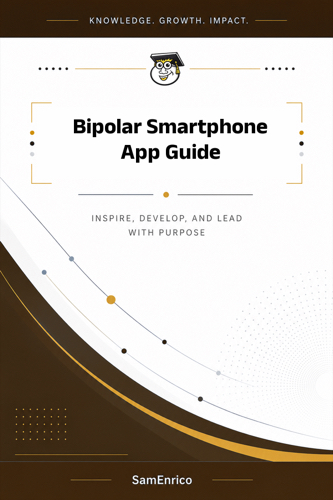
Non-FictionHealth & WellnessDigital Health
Bipolar Smartphone App Guide eBook
Use mood tracking and medication reminder apps to
Use mood tracking and medication reminder apps to stabilize bipolar symptoms effectively.
Formats
Free sample
Chapter 1: The Data Doesn't Lie--–- The first time I almost stopped tracking my mood, I was standing in a pharmacy parking lot, holding a bottle of lithium I had no intention of opening. I felt fine. Better than fine—I felt electric, clear-headed, productive. I had slept four hours the night before and woke up ready to reorganize my entire garage at 5 AM. My brain was whispering a very convincing lie: You don't have a disorder.
You have drive. Those doctors just wanted to sedate you.Three weeks later, I was in a psychiatric ward, having spent $7,000 on art supplies I would never use, sent thirty-seven incoherent emails to my boss, and frightened my partner so badly that she called 911 when she found me pacing the kitchen at 2 AM reciting poetry I had written in a single breath. The mania had arrived exactly as it always did—not as a thunderclap, but as a gentle seduction. And I had walked right into it because I trusted my feelings instead of my data.This book exists because I finally learned that lesson the hard way. Your bipolar brain will lie to you.
It will tell you that you're fine when you're not. It will tell you that your medications are poison when they're saving your life. It will tell you that you just have "a lot of energy" when you are, in fact, detaching from reality. The only thing that cuts through those lies is cold, hard, timestamped data—the kind your smartphone can collect effortlessly if you set it up correctly.This is not a book about becoming obsessed with your phone. It is a book about turning your phone into a medical instrument—like a thermometer for your mood, a blood pressure cuff for your sleep, a glucose monitor for your medications.
And it starts with a radical proposition: your feelings are not reliable, but your data is.The Smartphone Paradox: Trigger or Tool?Let me ask you a question that might make you uncomfortable. How many times today have you picked up your phone without intending to? Scrolled through an app, then closed it, then opened the same app again thirty seconds later? Felt a little worse after seeing someone's highlight reel on social media? Stayed up later than you meant to because you were watching videos that left you feeling empty?That is passive consumption.
It is the enemy of bipolar stability. The algorithms that power social media, news feeds, and short-form video platforms are designed to maximize engagement by triggering emotional reactions—outrage, envy, fear, excitement. For a brain with bipolar wiring, these emotional spikes are not just unpleasant. They are destabilizing. They can push you toward hypomania (if the content excites you) or depression (if it shames or exhausts you).But there is another way to use your phone.
It is called active, structured tracking. Instead of letting your phone hijack your attention, you deliberately use it to record your state—your sleep hours, your mood score, your medication compliance, your energy level, your physical symptoms. This is not passive scrolling. This is data collection. And it works.The JAMA Psychiatry Live Well study followed 447 adults with bipolar disorder over two years.
Half received standard care. Half received standard care plus access to a smartphone app designed for mood and sleep tracking. The results were striking: the app-assisted group had significantly lower relapse rates, fewer hospitalizations, and better medication adherence. Why? Because they caught early warning signs—sleep dips, mood elevation, medication gaps—before those warning signs became full episodes.Your phone is not inherently good or bad for bipolar disorder.
It is a tool. A hammer can build a house or smash a window. A phone can destabilize you through passive scrolling or stabilize you through active tracking. The difference is intentionality.The Fundamental Problem: Your Brain Is Lying to You Here is something that took me years to understand, and that most psychiatrists do not explain clearly enough. Bipolar disorder is not just a mood disorder.
It is a disorder of insight.During a depressive episode, your brain will tell you that you have always been depressed, that you will always be depressed, and that nothing you do matters. None of these things are true. But in that moment, they feel absolutely, irrefutably real.During a manic or hypomanic episode, your brain will tell you that you are finally free, that the medications were holding you back, that you are special, creative, and unstoppable. These feelings are seductive precisely because they feel good. But they are also lies.
Mania damages the brain. It destroys relationships, finances, and careers. It is not a gift—it is a neurological fire.The cruelest part of bipolar disorder is that the very episodes that destroy your life also destroy your ability to recognize that you are in an episode. This is called anosognosia—a fancy word for a simple, devastating fact: when you are sick, you cannot tell that you are sick.So how do you know the truth? You do not trust your feelings.
You trust your data.If your app tells you that you have slept an average of 4.2 hours for five consecutive nights, you do not need to feel manic to know that you are at risk. The data is the data. If your medication log shows that you have missed three doses of lithium in the past week, you do not need to feel unstable to know that you are heading toward an episode. The data is the data.This is the core philosophy of this book, and it will appear in every chapter: external, timestamped data is more reliable than internal feelings during episodes.What This Book Will Teach You Over the next twelve chapters, you will learn a complete system for using your smartphone to stabilize bipolar symptoms. Here is a roadmap of what is coming:Chapter 2 establishes the Holy Trinity of tracking: sleep, mood, and medication.
You will learn how to score each one consistently and how to spot the patterns that predict episodes days or weeks before they arrive.Chapter 3 guides you through choosing the right app for your specific needs, privacy preferences, and budget. You will compare four leading apps—e Moods, Bipolar Journey, Bearable, and Mind Research—and learn how to audit any app for red flags.Chapter 4 tackles the single biggest cause of relapse: medication non-adherence. You will learn a two-tier reminder system that works even when your brain is telling you to stop your pills.Chapter 5 shows you how to turn your tracking data into a "Doctor's Report" that transforms your psychiatric appointments. Instead of saying "I think I've been okay," you will walk in with a six-month graph and three key observations.Chapter 6 moves beyond internal feelings to track external triggers: weather, menstrual cycles, caffeine, alcohol, exercise, and workload. You will discover hidden correlations that your memory would never catch.Chapter 7 explores the new frontier of AI-powered mood analysis—chatbots that can identify thinking traps and offer cognitive reframing.
You will also learn the Three Gates of AI Use to stay safe.Chapter 8 prepares you for crisis mode—when tracking itself becomes obsessive (mania)…
This is the end of the free sample. Get the eBook to keep going. Buy now
About this book
Details
- Author
- Anderson Roberto
- Publisher
- SamEnrico
- Language
- English
- Genre
- Non-Fiction, Health & Wellness, Digital Health
- Released
- 2026-06-08
- Pages (approx.)
- 135
- Available as
- eBook, Audiobook

Read better in the ZLOADR app
Your eBooks on your phone or tablet. Sign in with your SamEnrico account and start reading.
More by Anderson Roberto
 Research Proposal Data Management PlanAnderson Roberto$12.99
 Anxiety Based Distraction ControlAnderson Roberto$11.99
 Parent Loss Podcast Listening GuideAnderson Roberto$11.99
 Spin for AthletesAnderson Roberto$11.99
 The Fishing Boat PrisonerAnderson Roberto$11.99
 Obsidian Notes MemoryAnderson Roberto$11.99
 Multiple Choice StrategyAnderson Roberto$11.99
 EQ for Depression Coping GuideAnderson Roberto$11.99
 Child Loss Creative ExpressionAnderson Roberto$11.99
 Socrates and the Art of Questioning: The Birth of Western ThoughtAnderson Roberto$11.99
 The Silk Road Gambit: How a Cabinet Secretary Reshaped Global TradeAnderson Roberto$11.99
 The African Merchants of Rome: Wealth, Trade, and Philanthropy in the Eternal CityAnderson Roberto$11.99
You may also like
 Hong Kong Handover 1997Dunn Johnnie$11.99
 Zumba For Postnatal Recovery CourseNeal Christian$11.99
 Zumba for BeginnersLadner Nikia$11.99
 YouTube Comment Mining GuideHumes Pandora$12.99
 Worry Box MeditationCarlin Rudy$11.99
 Workplace Stress MeditationNguyen Lynn$11.99
 Workplace Stress and Sleep RepairHawley Ivory$11.99
 Workplace Perfectionism CureDelaney Jeffry$11.99
 Workplace Injustice Anger GuideWallen Isabelle$11.99
 Work Addiction and Burnout LinkGreenwood Ester$11.99
 Women in Yoga and WellnessBeattie Galina$11.99
 Women in Stand Up ComedyChun Evangeline$11.99