
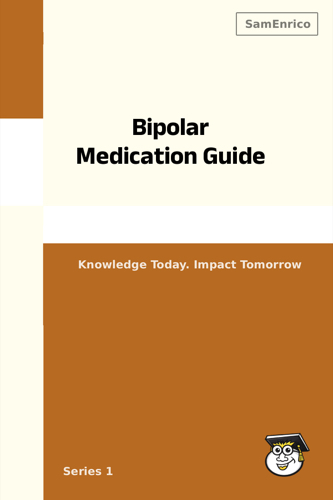
Non-FictionHealth & WellnessPsychopharmacology
Bipolar Medication Guide eBook
Understand mood stabilizers, antipsychotics, and a
Understand mood stabilizers, antipsychotics, and antidepressants with this practical guide.
Formats
Free sample
Chapter 1: The Epilepsy of Mood--–- You are not broken. You are not weak. And you did not cause this.If you are reading this book, chances are good that you or someone you love has received a diagnosis of bipolar disorder. Or perhaps no one has said those words yet, but you have suspected them for years. The crushing depressions that arrive without warning.
The periods of electric energy where sleep becomes optional, ideas race faster than you can write them down, and you feel, for the first time, like the person you were always meant to be. Then the crash. The shame. The desperate scrolling through old text messages to see what you said, whom you offended, what you spent, what you promised, what you broke.Let me tell you something that no one has told you clearly enough: bipolar disorder is not a character flaw. It is not a spiritual deficit.
It is not a failure of willpower. It is a medical condition of the brain, and like every other medical condition, it has treatments. Those treatments are called medications. And this book is the guide to understanding them, managing them, and finally—finally—building a life that does not revolve around the next episode.But before we talk about pills, dosages, and side effects, we have to talk about something more fundamental. We have to talk about why medication is not optional for bipolar disorder.
We have to talk about what happens to your brain when episodes go untreated. And we have to dismantle the single most dangerous myth in all of psychiatry.The Myth The myth sounds reasonable. It sounds like wisdom. It goes like this: "I don't want to be dependent on medication for the rest of my life. I want to handle this naturally.
Once I feel better, I'll stop the pills and just use therapy, diet, exercise, and mindfulness."This is the same logic as saying: "Once my blood sugar is normal, I'll stop insulin." Or: "Once my seizures stop, I'll stop the anticonvulsant." Or: "Once my blood pressure is healthy, I'll stop the beta-blocker."You see the problem. In every other branch of medicine, we understand that chronic conditions require chronic treatment. No one tells a patient with epilepsy that they should try harder to prevent their own seizures. No one tells a patient with Type 1 diabetes that they are weak for needing insulin. But in psychiatry, the rules are different.
And those different rules have killed people.Bipolar disorder is, in many ways, epilepsy of mood. A person with epilepsy has neurons in the brain that fire abnormally, creating a seizure. A person with bipolar disorder has mood circuits in the brain that fire abnormally, creating a manic or depressive episode. The mechanism is different, but the principle is identical: the brain has a disease, and medication stabilizes the abnormal firing. You cannot will yourself out of a manic episode any more than you can will yourself out of a grand mal seizure.Let me be absolutely clear.
Bipolar disorder is a medical illness. It has a biological basis. It runs in families. It changes the structure and function of the brain. And like every other medical illness, it requires medical treatment.The Kindling Theory Here is the most important scientific concept you will learn in this entire book.
It is called the kindling theory, and understanding it will save your life.The word "kindling" comes from what happens when you try to start a fire. You take small twigs and you expose them to a flame. The first time, it takes a while for the twigs to catch. The second time, it takes less time. The third time, it takes almost no time at all.
Eventually, the twigs have been "kindled" to the point where the smallest spark ignites a fire instantly.Your brain works the same way with mood episodes.The first time you experienced a manic or depressive episode, it may have been triggered by something major: a death in the family, a breakup, a major failure, a sleepless week, a new baby. Your brain was not yet "primed" for episodes, so it took a significant stressor to push you over the edge.The second episode required less of a trigger. Maybe just a missed night of sleep. The third episode required even less. Eventually, your brain becomes kindled to the point where episodes begin to happen on their own, with no trigger at all.
They become autonomous. Your brain learns how to have episodes the way a river learns how to flood.This is why early treatment matters so much. Every untreated episode makes the next episode easier to trigger and harder to treat. Every episode causes measurable damage to the brain, particularly to the hippocampus (memory center) and the prefrontal cortex (impulse control and decision-making). Bipolar disorder is not a static illness.
It is progressive. It gets worse over time if untreated.But here is the good news. The kindling process can be reversed. Medication—specifically mood stabilizers and atypical antipsychotics—cools the kindled brain. It raises the threshold for episodes, so that it takes more stress to trigger a mood swing.
And when episodes do occur, they are milder, shorter, and less damaging.This is why you cannot take a "holiday" from your medication. This is why you cannot stop when you feel better. Feeling better means the medication is working. Stopping it removes the protection and allows the kindling process to resume. And because of the rebound effect we will discuss in Chapter 12, stopping abruptly often triggers an episode far worse than anything you experienced before treatment.The Bipolar Spectrum Before we go any further, we need to make sure you understand what bipolar disorder actually is.
Most people have heard of "manic-depressive illness" and imagine something dramatic: someone laughing uncontrollably, spending their life savings, driving recklessly, and then collapsing into a week of catatonic depression. That happens. But it is only one part of the spectrum.Bipolar I Disorder: This is the classic form. To receive this diagnosis, you must have had at least one full manic episode lasting at least seven days, or a manic episode severe enough to require hospitalization. Mania is not just feeling happy or productive.
Mania is a state of elevated, expansive, or irritable mood that is clearly different from your baseline. It includes three or more of the following: grandiosity (believing you have special powers, talents, or connections), decreased need for sleep (feeling rested after three hours), pressured speech (talking so fast others cannot interrupt), racing thoughts or flight of ideas, distractibility, increased goal-directed activity (starting many projects, making many calls, writing many emails), and high-risk behavior (spending, sexual indiscretions, reckless driving, substance use). These symptoms cause marked impairment in functioning or require hospitalization to prevent harm to self or others. Psychosis (hallucinations or delusions) can occur in severe mania.Most people with Bipolar I also experience major depressive episodes, but the diagnosis can be made based on mania alone. The depressions are typically severe, with suicidal ideation common.Bipolar II Disorder: This is often missed or misdiagnosed as unipolar depression.
In Bipolar II, you have never had a full manic episode. Instead, you have had one or more hypomanic episodes…
This is the end of the free sample. Get the eBook to keep going. Buy now
About this book
Details
- Author
- Gladden Marinda
- Publisher
- SamEnrico
- Language
- English
- Genre
- Non-Fiction, Health & Wellness, Psychopharmacology
- Released
- 2026-06-06
- Pages (approx.)
- 150
- Available as
- eBook, Audiobook

Read better in the ZLOADR app
Your eBooks on your phone or tablet. Sign in with your SamEnrico account and start reading.
More by Gladden Marinda
 Bosnian Srebrenica EscapeGladden Marinda$11.99
 Subscription Service Adoption GuideGladden Marinda$11.99
 Sleep And IBS GuideGladden Marinda$11.99
 Scarcity Marketing TacticsGladden Marinda$11.99
 Gacy Death Row DrawingsGladden Marinda$11.99
 Night Stalker Car Jacking EscapeGladden Marinda$11.99
 Entrainment Failure TreatmentGladden Marinda$11.99
 The Nobel Deception: How a Forgotten Writer Fooled the Swedish AcademyGladden Marinda$11.99
 The Cadaver Heist: Canada's Most Audacious Body TheftGladden Marinda$11.99
 A Collector's Handbook to the Citroën Citroen 11 Légère (Sports 12, Light 15)Gladden Marinda$11.99
 Age Limits for Trade MigrationGladden Marinda$12.99
 Factoring for Government Contractors HandbookGladden Marinda$12.99
You may also like
 Hong Kong Handover 1997Dunn Johnnie$11.99
 Zumba For Postnatal Recovery CourseNeal Christian$11.99
 Zumba for BeginnersLadner Nikia$11.99
 YouTube Comment Mining GuideHumes Pandora$12.99
 Worry Box MeditationCarlin Rudy$11.99
 Workplace Stress MeditationNguyen Lynn$11.99
 Workplace Stress and Sleep RepairHawley Ivory$11.99
 Workplace Perfectionism CureDelaney Jeffry$11.99
 Workplace Injustice Anger GuideWallen Isabelle$11.99
 Work Addiction and Burnout LinkGreenwood Ester$11.99
 Women in Yoga and WellnessBeattie Galina$11.99
 Women in Stand Up ComedyChun Evangeline$11.99