
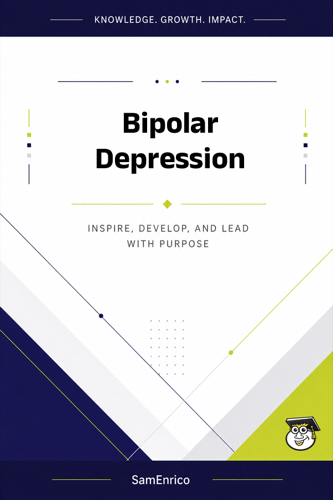
Bipolar Depression eBook
Distinguishes MDD from bipolar to avoid antidepres
Distinguishes MDD from bipolar to avoid antidepressant induced mania.
Formats
Free sample
Chapter 1: The Unseen Landmine...--–- Sarah was twenty-four years old, and she had been dying for eight years. Not the dramatic, cinematic kind of dying—no car crashes, no terminal diagnoses delivered in sterile hospital rooms. Her dying was the slow, humiliating kind. The kind where you stop returning texts, stop showering, stop being able to feel the warmth of sunlight on your skin. The kind where you lie in bed at two in the afternoon, wearing the same clothes you’ve worn for three days, and you think: This is not living.
But I don’t have the energy to die.By the time Sarah walked into Dr. Patel’s office, she had been prescribed six different antidepressants. Prozac. Zoloft. Wellbutrin.
Effexor. Cymbalta. Lexapro. Each one had been given to her by well-meaning doctors who looked at her symptoms—profound sadness, loss of interest, fatigue, suicidal thoughts—and did exactly what they had been trained to do. They diagnosed Major Depressive Disorder.
They wrote a prescription for an SSRI or an SNRI. They told her to come back in six weeks.Six weeks later, Sarah would return, unchanged or worse. So they would try another antidepressant. And another. And another.
Each failure was labeled “treatment-resistant depression.” Each new prescription came with a slightly more desperate tone: This one works differently. This one has a different mechanism. Don’t give up.Sarah didn’t give up. She tried them all. And somewhere along the way, something strange began to happen.
On some of the medications, she didn’t just feel unchanged—she felt worse in a completely new way. She became irritable. Snapping at her roommate for leaving dishes in the sink. Pacing her apartment at three in the morning, unable to sleep but also not tired. Her thoughts raced so fast she couldn’t finish a sentence.
She started three different online businesses in a single week, maxed out a credit card, and told her mother she had finally figured out the meaning of life.Her doctors saw this too. They called it “anxiety” and added a benzodiazepine. They called it “activation syndrome” and lowered the dose. They called it “bipolar features” but only in passing, never as a formal diagnosis, because Sarah had never been hospitalized, never been psychotic, never had what they thought of as real mania. She just had “bad reactions” to antidepressants.Then came the suicide attempt.
Sarah swallowed a bottle of her latest antidepressant—the one that was supposed to be different—and woke up in an ICU three days later. That was when she met Dr. Patel, a psychiatrist who asked different questions.“Tell me about your sleep during depressions,” Dr. Patel said.Sarah hesitated. “I sleep.
A lot. Twelve, sometimes fourteen hours. But I wake up exhausted.”Dr. Patel nodded. “That’s called hypersomnia.
It’s unusual in typical depression.”“What about your family?” Dr. Patel asked. “Has anyone in your family ever had extreme mood swings? Periods of high energy, little need for sleep, reckless behavior?”Sarah thought for a moment. “My uncle.
My mother’s brother. He was diagnosed with something. Bipolar, I think. But he was ‘crazy.’ I’m not crazy. I’m just depressed.”Dr.
Patel set down his pen. “Sarah, you have bipolar II disorder. You’ve had it for eight years. The antidepressants you’ve been taking haven’t been treating your illness. They’ve been making it worse.”That was the moment everything changed.The 40 Percent Sarah’s story is not unusual.
It is, in fact, so common that it has become a silent epidemic within psychiatry. Studies consistently show that approximately 40 percent of people diagnosed with major depressive disorder actually have bipolar disorder—most commonly bipolar II, the subtype in which depression dominates and hypomania is mild enough to be mistaken for “feeling better” or “finally getting things done.”Let that number sink in. Forty percent. Nearly half of the people walking around with a “depression” diagnosis are carrying the wrong label. And because they have the wrong label, they are receiving the wrong treatment.
The standard treatment for depression—antidepressant medications—is not merely ineffective for bipolar depression. It is actively dangerous.The data on this danger is robust and, for anyone paying attention, alarming. Among people with true unipolar major depressive disorder, the risk of switching into mania or hypomania when taking an antidepressant is approximately 3 percent. That is a small, manageable risk. But among people with an underlying bipolar diathesis—a brain wired for mood instability—the risk of antidepressant-induced mania (AIM) jumps to 10 to 40 percent, depending on the specific medication, the bipolar subtype, and the presence of a mood stabilizer.Ten to forty percent.
Those are not rare side effects. Those are predictable, pharmacodynamic events. When you give an antidepressant to a bipolar brain, you are not gently lifting mood. You are pouring gasoline on a smoldering fire.The consequences extend far beyond a single manic episode. Antidepressants are the single leading cause of rapid cycling in bipolar disorder—the terrifying phenomenon in which a patient experiences four or more mood episodes per year, swinging from depression to mania to depression again like a deranged pendulum.
Rapid cycling is the form of bipolar disorder most resistant to treatment, most disabling, and most associated with suicide. And in the vast majority of cases, it is iatrogenic: caused by the very medications intended to help.Then there is the mixed state. When depression and mania collide, the result is the most dangerous psychiatric condition known to medicine. A patient in a mixed state has the dark, suicidal despair of depression combined with the high energy, agitation, and impulsivity of mania. They have the energy to act on their suicidal thoughts.
They are the patients who jump from bridges, who put guns to their heads, who succeed where purely depressed patients often fail. And antidepressants are one of the most common triggers of mixed states in bipolar disorder.Sarah was lucky. She survived. Her uncle, the one with bipolar disorder, did not. He died by suicide during a mixed state triggered by an antidepressant prescribed by a primary care doctor who had never asked about his family history.The Great Misdiagnosis Why does this happen?
Why are millions of bipolar patients being treated with medications that make them worse? The answer is not simple, but it is clear.First, bipolar depression looks almost identical to unipolar depression—until it doesn’t. A patient in a depressive episode cannot tell you, in that moment, that they have periods of hypomania. They cannot remember feeling good. Depression has a vicious cognitive effect: it erases the memory of ever having been well.
So when a depressed patient sits in a doctor’s office and reports sadness, fatigue, and suicidal thoughts, the doctor hears “MDD.” The possibility of bipolar disorder does not come up unless the patient spontaneously reports a history of mania—which they rarely do, because mania and hypomania often feel good, and people do not complain about feeling good.Second, the diagnostic criteria for bipolar II disorder are poorly understood and frequently ignored. Bipolar II does not require full-blown mania—the kind that leads to hospitalization, psychosis…
This is the end of the free sample. Get the eBook to keep going. Buy now
About this book
Details
- Author
- Ainsworth Rosendo
- Publisher
- SamEnrico
- Language
- English
- Genre
- Non-Fiction, Health & Wellness, Bipolar
- Released
- 2026-06-06
- Pages (approx.)
- 156
- Available as
- eBook, Audiobook

Read better in the ZLOADR app
Your eBooks on your phone or tablet. Sign in with your SamEnrico account and start reading.
More by Ainsworth Rosendo
 Parenting Stress From COVID AftermathAinsworth Rosendo$11.99
 The Theater FounderAinsworth Rosendo$11.99
 Anger At Child's Speech DelayAinsworth Rosendo$11.99
 Inventory Tax Optimization ManualAinsworth Rosendo$11.99
 Startup Loss CarryforwardAinsworth Rosendo$11.99
 Cecil Rhodes Cape to CairoAinsworth Rosendo$11.99
 LeetCode Ranking CompareAinsworth Rosendo$11.99
 When the Sky Kissed the Earth: The Love That Shaped the WorldAinsworth Rosendo$11.99
 Operation Golden Dragon: The Sydney Triad Siege of 1989Ainsworth Rosendo$11.99
 How to Start a Dog Biscuit Business (Beginners Guide)Ainsworth Rosendo$11.99
 How to Produce Haze RemoverAinsworth Rosendo$11.99
 VA Reference Check Script for Past EmployersAinsworth Rosendo$12.99
You may also like
 Cocaine and Bipolar DisorderIvory Maudie$11.99
 SAD And Bipolar DisorderAlmond Kaila$11.99
 Circadian Rhythm And Bipolar DisorderDoan Kathlyn$11.99
 Bipolar Disorder and CocaineMcclendon Vertie$11.99
 Gut Brain Axis and BipolarNeeley Luis$11.99
 Bipolar Disorder Nap GuideBenson Rex$11.99
 SAD And BipolarBecerra Roy$11.99