
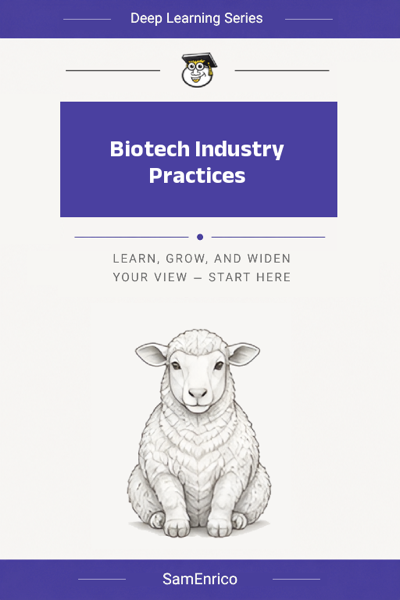
Non-FictionInformativeEducational
Biotech Industry Practices eBook
A Coursebook on Biotech Industry Practices
A Coursebook on Biotech Industry Practices
Formats
Free sample
Chapter 1: The Living Factory--– The biotechnology industry is not merely about test tubes, pipettes, and Petri dishes, though these tools fill its laboratories. At its core, biotech is the art and science of transforming living organisms into manufacturing platforms—turning cells into factories, bacteria into pharmacists, and DNA into programmable code. This fundamental insight separates biotechnology from every other branch of industrial science. Unlike a chemical plant that cracks petroleum into plastic or a pharmaceutical factory that synthesizes small molecules through organic chemistry reactions, a biotech facility grows its products inside living systems, coaxing microbes or mammalian cells to assemble molecules that nature never intended to be mass-produced. Understanding this distinction is the first step toward mastering biotech industry practices, because every subsequent decision—from patent strategy to clinical trial design to manufacturing scale-up to commercialization—flows directly from whether your product is a living entity, a derivative of one, or a tool to modify life itself.This chapter establishes the foundational landscape upon which the entire biotech industry is built.
It defines what biotech means in commercial practice, traces the historical evolution that created today's multibillion-dollar global industry, maps the key subsectors and their unique characteristics, explains the brutal risk-reward calculus that shapes every business decision, profiles the major geographic hubs where innovation concentrates, and introduces the ecosystem players who will appear throughout this coursebook. By the end of this chapter, readers should understand not just what the biotech industry does, but why it operates the way it does—and why mastering its practices is essential for anyone seeking to participate in modern life sciences.Defining the Biotech Industry: More Than a Buzzword The term "biotechnology" entered the English language in 1919, coined by Hungarian agricultural engineer Karl Ereky to describe the conversion of raw materials into useful products using living organisms. For five decades, the term remained obscure, used primarily in agricultural and fermentation contexts. That changed dramatically in the 1970s, when two scientific breakthroughs rewrote the rules of biological possibility and launched an entirely new industry.The first breakthrough was recombinant DNA technology, developed by Herbert Boyer at the University of California, San Francisco, and Stanley Cohen at Stanford University in 1973. They demonstrated that DNA from one organism could be cut, spliced into the DNA of another organism, and expressed to produce functional proteins.
In practical terms, this meant that a human gene could be inserted into a bacterium, and that bacterium would then produce human proteins. The second breakthrough was hybridoma technology, developed by Georges Köhler and César Milstein in 1975, which enabled the mass production of monoclonal antibodies—highly specific immune system proteins that could recognize and bind to individual targets with remarkable precision. These two technologies, recombinant DNA and monoclonal antibodies, remain the foundation of the biotech industry nearly fifty years later.But scientific breakthroughs alone do not create industries. The modern biotech industry required a third ingredient: venture capital willing to fund speculative, long-term, high-risk research. In 1976, venture capitalist Robert Swanson approached Boyer with an audacious proposal: form a company to commercialize recombinant DNA technology.
The result was Genentech (Genetic Engineering Technology, Inc.), widely considered the first true biotechnology company. Swanson and Boyer raised $100,000 in startup capital, a modest sum even by 1970s standards, and set to work. In 1982, Genentech won approval from the U.S. Food and Drug Administration (FDA) for Humulin, recombinant human insulin, marking the first biotech drug to reach the market.The impact of Humulin cannot be overstated. Prior to its approval, insulin for diabetics was extracted from the pancreases of slaughtered pigs and cows—an inconsistent, impure, and potentially allergenic product that required extensive purification and still provoked immune reactions in many patients.
Humulin was chemically identical to human insulin, produced in genetically engineered E. coli bacteria, and available in essentially unlimited quantities. Within five years, Humulin had captured most of the U.S. insulin market, and the era of biopharmaceuticals had begun. Genentech went public in 1980, just four years after its founding, in one of the most successful initial public offerings in Wall Street history.Amgen (Applied Molecular Genetics) followed soon after, founded in 1980 in Thousand Oaks, California, by a group of scientists and venture capitalists including William Bowes and George Rathmann.
While Genentech initially focused on replacing missing hormones (insulin, human growth hormone), Amgen pursued a different strategy: discovering entirely new proteins that could manipulate human biology in novel ways. In 1989, Amgen received FDA approval for Epogen (erythropoietin), a hormone that stimulates red blood cell production. Epogen transformed the treatment of anemia in kidney dialysis patients and became biotech's first blockbuster drug, generating over one billion dollars in annual sales within five years of launch. More importantly, Epogen proved that biotech companies could discover, develop, and commercialize novel therapeutics without relying on traditional pharmaceutical partners. Amgen was not just a supplier to big pharma; it was a competitor.Together, Genentech and Amgen demonstrated two viable business models for biotech: the replacement protein model (Genentech) and the novel protein model (Amgen).
Both succeeded spectacularly, attracting a flood of capital and entrepreneurial energy throughout the 1980s and 1990s.The Distinction Between Biotech, Pharma, and Life Sciences Before proceeding further, it is essential to clarify a source of persistent confusion: the relationship between biotech, pharma, and life sciences. These terms are often used interchangeably in popular discourse, but they mean different things in industry practice.Biotech refers specifically to products and processes that use living organisms (or their components) to create or modify products. A monoclonal antibody produced in Chinese hamster ovary (CHO) cells is a biotech product. A genetically modified yeast that produces a pharmaceutical intermediate is biotech. A diagnostic test that uses CRISPR to detect viral RNA is biotech.
The defining feature is the involvement of a biological system in the manufacturing process.Pharma (pharmaceutical industry) refers to products discovered and manufactured through chemical synthesis, without the use of living organisms. Aspirin, statins, antihistamines, and most traditional oral medications are pharma products. Historically, pharma companies discovered new drugs by screening chemical libraries, then scaled up those chemicals through organic chemistry reactions in stainless steel reactors. No cells, no fermentation, no recombinant DNA.However, the boundary between biotech and pharma has blurred significantly since 2000. Most large pharma companies now have extensive biotech divisions and biologic products.
Conversely, many biotech companies rely on small molecule discovery methods that differ little from traditional pharma approaches. The distinction is now more about modality (what kind of molecule) and manufacturing process (biological vs. chemical) than about company identity. For the purposes of this coursebook, we will use "biotech" to include both biologics and small molecules discovered through biological screening methods, while recognizing the gray areas.Life sciences is the broadest term, encompassing all scientific disciplines that study living organisms: biology, biochemistry, genetics, neuroscience, ecology, and many others. Life sciences is an academic and research category, not an industry category.
A university genetics department is part of life sciences; a company that sells DNA sequencing instruments is in the life sciences tools industry; a company that develops gene therapies is in biotech. Life sciences is the foundational knowledge base; biotech is the commercial application.A quick test to distinguish them: if the primary product…
This is the end of the free sample. Get the eBook to keep going. Buy now
About this book
Details
- Author
- Cottrell Adan
- Publisher
- SamEnrico
- Language
- English
- Genre
- Non-Fiction, Informative, Educational
- Released
- 2026-05-06
- Pages (approx.)
- 160
- Available as
- eBook, Audiobook

Read better in the ZLOADR app
Your eBooks on your phone or tablet. Sign in with your SamEnrico account and start reading.
More by Cottrell Adan
 Objection Handling Written ResponsesCottrell Adan$11.99
 High Performance Breath TrainingCottrell Adan$11.99
 Early Onset Bipolar GuideCottrell Adan$11.99
 CPR Training App GuideCottrell Adan$11.99
 Gratitude for AnniversariesCottrell Adan$11.99
 The Panama Canal SoloCottrell Adan$11.99
 BeReal Authentic InfluencerCottrell Adan$11.99
 Student Study Break NappingCottrell Adan$11.99
 Mickey Brown Holiday InnCottrell Adan$11.99
 The Last Broadcast: How a 1938 Radio Play Sparked a Nationwide PanicCottrell Adan$11.99
 The Sweethearts of Pasteur: Love and the Birth of Modern MedicineCottrell Adan$11.99
 Quantum Alchemists: The Secret Code of the I ChingCottrell Adan$11.99
You may also like
 Hong Kong Handover 1997Dunn Johnnie$11.99
 Zumba For Postnatal Recovery CourseNeal Christian$11.99
 Zumba for BeginnersLadner Nikia$11.99
 YouTube Comment Mining GuideHumes Pandora$12.99
 Worry Box MeditationCarlin Rudy$11.99
 Workplace Stress MeditationNguyen Lynn$11.99
 Workplace Stress and Sleep RepairHawley Ivory$11.99
 Workplace Perfectionism CureDelaney Jeffry$11.99
 Workplace Injustice Anger GuideWallen Isabelle$11.99
 Work Addiction and Burnout LinkGreenwood Ester$11.99
 Women in Yoga and WellnessBeattie Galina$11.99
 Women in Stand Up ComedyChun Evangeline$11.99