
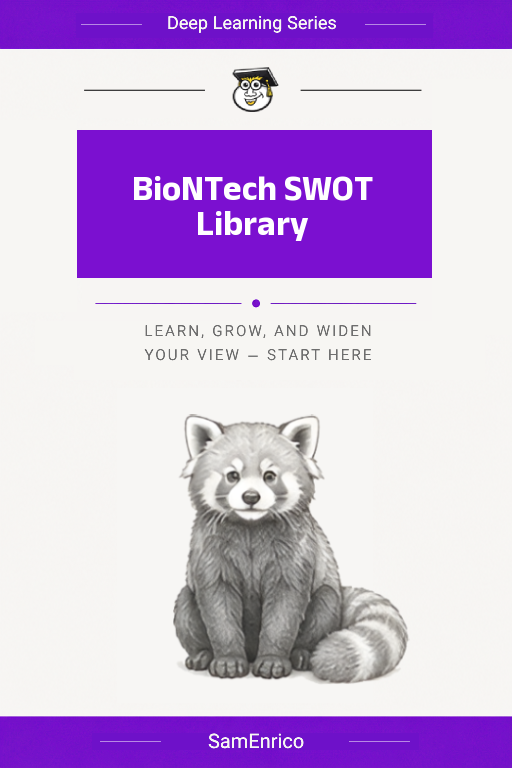
Non-FictionStrategic AtlasBiotech
BioNTech SWOT Library eBook
Evaluate Comirnaty partnership with Pfizer, oncolo
Evaluate Comirnaty partnership with Pfizer, oncology pipeline, personalized cancer vaccines, and R&D focus.
Formats
Free sample
Chapter 1: The Mainz Blueprint...--–- In the basement of a university hospital in Mainz, Germany, where the linoleum floors were scuffed and the fluorescent lights hummed a tired drone, a young physician named Uğur Şahin spent his nights thinking about something most doctors learn to ignore: the inevitability of failure. He had watched patients with pancreatic cancer arrive with hope and leave in coffins, victims of a brutal arithmetic where the tumor always seemed to outpace the therapy. The standard of care was poison, surgery, and prayer. Şahin found this unacceptable. But unlike most oncologists who channeled their frustration into empathy, he channeled his into an obsession with a molecule so fragile that it would disintegrate if you looked at it wrong.
That molecule was messenger RNA. And that basement, unknown to the world at the time, was the birthplace of a blueprint that would one day force the pharmaceutical industry to rewrite its own rulebook.This chapter is not about the COVID-19 vaccine. That story has been told, retold, and commoditized into business school case studies about logistics and public-private partnerships. This chapter is about the fifteen years of lonely, underfunded, often ridiculed research that preceded the pandemic. It is about a scientific and cultural blueprint that turned Bio NTech from a footnote in German biotech into a platform powerful enough to challenge the very structure of how medicines are discovered, tested, and delivered.
The argument here is simple but essential for understanding everything that follows in this book: Bio NTech’s greatest Strength is not its COVID-19 vaccine. The vaccine was merely the first commercial manifestation of a platform that had been built, brick by molecular brick, for cancer. If you want to understand why Pfizer needed Bio NTech more than Bio NTech needed Pfizer, you must first understand the Mainz Blueprint.The Founders Who Didn't Want to Be Founders Uğur Şahin and Özlem Türeci are not typical biotech founders. They do not pose for magazine covers. They do not tweet about their stock price.
When the world was clamoring for their attention during the pandemic, Şahin reportedly continued to show up to his lab in a worn leather jacket and ride his bicycle to work. This is not performative humility. It is a reflection of a value system that prioritizes the scientific question over the commercial answer. Şahin, the son of Turkish immigrants, grew up in Cologne with a single-minded focus: he wanted to understand the immune system’s failure to kill cancer. Türeci, also the child of Turkish immigrants, shared that obsession.
They met at a hospital where both were training, and while other couples discussed vacations or mortgage rates, they discussed the problem of MHC class I downregulation in metastatic lesions.This cultural foundation is the first and most overlooked Strength in the Bio NTech story. From its incorporation in 2008, the company was structured not as a drug developer but as a platform developer. Most biotech startups raise money around a single molecule—a promising antibody, a small molecule inhibitor, a gene therapy candidate. If that molecule fails in Phase 2, the company collapses or pivots desperately. Bio NTech did the opposite.
Şahin and Türeci raised seed capital to build a toolbox: multiple m RNA formats (unmodified, modified, trans-amplifying), multiple delivery vehicles (lipid nanoparticles, protamine, polymers), and multiple targeting strategies (neoantigens, shared antigens, bispecifics). The goal was never to produce one drug. The goal was to produce a machine that could produce many drugs.This distinction sounds academic, but it is the difference between a gunsmith and an armory. A gunsmith crafts a single weapon. An armory builds the factory that can retool overnight to produce a rifle, a pistol, or a cannon depending on the threat.
When SARS-Co V-2 emerged, Bio NTech did not scramble to invent a vaccine from scratch. It opened its catalog of interchangeable parts, selected the antigen (the spike protein), selected the delivery vehicle (the LNP formulation it had already optimized for its Fix Vac cancer vaccine), and began human trials within weeks. The industry called this a miracle. It was not a miracle. It was fifteen years of patient, obsessive, academically rigorous platform-building masquerading as overnight success.The Fix Vac Platform: The Off-the-Shelf Weapon Before personalized vaccines became the obsession of Wall Street, Bio NTech developed Fix Vac—a fixed, off-the-shelf m RNA cancer vaccine targeting four non-mutated tumor-associated antigens commonly expressed in multiple cancer types.
The logic was pragmatic: not every patient has time for a bespoke solution. A patient with stage IV melanoma or small cell lung cancer cannot wait sixty days for a personalized vaccine to be sequenced, manufactured, and released. They need a weapon now. Fix Vac was designed to be that weapon.The platform works by encoding four antigens—typically NY-ESO-1, MAGE-A3, Tyrosinase, and TPTE—into a single m RNA construct delivered via liposomal formulation. Unlike personalized vaccines that hunt for neoantigens unique to each patient’s tumor, Fix Vac targets antigens that are overexpressed in cancer but present at low levels in healthy tissue.
This is a deliberate trade-off: lower specificity for higher speed and lower cost. In the Phase 1 trial of BNT111 (Fix Vac for melanoma), Bio NTech demonstrated that the vaccine could be manufactured and released in under three weeks, compared to the eight to ten weeks required for its personalized counterpart.Why does this matter for understanding Bio NTech’s Strength? Because Fix Vac proved the manufacturing thesis. Before any investor had seen a personalized cancer vaccine data readout, Bio NTech had already built and validated the production workflows for m RNA cancer vaccines. The same clean rooms, the same lipid synthesis, the same fill-and-finish lines.
When the pandemic hit, Bio NTech did not need to build a new factory for the COVID vaccine. It simply changed the m RNA sequence in the Fix Vac production line. This is the "plug-and-play" concept that will recur throughout this book, but it is introduced here in its proper context: as a deliberate strategic choice made years before anyone had heard of Comirnaty.The i Ne ST Platform: The Bespoke Arsenal If Fix Vac was the pragmatic play, i Ne ST (individualized Neoantigen Specific Immunotherapy) was the moonshot. The scientific premise is elegant, almost beautiful in its logic. Every patient’s cancer is genetically unique.
The mutations that drive a particular tumor—the so-called "driver mutations"—create neoantigens: protein fragments that should, in theory, mark the cancer cell as foreign to the immune system. In practice, tumors evolve to hide these neoantigens or suppress the immune response against them. i Ne ST was designed to reverse this suppression by training the immune system to recognize exactly those neoantigens.The workflow is a marvel of modern biotechnology. Step one: a surgeon removes a tumor biopsy, typically one to two grams of tissue. Step two: Bio NTech sequences the tumor’s DNA and RNA to identify all somatic mutations—often thousands per tumor.
Step three: proprietary algorithms (enhanced by the Insta Deep acquisition, which we will cover in Chapter 9) predict which of these mutations are likely to be presented on the tumor’s surface via MHC molecules. Typically, this narrows…
This is the end of the free sample. Get the eBook to keep going. Buy now
About this book
Details
- Author
- Farias Kathryne
- Publisher
- SamEnrico
- Language
- English
- Genre
- Non-Fiction, Strategic Atlas, Biotech
- Released
- 2026-05-29
- Pages (approx.)
- 133
- Available as
- eBook, Audiobook

Read better in the ZLOADR app
Your eBooks on your phone or tablet. Sign in with your SamEnrico account and start reading.
More by Farias Kathryne
 Self Talk For Depression GuideFarias Kathryne$11.99
 The Caregiver Nutrition GuideFarias Kathryne$11.99
 Nightmare Processing for VeteransFarias Kathryne$11.99
 Anger at Politicians CognitiveFarias Kathryne$11.99
 Fertility and Lubricant GuideFarias Kathryne$11.99
 Phoenix Rising: The Lost Codex of HypatiaFarias Kathryne$11.99
 Understanding Oculorenocerebellar SyndromeFarias Kathryne$17.99
 How to Become a Laundry-machine MechanicFarias Kathryne$11.99
 Studying Traditional Chinese Medicine GuideFarias Kathryne$12.99
 Chef De PartieFarias Kathryne$11.99
You may also like
 Hong Kong Handover 1997Dunn Johnnie$11.99
 Zumba For Postnatal Recovery CourseNeal Christian$11.99
 Zumba for BeginnersLadner Nikia$11.99
 YouTube Comment Mining GuideHumes Pandora$12.99
 Worry Box MeditationCarlin Rudy$11.99
 Workplace Stress MeditationNguyen Lynn$11.99
 Workplace Stress and Sleep RepairHawley Ivory$11.99
 Workplace Perfectionism CureDelaney Jeffry$11.99
 Workplace Injustice Anger GuideWallen Isabelle$11.99
 Work Addiction and Burnout LinkGreenwood Ester$11.99
 Women in Yoga and WellnessBeattie Galina$11.99
 Women in Stand Up ComedyChun Evangeline$11.99