
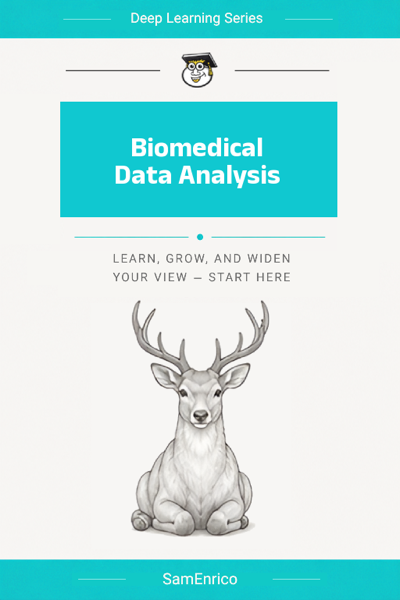
Biomedical Data Analysis
A Coursebook on Biomedical Data Analysis
A Coursebook on Biomedical Data Analysis
Formats
About this book
Free sample
Chapter 1: Beyond the Bedside--–- The most important medical discovery of the next decade will not occur in a laboratory. It will not emerge from a petri dish, a microscope, or the careful observation of a single patient’s unusual symptoms. It will be found hiding in plain sight—inside the torrents of data that modern healthcare produces every second, waiting for someone with the right tools and the right questions to unlock its secrets.Consider the intensive care unit. A single bed in a modern ICU generates more than one thousand data points per second: heart rate from the electrocardiogram monitor, blood pressure from the arterial line, oxygen saturation from the pulse oximeter, respiratory rate from the ventilator, temperature from the esophageal probe, and a dozen other measurements that stream continuously into the electronic health record. Multiply that by twenty beds, by three hundred and sixty‑five days, by a decade of operation, and you have more data than all the medical textbooks ever written, combined.Yet most of this data is never used.
It is stored in proprietary formats, fragmented across incompatible systems, and discarded after mandatory retention periods expire. The few researchers who manage to extract even a fraction of it often lack the statistical training to distinguish genuine signals from random noise, the computational skills to process datasets too large for Excel, or the clinical knowledge to ask questions that matter to patients.This book exists to bridge that gap. Biomedical data analysis is not a single discipline but a convergence of many: biostatistics, computer science, clinical epidemiology, bioinformatics, medical imaging, and artificial intelligence. The practitioners who succeed in this field are not necessarily the world’s best programmers or the most accomplished clinicians. They are the people who can translate between these worlds—who can explain to a surgeon why a random forest works better than logistic regression for their prediction problem, and explain to a data scientist why a p‑value of 0.049 does not necessarily mean the treatment is effective.This chapter lays the foundation for everything that follows.
We will map the landscape of biomedical data, introducing the four major modalities that you will encounter throughout this book…
This is the end of the free sample. Get the eBook to keep going. Buy now
Contents
- Chapter 1
- Chapter 2
- Chapter 3
- Chapter 4
- Chapter 5
- Chapter 6
- Chapter 7
- Chapter 8
- Chapter 9
- Chapter 10
- Chapter 11
- Chapter 12
Details
- Author
- Bellamy Alane
- Publisher
- SamEnrico
- Language
- English
- Genre
- Non-Fiction, Informative, Educational
- Released
- 2026-05-04
- Pages (approx.)
- 147
- Available as
- eBook, Audiobook

Read better in the ZLOADR app
Your eBooks on your phone or tablet. Sign in with your SamEnrico account and start reading.
More by Bellamy Alane
 Home AED Buying GuideBellamy Alane$11.99
 Diving Breath PreparationBellamy Alane$11.99
 The Timeline RushBellamy Alane$11.99
 Persuasive Sales Deck StructureBellamy Alane$11.99
 WhatsApp Status InfluencerBellamy Alane$11.99
 Joyful New Year Resolution GuideBellamy Alane$11.99
 Rounding Cape Horn AloneBellamy Alane$11.99
 Dick Cavett InterviewsBellamy Alane$11.99
 Blue Zone Walking HabitsBellamy Alane$11.99
 The Last Voyage of the SS Ourang Medan: A Cursed CargoBellamy Alane$11.99
 The Condottieri's Gambit: Blood and Betrayal in the Italian WarsBellamy Alane$11.99
 The Architect of the Marid: A Djinn’s Tower of BabelBellamy Alane$11.99