
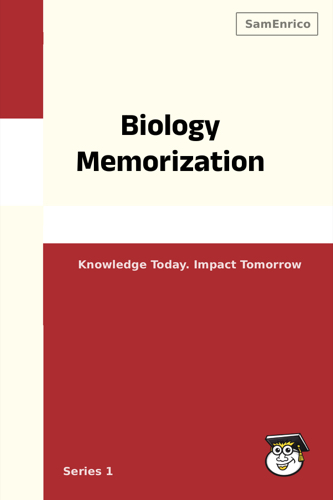
Biology Memorization eBook
undefined
undefined
Formats
Free sample
Chapter 1: The 3 AM Panic--–- You close the textbook. Your eyes burn from fourteen hours of staring at diagrams of mitochondria, Punnett squares, and the Krebs cycle. You’ve highlighted. You’ve re-read. You’ve whispered “glycolysis” to yourself until the word lost all meaning.
You walk to the kitchen, pour a glass of water, and return to your desk. Then you open the book to a random page. Your mind goes blank. The mitochondria – was that the powerhouse or the something else? Was the Krebs cycle the one with the citric acid or the one with the electron chain?
You flip to another page. Same emptiness. You slam the book shut. It’s 3 AM. Your exam is in nine hours.
And you remember nothing.This is not a character flaw. It is not a sign that you are “bad at science” or that your brain simply doesn’t work that way. This is the predictable, almost mathematical consequence of using the wrong memorization strategy for biology. And the tragedy is that most students – even diligent, motivated, straight-A students – have never been taught the right one.Let me tell you a story. When I was a pre-med student, I nearly failed my first biology midterm.
I had studied for twenty hours. I had rewritten my notes three times. I had used flashcards until my fingers cramped. My score: 67 percent. The person sitting next to me, who had studied for six hours and spent the rest of the weekend at the movies, scored a 92.
I assumed he was a genius or a cheater. Years later, I learned the truth: he simply knew something I didn’t. He knew that biology is not a list of facts to be memorized in isolation. It is a set of interconnected systems that must be learned relationally. And he had a toolbox of memory techniques that turned those systems into stories, maps, and analogies – while I was still brute-forcing my way through definitions.This chapter is designed to do one thing: convince you that your memory is not broken, and then show you exactly how to fix it.
By the time you finish reading, you will understand why cramming fails, how your brain actually encodes and stores information, and why biology – unlike history, literature, or law – demands a completely different approach to memorization. More importantly, you will walk away with a clear, actionable roadmap for the rest of this book.The Forgetting Curve: Why Hard Work Isn’t Enough In 1885, a German psychologist named Hermann Ebbinghaus published a book that should be required reading for every student on earth. He had spent years memorizing nonsense syllables – meaningless three-letter combinations like “ZOF” and “WUX” – and then testing himself at various intervals to see how much he retained. What he discovered became known as the Forgetting Curve, and it is one of the most replicated findings in the history of psychology.Here is what Ebbinghaus found: within one hour of learning new information, you forget approximately 50 percent of it. Within twenty-four hours, you forget 70 percent.
Within one week, unless you actively review the material, you retain less than 20 percent. This curve is not a suggestion. It is a biological reality, as measurable as your heart rate or body temperature. Your brain is wired to prioritize survival-relevant information – where to find food, how to avoid predators, who to trust – over academic trivia about cellular respiration. From an evolutionary perspective, your brain’s default setting is to forget everything that does not directly help you survive and reproduce.
The Krebs cycle? Not on the list.But here is the crucial insight that Ebbinghaus also discovered: the Forgetting Curve can be flattened. Dramatically. When you review information at strategic intervals – just before you would have forgotten it – you send a powerful signal to your brain: “This matters. Keep it.” Each successful retrieval strengthens the neural pathway, making the next retrieval faster and more reliable.
This is called spaced repetition, and it is the single most effective memorization technique ever studied. We will devote an entire chapter to building a spaced repetition system later in this book. For now, understand this: cramming the night before an exam is the worst possible strategy because it fights against the Forgetting Curve rather than working with it. You are trying to pour water into a leaky bucket. No matter how much you pour, the bucket will be nearly empty by morning.Let me give you a concrete example.
Two students, Maria and James, both need to memorize the ten steps of glycolysis. Maria studies for four hours on Sunday afternoon, then doesn’t look at the material again until the exam on Friday. By Friday, she has forgotten approximately 80 percent of what she learned. James studies for forty-five minutes on Sunday, fifteen minutes on Monday, ten minutes on Wednesday, and five minutes on Thursday. His total study time is actually less than Maria’s – seventy-five minutes versus four hours – but his retention on Friday is nearly 90 percent.
Why? Because each review session occurred just before the Forgetting Curve would have erased the information. James worked with his brain’s biology. Maria fought against it.This is not a matter of intelligence or effort. It is a matter of strategy.
And the first step to adopting a better strategy is understanding exactly how your brain creates and stores memories in the first place.Neuroplasticity: Your Brain Is Wet Clay There is a phrase that neuroscientists use that I want you to remember: neurons that fire together, wire together. This is the principle of neuroplasticity, and it is the biological foundation of all learning. Here is what it means in plain English.Your brain contains approximately 86 billion neurons. Each neuron has branches called dendrites that receive signals from other neurons, and a long cable called an axon that sends signals to other neurons. The gap between one neuron’s axon and another neuron’s dendrite is called a synapse.
When you learn something new – say, the fact that mitochondria produce ATP – a specific pattern of neurons fires across your brain. The first time this happens, the connection is weak, like a footpath through tall grass. But each time you successfully recall that fact – not just re-read it, but actually pull it from memory – the connection strengthens. More neurotransmitters are released. The synapse becomes more efficient.
Myelin, a fatty insulation, wraps around the axon, speeding the signal. What was once a faint footpath becomes a gravel road, then a two-lane highway, then a four-lane freeway.This is neuroplasticity: your brain physically rewires itself in response to your experiences and behaviors. The word “plastic” comes from the Greek plastikos, meaning “capable of being molded.” Your brain is not a computer with fixed hardware. It is wet clay, constantly being reshaped by every thought, every recall, every study session. This is extraordinarily good news.
It means that no one is “born” with a good memory for biology. There is no memory gene that some people have and others lack. There are only people who have accidentally discovered effective study strategies and people who have not. The strategies in this book will reshape your brain’s wiring, regardless of your starting…
This is the end of the free sample. Get the eBook to keep going. Buy now
About this book
Details
- Author
- Power Leonardo
- Publisher
- SamEnrico
- Language
- English
- Genre
- Non-Fiction, Self-Help
- Released
- 2026-06-08
- Pages (approx.)
- 153
- Available as
- eBook, Audiobook

Read better in the ZLOADR app
Your eBooks on your phone or tablet. Sign in with your SamEnrico account and start reading.
More by Power Leonardo
 Open Office Noise Management GuidePower Leonardo$11.99
 Zumba for PostpartumPower Leonardo$11.99
 Grandchild Death GriefPower Leonardo$11.99
 ClickUp Memory SystemPower Leonardo$11.99
 Parent Death Photo OrganizationPower Leonardo$11.99Parent Death Photo OrganizationPower Leonardo$11.99
 Tobacco Cessation In PrisonsPower Leonardo$11.99
 The Massage Parlor EscapePower Leonardo$11.99
 The Last Broadcast: How Radio Silence Saved Lives in the 2004 TsunamiPower Leonardo$11.99
 The Healers of Plataea: Women in the Shadow of WarPower Leonardo$11.99
 The First Broadcast: How a Colonial Cricket Match Changed the WorldPower Leonardo$11.99
 Proposal Writing For CourseworkPower Leonardo$12.99
You may also like
 Hong Kong Handover 1997Dunn Johnnie$11.99
 Zumba For Postnatal Recovery CourseNeal Christian$11.99
 Zumba for BeginnersLadner Nikia$11.99
 YouTube Comment Mining GuideHumes Pandora$12.99
 Worry Box MeditationCarlin Rudy$11.99
 Workplace Stress MeditationNguyen Lynn$11.99
 Workplace Stress and Sleep RepairHawley Ivory$11.99
 Workplace Perfectionism CureDelaney Jeffry$11.99
 Workplace Injustice Anger GuideWallen Isabelle$11.99
 Work Addiction and Burnout LinkGreenwood Ester$11.99
 Women in Yoga and WellnessBeattie Galina$11.99
 Women in Stand Up ComedyChun Evangeline$11.99