
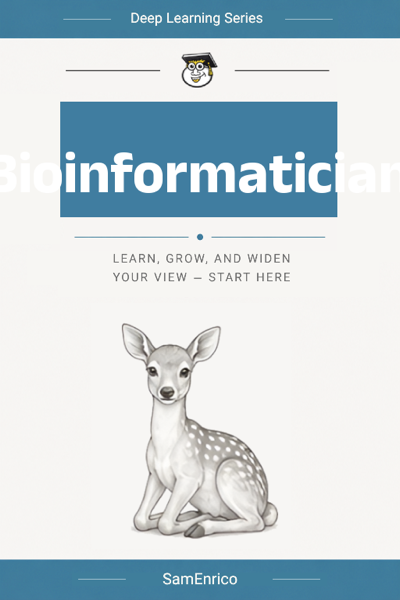
Non-FictionInformativeEducational
Bioinformatician eBook
A Coursebook on Bioinformatician
A Coursebook on Bioinformatician
Formats
Free sample
Chapter 1: The Excel Graveyard--–- Dr. Elena Vasquez had killed seventeen Excel spreadsheets before she finished her morning coffee. Not metaphorically. She had watched them freeze, stutter, and finally collapse under the weight of sixty thousand rows of RNA-seq data—rows that should never have been in Excel in the first place. The green bar stopped moving at 47%.
Her laptop fan screamed like a dying animal. She closed the lid, counted to ten, and considered becoming a farmer.Elena was thirty-four years old, three years into a tenure-track position in molecular biology at a mid-tier research university, and she had just spent eight months of her postdoc generating a beautiful dataset: RNA-seq from pancreatic cancer organoids treated with a novel small molecule. Eight months. Two hundred thousand dollars in sequencing costs. And now, because she had opened the count matrix in Excel to "just take a quick look," the software had helpfully auto-formatted several gene names as dates.
MARCH1 became *1-Mar*. SEPT1 became *1-Sep*. DEC1, OCT4, and a dozen other genes with month-like symbols had been silently corrupted. The data was still there, technically, but the identifiers were wrong. She would not discover this for another two weeks, after she had already run her differential expression analysis and presented her "significant" findings to her department.This is not a story about Elena's mistake.
It is a story about what happened next—and about a book that could have saved her.Elena did what any desperate scientist would do. She emailed the bioinformatics core facility. The reply arrived in forty-seven minutes: an eight-week waitlist, a budget estimate of $12,000, and a polite note that her data would need to be re-analyzed from the raw FASTQ files because "Excel-modified files cannot be trusted." Twelve thousand dollars. Two more months. Her tenure clock was ticking.
Her grant renewal was due in four months. She could not afford either.So she opened her laptop at 11:00 PM, Googled "how to learn bioinformatics fast," and fell into a rabbit hole of conflicting advice, abandoned Git Hub repositories, and You Tube tutorials that assumed she already knew what a "conda environment" was. She did not. She knew pipettes and western blots and how to keep organoids alive in culture. She knew what a p-value meant and how to design a proper control.
She did not know why her command line kept saying command not found, or what a "kernel" was, or why Python cared about spaces at the beginning of lines.Six months later, Elena had taught herself enough R, Python, and command-line bioinformatics to re-analyze her own data. She published her paper in a good journal—not Nature, but solid. She also published a small R package for RNA-seq quality control that had been downloaded four thousand times. She was not a programmer. She was a biologist who had learned just enough computation to be dangerous in the right way.
And when she interviewed for her next position—a group leader role at a major cancer institute—the hiring committee did not ask about her publication record. They asked about the R package."We have three postdocs who use it," the committee chair said. "Can you teach them?"Elena got the job.The Three Stories That Open This Book Elena's story is not unique. It is not even unusual. It is the modal experience of a generation of life scientists who were trained in the era of single-gene biology and found themselves launched into the age of multi-omics.
This book is written for three kinds of people, and you are almost certainly one of them.The Wet-Lab Biologist (Elena's Tribe)You know how to design experiments. You understand biological replicates versus technical replicates. You can troubleshoot a Western blot that looks like a Jackson Pollock painting. You have opinions about antibody suppliers. But when you get your sequencing data back—a folder full of files with names like SRR12345678_1.fastq.gz—you feel a cold dread.
You open a Google Doc titled "Bioinformatics Notes" and paste random commands you found on Stack Overflow. You do not know what they do. You just know that if you run them in the right order, something happens. Sometimes that something is correct. Sometimes it is not, and you do not find out until your reviewer asks why your quality control report looks "unusual."Here is what no one tells you: the barrier to entry for bioinformatics is not intelligence.
It is not even coding ability. It is cognitive overload—the feeling that you need to learn three overlapping skill sets (biology, statistics, and programming) simultaneously while also managing your actual research. This book solves that problem by teaching you the minimal viable skills in a specific order, with working code that you can copy and adapt immediately.The Computer Scientist (The Other Side of the Bench)You can write elegant Python. You understand object-oriented design. You have opinions about functional programming.
But someone just handed you a file called genome.fa and asked you to "find the mutations associated with drug resistance." You have no idea what a FASTA file actually represents. You do not know why the "T" in the sequence matters, or why some letters are lowercase, or why the collaborator keeps using words like "reading frame" and "missense variant." You have been given a biological problem dressed up as a string-matching problem, and the hidden assumptions are killing you.Here is what no one tells you: biology is not messy because biologists are sloppy. Biology is messy because evolution is a tinkerer, not an engineer. The rules have exceptions. The exceptions have exceptions.
Your beautiful algorithm that worked perfectly on simulated data will fail on real data in ways that feel personal. This book teaches you the biological logic behind the data—not enough to become a biologist, but enough to have intelligent conversations with the people who are.The Career-Switcher (The Fastest-Growing Tribe)You have a bachelor's degree in something science-adjacent (chemistry, psychology, public health). You worked in a lab for a few years, or maybe you worked in tech support, or maybe you taught high school biology. You have seen the job postings: "Bioinformatician – $85k–$140k – Remote – 2+ years experience." You want that job. You know the market is hot.
But every job description asks for skills you do not have: NGS analysis, Python, R, Linux command line, Git, Snakemake, AWS. The list feels endless. You do not know where to start.Here is what no one tells you: the job market is desperate for people who can bridge the gap. Pure biologists cannot code. Pure programmers do not understand the biology.
The person who can do both—even imperfectly—is worth their weight in sequencing reagents. You do not need a Ph D. You do not need a master's degree. You need a portfolio of projects that demonstrate you can take raw data and turn it into biological insight. That is what this book builds.The Bioinformatician's Compass: A Mental Model for the Entire Book Before we dive into any techniques, let me give you a framework that will organize everything that follows.
I call it the Bioinformatician's Compass. It has four points, and every chapter in this book maps cleanly onto at…
This is the end of the free sample. Get the eBook to keep going. Buy now
About this book
Details
- Author
- Buffington Cinda
- Publisher
- SamEnrico
- Language
- English
- Genre
- Non-Fiction, Informative, Educational
- Released
- 2026-06-03
- Pages (approx.)
- 156
- Available as
- eBook, Audiobook

Read better in the ZLOADR app
Your eBooks on your phone or tablet. Sign in with your SamEnrico account and start reading.
More by Buffington Cinda
 Indonesia Consumer GuideBuffington Cinda$11.99
 Estate Planning for Single ParentsBuffington Cinda$11.99
 Water Phobia RecoveryBuffington Cinda$11.99
 Affirmations For Depression GuideBuffington Cinda$11.99
 The Persuasive Classroom ManagementBuffington Cinda$11.99
 The Timbuktu Scholars: Masters of the Mathematical UniverseBuffington Cinda$11.99
 How to Become a Driver-utility WorkerBuffington Cinda$11.99
 Video Ad First Campaign GuideBuffington Cinda$12.99
 Doug McMillon GuideBuffington Cinda$12.99
 Understanding Paget Disease ExtramammaryBuffington Cinda$17.99
You may also like
 Hong Kong Handover 1997Dunn Johnnie$11.99
 Zumba For Postnatal Recovery CourseNeal Christian$11.99
 Zumba for BeginnersLadner Nikia$11.99
 YouTube Comment Mining GuideHumes Pandora$12.99
 Worry Box MeditationCarlin Rudy$11.99
 Workplace Stress MeditationNguyen Lynn$11.99
 Workplace Stress and Sleep RepairHawley Ivory$11.99
 Workplace Perfectionism CureDelaney Jeffry$11.99
 Workplace Injustice Anger GuideWallen Isabelle$11.99
 Work Addiction and Burnout LinkGreenwood Ester$11.99
 Women in Yoga and WellnessBeattie Galina$11.99
 Women in Stand Up ComedyChun Evangeline$11.99