
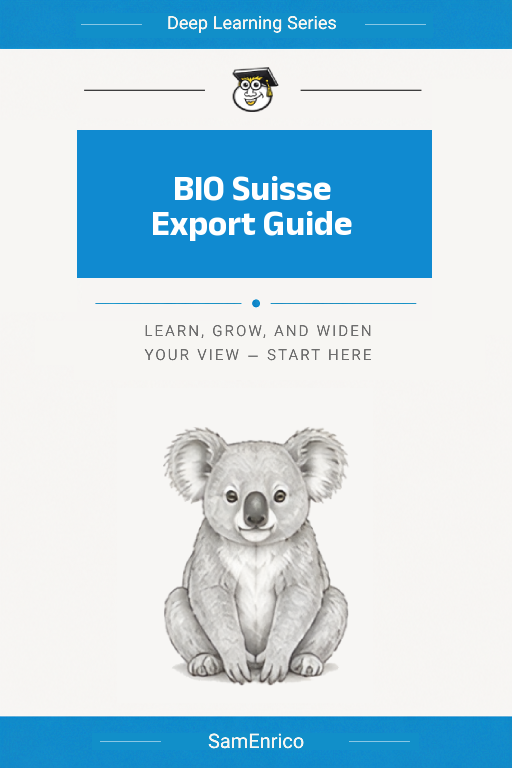
Non-FictionBusiness BriefBIO Suisse
BIO Suisse Export Guide eBook
Get BIO Suisse certification for organic exports t
Get BIO Suisse certification for organic exports to Swiss premium retail market.
Formats
Free sample
Chapter 1: The Bud Premium--–- In the rolling hills of Tuscany, a family-owned organic olive oil producer spent three years and nearly €15,000 pursuing Bio Suisse certification. When they finally shipped their first certified batch to Zurich, they discovered something that transformed their business: Swiss consumers paid them 28 percent more for the exact same oil that had previously sold under a standard EU Organic label. The only difference was a small white flower on the label—the Bio Suisse Bud. This is not an isolated story. Across dozens of product categories, from coffee grown on smallholder cooperatives in Peru to apples harvested in the orchards of South Tyrol, producers who crack the code of Switzerland’s most demanding organic standard consistently earn returns that leave EU-only competitors wondering what they are missing.Yet for every success story, there are three producers who give up halfway through the certification process, defeated by confusion, misinformation, or simply the sheer complexity of a system that works very differently from any other organic certification they have encountered.
Some are told by well-meaning but misinformed consultants that Bio Suisse is just “EU Organic with a different logo.” Others spend months preparing documentation, only to discover that they cannot apply for certification at all without first securing a Swiss importer—a requirement that exists nowhere else in the organic world. Still others receive their Bio Suisse certificate with pride, ship their first container to Basel, and then face rejection at customs because their product category is restricted under import rules they never knew existed.This book exists to ensure that you are not one of those producers. Whether you are an organic farmer in Morocco growing argan oil, a cooperative in Kenya producing specialty coffee, a grain cooperative in Ukraine, or a family orchard in New Zealand, the path to Switzerland’s premium organic market follows a predictable pattern—once you understand the rules. This chapter establishes the strategic foundation for everything that follows. It answers the single most important question every producer asks first: Is Bio Suisse worth the investment?The answer, as the Tuscan olive oil producer discovered, is almost always yes.
But the magnitude of that yes depends on where you are starting from, what you grow, and how well you navigate the system. By the end of this chapter, you will understand why Switzerland spends more per person on organic food than any other country on earth, why the Bud logo commands consumer trust that no other organic label can match, and why the investment in Bio Suisse certification—while significant—typically pays for itself within two to three shipping seasons.Understanding the Swiss Organic Market: A Statistical Portrait Switzerland is an outlier in the global organic food market. While organic food accounts for approximately 6 to 8 percent of total food sales across most European Union countries, Switzerland consistently exceeds 11 percent, with certain product categories reaching 30 percent or higher. According to Fi BL (Research Institute of Organic Agriculture), Swiss consumers spent an average of CHF 425 per person on organic products in the most recent reporting year. To put this in perspective, the average German consumer spent CHF 180, the average French consumer CHF 150, and the average American consumer approximately CHF 90.
Switzerland’s per-capita organic spending is more than double the European Union average and nearly five times the global average.What drives this extraordinary demand? Three factors converge in ways that exist nowhere else. First, Swiss disposable income is among the highest in the world. The median household in Zurich or Geneva has significantly more purchasing power than households in neighboring Germany, France, or Italy. Organic products, which typically carry a price premium of 20 to 50 percent over conventional alternatives, remain accessible to a broad segment of the population.Second, Swiss environmental awareness has deep cultural roots that predate the modern organic movement.
The country’s alpine landscape, which generates billions in tourism revenue, depends on agricultural practices that preserve biodiversity, prevent soil erosion, and maintain water quality. Swiss consumers understand intuitively that organic farming supports the landscapes they value. This is not abstract environmentalism; it is economic self-interest wrapped in cultural identity.Third, and most important for exporters, Swiss consumers have been trained by decades of consistent marketing to trust the Bio Suisse Bud logo above all others. Unlike the European Union’s organic leaf logo, which appears on millions of products of widely varying quality, the Bud logo has maintained strict standards that have become stricter over time rather than looser. When a Swiss consumer sees the Bud, they know they are buying a product that meets the country’s most rigorous organic requirements—requirements that frequently exceed those of the EU Organic regulation.The Coop and Migros Factor No discussion of the Swiss organic market is complete without understanding the duopoly that controls approximately 70 percent of Swiss food retail: Coop and Migros.
These two cooperatives have engaged in an organic arms race for two decades, each trying to outdo the other in organic selection, pricing, and standards.Coop launched its Naturaplan brand in 1993, making it one of the first supermarket chains in Europe to develop a comprehensive organic private label. Today, Coop claims that more than 30 percent of its total product assortment is organic, with some store locations dedicating entire aisles to Bud-certified products. Migros followed with its own organic strategy, developing the Migros Bio label (also Bud-certified) and acquiring organic processing and distribution assets across Switzerland.For foreign producers, the Coop and Migros dominance creates both opportunity and constraint. The opportunity is clear: if you can secure a listing with either cooperative (or with one of their authorized importers), you gain access to hundreds of retail locations and a built-in consumer base that actively seeks Bud-labeled products. The constraint is equally clear: both cooperatives have rigorous supplier approval processes, and they prioritize Swiss producers for most product categories.
Foreign suppliers are welcome only when domestic production cannot meet demand—a dynamic explored in depth in Chapter 10.Beyond Coop and Migros, a network of specialized importers serves smaller retail chains (Denner, Volg, Manor), food service channels, and direct-to-consumer organic subscription services. These importers often provide the entry point for foreign producers who cannot immediately secure a Coop or Migros listing. Chapter 3 provides a complete guide to finding, vetting, and contracting with these importers.The Bud Logo: More Than a Label To understand why the Bud logo matters, you must understand what it represents to Swiss consumers. In focus groups conducted by Bio Suisse, consumers consistently describe the Bud as “strict,” “trustworthy,” and “worth paying more for.” These perceptions are not accidental; they are the result of Bio Suisse’s deliberate strategy of maintaining standards that exceed legal requirements.Consider the difference between the EU Organic regulation and Bio Suisse standards. Under EU Organic rules, a farmer may operate a mixed farm with some organic parcels and some conventional parcels.
The same farmer may use copper-based fungicides within specified limits, source conventional manure for fertilizer, and house livestock in barns with limited outdoor access. Under Bio Suisse, every one of these practices is either restricted or prohibited. The entire farm must convert to organic management. Copper use faces lower caps and additional mitigation requirements.…
This is the end of the free sample. Get the eBook to keep going. Buy now
About this book
Details
- Author
- Mckenna Kandi
- Publisher
- SamEnrico
- Language
- English
- Genre
- Non-Fiction, Business Brief, BIO Suisse
- Released
- 2026-05-30
- Pages (approx.)
- 157
- Available as
- eBook, Audiobook

Read better in the ZLOADR app
Your eBooks on your phone or tablet. Sign in with your SamEnrico account and start reading.
More by Mckenna Kandi
 Butterfly Metamorphosis RelaxationMckenna Kandi$11.99
 Music For Sleep MeditationMckenna Kandi$11.99
 Grocery Shopping ListsMckenna Kandi$11.99
 Downsizing Your Yard and Garden ToolsMckenna Kandi$11.99
 Rom Com Improv StyleMckenna Kandi$11.99
 Night Stalker Special OpsMckenna Kandi$11.99
 Menopause And Vision ChangesMckenna Kandi$11.99
 Alzheimer Apathy GuideMckenna Kandi$11.99
 Chasing the Dream: The Untold Story of the 2003 Rugby World Cup MiracleMckenna Kandi$11.99
 How to Start a Coastal Water Transport for Passengers Business (Beginners Guide)Mckenna Kandi$11.99
 How to Produce Lacrosse Stick PartsMckenna Kandi$11.99
 A Collector's Handbook to the Lincoln Zephyr (1936-37)Mckenna Kandi$11.99
You may also like
 Hong Kong Handover 1997Dunn Johnnie$11.99
 Zumba For Postnatal Recovery CourseNeal Christian$11.99
 Zumba for BeginnersLadner Nikia$11.99
 YouTube Comment Mining GuideHumes Pandora$12.99
 Worry Box MeditationCarlin Rudy$11.99
 Workplace Stress MeditationNguyen Lynn$11.99
 Workplace Stress and Sleep RepairHawley Ivory$11.99
 Workplace Perfectionism CureDelaney Jeffry$11.99
 Workplace Injustice Anger GuideWallen Isabelle$11.99
 Work Addiction and Burnout LinkGreenwood Ester$11.99
 Women in Yoga and WellnessBeattie Galina$11.99
 Women in Stand Up ComedyChun Evangeline$11.99