
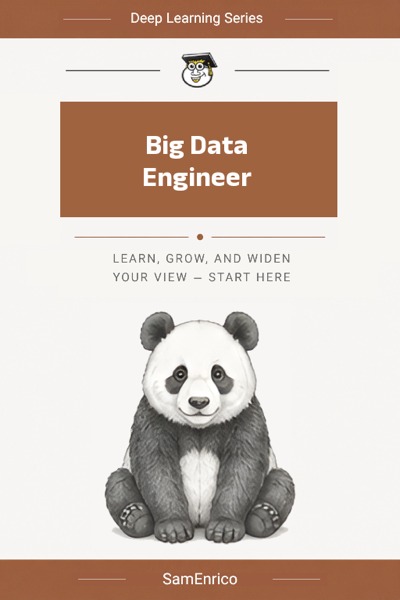
Big Data Engineer eBook
A Coursebook on Big Data Engineer
A Coursebook on Big Data Engineer
Formats
Free sample
Chapter 1: The Data Beneath…--It was 11:47 PM on a Tuesday when Sarah’s phone buzzed with a Pager Duty alert. The dashboard she’d spent three weeks building for the e‑commerce company’s executive team was showing flat sales for the last six hours. Flat sales at 6 PM on a Tuesday—during a flash sale. The numbers were impossible.She opened her laptop, connected to the VPN, and started digging. The dashboard query ran against a table that was supposed to be updated every hour.
The last update timestamp read 4:00 PM. Six hours of missing data. The product manager would be furious. The CMO would demand answers at the 9 AM meeting. And somewhere in the data pipeline, a silent failure had been eating transaction records for dinner.Sarah was a data engineer.
Not a data scientist building models. Not an analyst creating dashboards. She was the person who built the pipes, the pumps, and the filters that moved billions of events from click to database. And tonight, one of those pipes had burst.She traced the failure to a Spark job that had crashed because a source JSON file had an unexpected field. The schema validation—which no one had documented—expected a field called “user_id” but the new mobile app release was sending “user Id.” The job failed silently, retried three times, then gave up.
No email alert. No Slack notification. Just a log file on a server no one checked.By 1:30 AM, Sarah had hot‑patched the transformation logic, backfilled six hours of data, and re‑ran the dashboard queries. Sales were actually up 22 percent. The flat line was a lie—a lie caused by a single underscore.She closed her laptop and stared at the ceiling.
This was the job. Not the glamorous AI predictions or the sleek data visualizations. This was the reality: finding needles in haystacks, decoding undocumented schemas, and rebuilding pipelines before the morning meeting. And she loved every minute of it.This book is for the Sarahs of the world. For the engineers who know that data doesn’t magically appear in dashboards.
For the problem‑solvers who understand that before you can predict the future, you have to reliably store the present. Welcome to the world of the Big Data Engineer.1.1 What Is Big Data, Really?If you search online for “big data definition,” you will find endless articles about the four Vs: Volume, Velocity, Variety, and Veracity. Some add a fifth V for Value. These are useful labels, but they miss the point. Big data is not about size or speed.
Big data is about the gap between what you want to do with your data and what your current tools can handle.Think about a single row in a My SQL database. You can query it, update it, and delete it with ease. Now imagine a billion rows. Your My SQL query that took 0.1 seconds now takes two hours. The data hasn't changed.
Your query hasn't changed. But the scale has broken the tool.That gap—between the capabilities of traditional systems and the demands of modern data—is where big data engineering lives.The Four Vs as a Diagnostic, Not a Definition Let’s briefly examine the four Vs, not as a definition but as a way to diagnose problems:Volume – The sheer number of bytes. One gigabyte is manageable on a laptop. One petabyte is not. Volume forces you to think about distributed storage, compression, and partitioning.Velocity – The speed at which data arrives.
A thousand events per second from a mobile app is very different from a daily CSV upload. Velocity forces you to think about streaming, queues, and exactly‑once processing.Variety – The shapes of data. CSV, JSON, Avro, Parquet, images, video, logs. Variety forces you to think about schema evolution, type systems, and data lakes.Veracity – The trustworthiness of the data. If 5 percent of your sensor readings are garbage, how do you detect and fix it?
Veracity forces you to think about data quality, validation, and lineage.These four dimensions interact. High volume plus high velocity is a streaming problem. High variety plus low veracity is a data quality problem. The engineer’s job is to recognize the combination and choose appropriate tools.The Real Challenges: Storage Costs, Compute Limits, and Data Gravity Beyond the four Vs, three practical challenges dominate daily engineering work.Storage costs are not just about disk space. They are about retrieval speed, replication, and durability.
Cloud storage like S3 is cheap for the first petabyte but becomes expensive when you add cross‑region replication, lifecycle policies, and frequent access. Every engineer must learn to estimate storage costs before designing a pipeline.Compute limits are the hidden constraint. You can store a petabyte of log files for relatively little money, but processing that petabyte with a Spark cluster costs real dollars per hour. Engineering is about trade‑offs: do you spend more on storage to make compute faster (e.g., using columnar formats like Parquet) or spend more on compute to avoid expensive storage transformations?Data gravity is the least understood concept. Data gravity means that as data accumulates in one place, it becomes easier to move queries to the data than to move the data to the queries.
A massive dataset in S3 attracts compute (EMR, Athena, Redshift Spectrum) to that same region. Over time, your entire infrastructure orbits around your largest datasets. Breaking that orbit requires expensive data transfers.A New Definition for the Working Engineer Here is the definition this book will use:Big data is any dataset or data flow that forces you to use distributed systems to store, process, or query it within your required time and budget constraints.Notice what this definition includes: distributed systems, time, and budget. It does not name a specific number of terabytes or events per second. A dataset that fits on your laptop is not big data for you.
The same dataset, loaded into a data warehouse with millions of concurrent queries, suddenly becomes big data because your laptop cannot handle the concurrency.This pragmatic definition will serve you well in interviews and on the job. When someone asks, “Do you have big data experience?” you can answer: “I have experience designing distributed systems to meet storage, compute, and latency requirements under budget constraints.”1.2 The Data Maturity Curve Not every company needs a distributed data architecture. A local bakery with a point‑of‑sale system and an Excel spreadsheet does not need Spark. A ride‑sharing company with two million trips per day does. The difference is where the company sits on the data maturity curve.Stage 1: Descriptive Analytics (What Happened?)The first stage is simply knowing what happened.
How many sales yesterday? Which products sell best on weekends? This stage relies on basic business intelligence: SQL queries, dashboards, and periodic reports.The data engineer at this stage is often a “data analyst who knows some SQL” or a “database administrator who can write scripts.” Pipelines are simple: extract from a transactional database, transform minimally, load into a reporting table. The biggest challenge is usually performance optimization of SQL queries.Stage 2: Diagnostic Analytics (Why Did It Happen?)The second stage…
This is the end of the free sample. Get the eBook to keep going. Buy now
About this book
Details
- Author
- Mccann Marietta
- Publisher
- SamEnrico
- Language
- English
- Genre
- Non-Fiction, Informative, Educational
- Released
- 2026-05-09
- Pages (approx.)
- 147
- Available as
- eBook, Audiobook

Read better in the ZLOADR app
Your eBooks on your phone or tablet. Sign in with your SamEnrico account and start reading.
More by Mccann Marietta
 The Remote Work Zero InboxMccann Marietta$11.99
 Weight Loss Self Hypnosis GuideMccann Marietta$11.99
 Meeting Recap AutomationMccann Marietta$11.99
 Richard Ramirez Mugshot StoryMccann Marietta$11.99
 Calvin Coolidge Silent CalMccann Marietta$11.99
 The Last Letter: A Love Rekindled Across TimeMccann Marietta$11.99
 Black Sunday: The Storm That Stole the PlainsMccann Marietta$11.99
 Understanding Cutis Verticis Gyrata Thyroid Aplasia Mental RetardationMccann Marietta$17.99
 Carbon Capture Tax CreditMccann Marietta$12.99
 Influencer Marketing One PageMccann Marietta$12.99
 How to Start a Hobby in Metal detectingMccann Marietta$11.99