
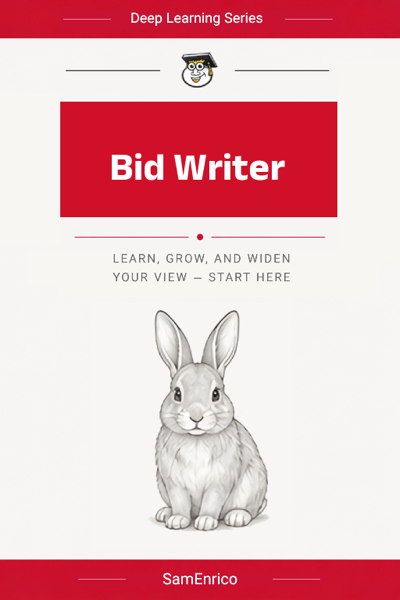
Non-FictionInformativeEducational
Bid Writer eBook
A Coursebook on Bid Writer
by Herr Elnora
A Coursebook on Bid Writer
Formats
Free sample
Chapter 1: The Go/No-Go Gate--–- The email arrives at 4:47 on a Tuesday afternoon. Subject line: “URGENT - Major Opportunity - Response Due in 10 Days.” Your heart rate ticks up. This could be the big one. The contract that puts your team on the map. The reference client you have been chasing for years.
You open the attachment and scroll through 137 pages of requirements, evaluation criteria, and mandatory forms. Your stomach sinks. You do not have two of the required certifications. The incumbent is a well-respected competitor with a decade of history. And you have never spoken to the buyer.But it is a major opportunity.
So you bid anyway. And you lose.This scenario plays out thousands of times every week across every industry. Smart, capable, motivated professionals pour hundreds of hours into proposals they were never going to win. They do it because no one stopped them at the door. No one asked the uncomfortable question: Should we really bid on this?The decision to bid or not to bid is the single most important judgment a bid writer makes.
More important than the writing. More important than the pricing. More important than the graphics. Because a brilliant proposal for the wrong opportunity is still a loss. And a loss costs you more than the contract.
It costs you time, money, reputation, and morale.This chapter introduces the Go/No-Go Gate: a disciplined, two-stage framework for deciding which battles to fight. It draws on the principles found in the most successful bidding organizations worldwide. And it will save you from the graveyard of good intentions where beautifully written losing proposals go to die.Why Most Bidding Decisions Are Broken Before we build a better framework, we need to understand why the current approach fails so consistently. The problems fall into four categories.The Optimism Bias Human beings are terrible at estimating probability. We consistently overestimate our chances of success, especially when we want something badly.
This is called the optimism bias, and it is hardwired into our brains. When a sales director sees a large contract opportunity, their brain releases dopamine. The dopamine feels good. The good feeling clouds judgment. And suddenly a 20 percent chance feels like a 60 percent chance.Bid writers are not immune.
You have invested time in understanding the opportunity. You have started to imagine what winning would feel like. You have mentally spent the revenue. This emotional investment makes it nearly impossible to evaluate probability objectively. You need a framework that forces objectivity because your brain will not provide it.The Sunk Cost Fallacy Once an organization starts pursuing an opportunity, stopping feels like failure.
Even when the evidence clearly shows the bid is unwinnable, the conversation shifts to how to salvage it, not whether to abandon it. This is the sunk cost fallacy. The time already spent becomes a reason to spend more time.The Go/No-Go Gate solves this problem by moving the decision to the very beginning of the process. Before any writing. Before any significant expense.
Before any emotional investment. The decision happens when you are still objective because you have nothing to lose.The Fear of Missing Out No one wants to be the person who said no to a contract that a competitor won. This fear drives bad decisions. Organizations bid on opportunities because they are terrified of seeing a rival’s logo on a press release. They would rather lose than not compete.This is strategic cowardice dressed up as ambition.
The fear of missing out is not a strategy. It is an expensive emotional response. The Go/No-Go Gate treats it as exactly that: an irrational factor to be identified and dismissed, not a reason to bid.The Absence of Accountability Most organizations have no formal process for bid decisions. The sales director makes a call. The CEO gets excited.
The bid writer is told to make it happen. No one records the decision. No one reviews whether it was correct. No one learns.When there is no accountability, there is no improvement. The same bad decisions repeat every quarter.
The Go/No-Go Gate creates a documented, auditable record. Every decision is recorded. Every outcome is reviewed. Every lesson is captured.The Two-Stage Framework The Go/No-Go Gate has two stages. Stage One is the Probability Assessment.
It answers the question: If we bid, how likely are we to win? Stage Two is the Strategic Value Assessment. It answers the question: If we win, how much does it matter?Between these stages sits a mandatory decision point. Low-probability, high-value bids do not die automatically. They proceed to a Strategic Override Review where an executive makes a documented judgment.
High-probability, low-value bids are rejected unless they serve a specific tactical purpose. Everything else is governed by the numbers.This framework respects both math and judgment. It prevents the arrogance of assuming you can overcome long odds. And it prevents the timidity of passing on opportunities that could transform your business.Let us examine each stage in detail.Stage One: The Probability Assessment The Probability Assessment uses a weighted scoring model called the Win Probability Calculator. It is not a magic formula.
It is a structured way to force honest conversation about factors that are easy to ignore when you want something.The calculator uses eight weighted criteria. Each is scored from zero to ten. The weights sum to one hundred percent. The final score is a percentage probability. Scores above seventy percent are strong bids.
Scores between fifty and seventy percent are marginal. Scores below fifty percent are weak.Incumbent Status (20 percent weight)Are you the current provider? Incumbents win approximately 70 to 80 percent of rebids when performance has been satisfactory. This is the single most predictive factor in most procurements. Score zero if you are not the incumbent and the incumbent is well-regarded.
Score five if you are not the incumbent but the incumbent has known problems. Score eight if you are the incumbent with average performance. Score ten if you are the incumbent with exceptional performance and documented client satisfaction.Relationship Strength (15 percent weight)Have you engaged with the buyer before the RFP was released? Have you helped them think through their requirements? Do they know your name?
Bids are won and lost in the relationship phase long before the document is opened. Score zero if you have no relationship and have never spoken to the buyer. Score three if you have made introductory contact. Score six if you have had substantive conversations about their needs. Score nine if you have helped shape the RFP requirements.
Score ten if you have a trusted advisor relationship.Unique Differentiators (15 percent weight)Do you have something no one else has? A proprietary methodology. A patented technology. A uniquely qualified team. A location advantage.
These differentiators must be real, provable, and relevant to the client’s stated needs. Score zero if you have no unique differentiators. Score four if your differentiators are common across competitors. Score seven if you have one or two meaningful differentiators. Score ten if you have multiple differentiators that are genuinely hard to replicate.Past Performance Relevance (12 percent weight)Have you done exactly this work before?
Not similar work. Not adjacent work. Exactly this scope, scale, and complexity in the same sector. Buyers value direct experience…
This is the end of the free sample. Get the eBook to keep going. Buy now
About this book
Details
- Author
- Herr Elnora
- Publisher
- SamEnrico
- Language
- English
- Genre
- Non-Fiction, Informative, Educational
- Released
- 2026-06-02
- Pages (approx.)
- 139
- Available as
- eBook, Audiobook

Read better in the ZLOADR app
Your eBooks on your phone or tablet. Sign in with your SamEnrico account and start reading.
More by Herr Elnora
 Anger for ChiropractorsHerr Elnora$11.99
 Internal Comms Crisis DrillHerr Elnora$11.99
 Food Intolerance MythsHerr Elnora$11.99
 Workaholism in MaritimeHerr Elnora$11.99
 The Atomic Habits for FitnessHerr Elnora$11.99
 The Birmingham Six: A Fight for Justice in the Shadow of the IRAHerr Elnora$11.99
 How to Start a Pet Shop (retail) Business (Beginners Guide)Herr Elnora$11.99
 Relationship Conflict ResetHerr Elnora$12.99
 Wave AI Accounting GuideHerr Elnora$12.99
 Understanding Stampe Sorensen SyndromeHerr Elnora$17.99
You may also like
 Hong Kong Handover 1997Dunn Johnnie$11.99
 Zumba For Postnatal Recovery CourseNeal Christian$11.99
 Zumba for BeginnersLadner Nikia$11.99
 YouTube Comment Mining GuideHumes Pandora$12.99
 Worry Box MeditationCarlin Rudy$11.99
 Workplace Stress MeditationNguyen Lynn$11.99
 Workplace Stress and Sleep RepairHawley Ivory$11.99
 Workplace Perfectionism CureDelaney Jeffry$11.99
 Workplace Injustice Anger GuideWallen Isabelle$11.99
 Work Addiction and Burnout LinkGreenwood Ester$11.99
 Women in Yoga and WellnessBeattie Galina$11.99
 Women in Stand Up ComedyChun Evangeline$11.99