
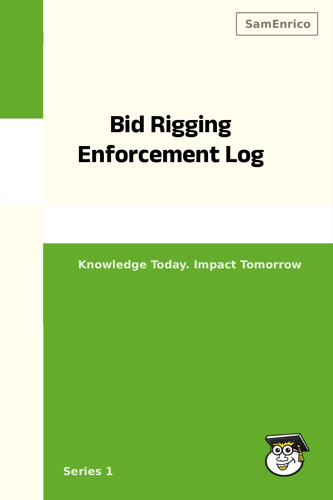
Non-FictionCompliance & Risk ArchiveProcurement
Bid Rigging Enforcement Log eBook
Criminal and civil cases against conspiratorial bi
Criminal and civil cases against conspiratorial bidding in public and private procurement.
Formats
Free sample
Chapter 1: The Wine Cellar--The cork made a soft, triumphant pop—the sound of a $300 bottle of Opus One surrendering to a waiter who had opened ten thousand such bottles in his career. The wine breathed. The three men around the table breathed too, but differently. They exhaled with the specific relief of men who had just concluded business without leaving a single piece of paper behind.The location was the wine cellar of a Michelin-starred restaurant in Napa Valley, chosen specifically because it had no windows, no security cameras pointed at the tables, and a maître d' who had been handsomely compensated for his discretion. The date was three weeks before the California Department of Transportation would open bids for a $97 million bridge reinforcement project.
The three men—let us call them Contractor A, Contractor B, and Contractor C, though their real names would later fill twenty-three pages of a federal indictment—were the owners of the three largest heavy civil construction firms in Northern California.Between them, they controlled approximately 85 percent of the region's bridge and highway repair market. Between them, they had decided, over the course of this three-hour dinner, exactly how the Caltrans bidding would proceed.Contractor A would win the bridge project. His bid would be $112 million—aggressive enough to beat any legitimate competitor, high enough to include a 22 percent profit margin that would be split three ways. Contractor B would submit a cover bid: $118 million, with a fatal error in the bonding documentation that would ensure disqualification if anyone bothered to check. Contractor C would not bid at all, citing "scheduling conflicts," and would instead receive a $3 million subcontract for the approach ramps—work he would have bid aggressively to win, had he not been paid to stay home.The wine was excellent.
The plan was simple. And for the next four years, no one caught them.The Mathematics of Theft Before we go any further, let us understand what those three men did, not in legal terms but in human terms. The Caltrans bridge project was funded by gasoline taxes paid by California drivers. Every time a family filled up their minivan, a fraction of that money went into a state infrastructure fund. Over the course of a year, the average California household contributed approximately $247 to that fund.The conspiracy in that Napa wine cellar did not steal from faceless corporations or distant shareholders.
It stole from those families. The inflated bid—$112 million instead of the competitive market price of approximately $93 million—meant that Caltrans paid an extra $19 million for the bridge. That $19 million would not go to additional road repairs, or to school construction, or to any other public good. It would be divided among three wealthy contractors who had simply agreed not to compete.This is the mathematics of bid rigging, and it is staggering. The Organisation for Economic Co-operation and Development (OECD), after studying procurement data from thirty-four countries over two decades, concluded that collusive bidding inflates contract prices by an average of 20 percent.
Not 2 percent. Not 5 percent. Twenty percent. For every $100 million in public infrastructure spending, $20 million is effectively stolen from taxpayers and transferred to conspirators.The Government Accountability Office (GAO) has attempted to estimate the total annual cost of procurement fraud in the United States, including bid rigging, and the numbers are almost impossible to comprehend. The GAO's conservative estimate is $233 billion per year.
Its upper bound is $521 billion. To put that in perspective, the entire budget for the Department of Homeland Security in 2024 was approximately $90 billion. The Department of Energy's budget was $48 billion. The combined budgets of the Environmental Protection Agency, NASA, and the National Science Foundation totaled less than $70 billion.The money stolen through bid rigging every year could fund all of those agencies twice over, with billions left over.But the mathematics, while shocking, is not the story. The story is how the Caltrans conspiracy worked, how it was eventually caught, and why similar conspiracies continue to operate in every state, in every industry, and at every level of government—including, as we shall see in Chapter 3, a loophole so large that a manufacturer can now legally collude with its own distributors.The Anatomy of a Conspiracy: Caltrans The California Department of Transportation conspiracy—formally known as United States v.
Fisk Electric Company, though the public came to call it the "Wine and Remodeling" scandal after evidence revealed conspirators meeting over expensive meals and home renovation projects—began not with a criminal mastermind but with a simple observation.The observation was this: bidding on public contracts was expensive. Preparing a bid required hiring engineers to estimate costs, lawyers to review specifications, and bonding companies to guarantee performance. A single bid could cost a contractor $500,000 to prepare. And for what? To win perhaps one contract out of every ten?
To grind margins down to 3 percent? To work through weekends for the privilege of building a bridge at cost?The men who gathered in Napa did not see themselves as criminals. They saw themselves as pragmatists. They had children in private schools, mortgages on second homes, and employees who depended on them for paychecks. Competition was inefficient.
Cooperation was rational. The only problem—the only obstacle, really—was the law.The Sherman Antitrust Act of 1890, which we will explore in detail in Chapter 10, makes it a felony for competitors to agree on prices, allocate markets, or rig bids. The penalty is up to ten years in prison and $1 million in fines for individuals, and up to $100 million for corporations. The law is clear, and it has been clear for more than 130 years.But the law is only as effective as its enforcement. And enforcement requires evidence.The Caltrans conspirators were careful.
They did not put anything in writing. They did not email. They did not text. They met in person, in places without recording devices, and they spoke in the coded language of businessmen who had been doing this since before most of their employees were born. "We need to be disciplined on the Smith Street job" meant "You will submit a cover bid." "The market is soft on the Bay Bridge approach" meant "You will not bid at all." "Let's have dinner and talk about the industry" meant "Let's allocate the next quarter's contracts."For four years, this system worked.
The conspiracy expanded from three contractors to seven, then to twelve. The rotation became more sophisticated. A spreadsheet—kept, remarkably, on a personal laptop that would later become the star witness at trial—tracked who had won which contracts and who was due for the next one. The spreadsheet did not say "Bid Rigging Schedule." It said "Project Tracking FY2018-2022." But the columns told the story: winner, price, cover bidder, subcontractor allocation, and a column labeled "Notes" that contained gems like "Joe owes us one" and "Steve's turn to sit out."What finally brought them down was not a whistleblower, not a wiretap, and not a confession. It was a junior analyst at the Department of Justice Antitrust Division named Sarah Brennan, who noticed something strange in a routine data review.The Yellow Highlighter Sarah Brennan was twenty-seven years old when she joined the DOJ's Antitrust Division.…
This is the end of the free sample. Get the eBook to keep going. Buy now
About this book
Details
- Author
- Gonzalez Dale
- Publisher
- SamEnrico
- Language
- English
- Genre
- Non-Fiction, Compliance & Risk Archive, Procurement
- Released
- 2026-06-10
- Pages (approx.)
- 155
- Available as
- eBook, Audiobook

Read better in the ZLOADR app
Your eBooks on your phone or tablet. Sign in with your SamEnrico account and start reading.
More by Gonzalez Dale
 Mentorship in Creative IndustriesGonzalez Dale$11.99
 Assertiveness For WritersGonzalez Dale$11.99
 Mindful Stress Reduction for NursesGonzalez Dale$11.99
 Self Worth After Job LossGonzalez Dale$11.99
 Barrymore DynastyGonzalez Dale$11.99
 Thumb Sprain RehabilitationGonzalez Dale$11.99
 The Crying CornerGonzalez Dale$11.99
 Trace Evidence Contamination PreventionGonzalez Dale$11.99
 The Silent Ward: The Forgotten Patients of St. Mary'sGonzalez Dale$11.99
 The Forgotten Clash of the Adriatic: Otranto Barrage and the Silent War Beneath the WavesGonzalez Dale$11.99
 Lancelot’s Last Waltz: The Knight Who Danced with ShadowsGonzalez Dale$11.99
 The Mineral Guide to RosasiteGonzalez Dale$11.99
You may also like
 Hong Kong Handover 1997Dunn Johnnie$11.99
 Zumba For Postnatal Recovery CourseNeal Christian$11.99
 Zumba for BeginnersLadner Nikia$11.99
 YouTube Comment Mining GuideHumes Pandora$12.99
 Worry Box MeditationCarlin Rudy$11.99
 Workplace Stress MeditationNguyen Lynn$11.99
 Workplace Stress and Sleep RepairHawley Ivory$11.99
 Workplace Perfectionism CureDelaney Jeffry$11.99
 Workplace Injustice Anger GuideWallen Isabelle$11.99
 Work Addiction and Burnout LinkGreenwood Ester$11.99
 Women in Yoga and WellnessBeattie Galina$11.99
 Women in Stand Up ComedyChun Evangeline$11.99