
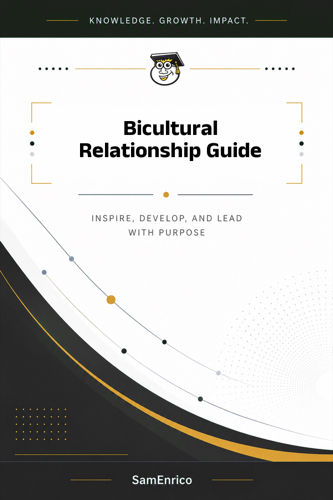
Bicultural Relationship Guide Audiobook
Balance two sets of norms, languages, and family e
Balance two sets of norms, languages, and family expectations peacefully.
Formats
Free sample
Chapter 1: The Iceberg Below--Every fight you have ever had about the dishwasher, about being late, about how much money to send to your mother, about whether to take your shoes off at the door—every single one of those fights was not about what you thought it was about. This is the first and most difficult truth of bicultural love: you have been arguing with a ghost. Not your partner. Not their family. Not their annoying habit of leaving the TV on while you need silence.
No. You have been arguing with your own unexamined normal—the invisible set of rules you mistake for objective reality, for common sense, for the way any reasonable person would do things.Let that land for a moment.When you say “Why can’t you just be on time?” you are not asking a question about clocks. You are making a moral statement. In your culture, punctuality equals respect. Tardiness equals disrespect.
You were not taught this explicitly. No one sat you down and said, “In our family, being late means you do not value the other person’s time.” You absorbed it. You drank it with your mother’s milk. And now it feels like gravity—not a choice, not a preference, but simply the way the world works.Your partner, meanwhile, was raised in a different gravity. In their culture, arriving exactly on time might feel aggressive, even rude.
Flexibility is a virtue. Relationships take precedence over schedules. Showing up “late” with a warm smile and a genuine apology is not a failure of character; it is a prioritization of people over plans.Neither of you is wrong. Both of you are acting on deep, unspoken, and perfectly logical cultural programming. And until you can see your own programming—until you can hold it in your hands and say, “This is not universal truth; this is my truth”—you will continue to mistake your partner’s difference for their deficiency.This chapter is not about fixing your partner.
It is about seeing yourself. Before you can build a shared culture with someone from another world, you must first excavate the ruins of your own.The Iceberg Model of Culture Cultural anthropologists have a useful metaphor for what we are about to do. Imagine an iceberg floating in cold, dark water. Above the surface, visible to any passerby, are the things we typically think…
This is the end of the free sample. Get the Audiobook to keep going. Buy now
About this book
Details
- Author
- Seward Elaina
- Publisher
- SamEnrico
- Language
- English
- Genre
- Non-Fiction, Self-Help
- Released
- 2026-06-10
- Pages (approx.)
- 138
- Available as
- eBook, Audiobook

Listen in the VoxFlicks app
Audiobooks and audio dramas wherever you go. Sign in with your SamEnrico account and press play.
More by Seward Elaina
 Menopause Travel Survival GuideSeward Elaina$11.99
 Monday Morning Review GuideSeward Elaina$11.99
 Email Metrics Dashboard SetupSeward Elaina$11.99
 Stress and Arrhythmia GuideSeward Elaina$11.99
 Frederick Sanger Double BiochemistSeward Elaina$11.99
 Eisenhower Matrix for ArchitectsSeward Elaina$11.99
 Assertiveness HypnosisSeward Elaina$11.99
 The Sheikhs and the Taxman: Dubai's Billion-Dollar Evasion Scandal (1980s)Seward Elaina$11.99
 Charlemagne's Tides: The Carolingian Renaissance and the Birth of the Western MindSeward Elaina$11.99
 How to Produce Dishwasher CleanersSeward Elaina$11.99
 Mastering Franchise Tax: State Business FeesSeward Elaina$11.99
 Chinese Supplier Social Compliance PlaybookSeward Elaina$12.99
You may also like
 Workplace Stress MeditationNguyen Lynn$11.99
 Volcano Monitoring ScientistCox Alexis$11.99
 The Tech Professional NetAguiar Nevada$11.99
 The Morning Metta RitualCanales Anya$11.99
 The Chunking Memory TechniqueClanton Hyacinth$11.99
 The Beginner Mistake FixAmmons Cassondra$11.99
 Surrendering to What IsGrimm Reatha$11.99
 Self Hypnosis for Fear of FireBillups Eli$11.99
 Road Rage for Professional DriversBrackett Janise$11.99
 Psychiatric Ward Nurse StressDunning Wyatt$11.99
 Observation vs Evaluation NVCTimmons Alda$11.99
 Networking for Nonprofit ProfessionalsPoole Jesse$11.99