
Non-FictionBiographyInvestor Relations
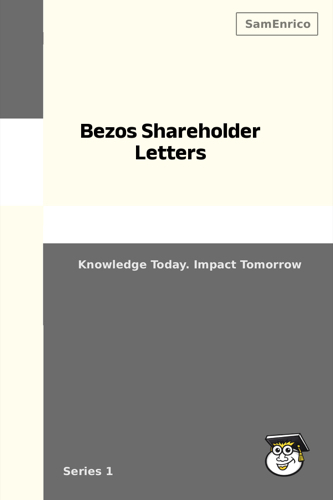
Bezos Shareholder Letters eBook
Communicate long-term strategy to investors to ear
Communicate long-term strategy to investors to earn patience.
Formats
Free sample
Chapter 1: The Long Game Manifesto--–- In 1997, Jeff Bezos wrote a letter to his shareholders that was, by every conventional measure, insane. Amazon had just completed its first year as a public company. It had lost money. It was a tiny online bookstore competing against the retail giant Barnes & Noble. Wall Street expected a mea culpa.
They expected promises of future profitability, cost-cutting measures, and a timeline for turning red ink into black. Instead, Bezos gave them a manifesto. He wrote that Amazon would prioritize "market leadership" over short-term profits. He warned that the stock would be volatile. He explicitly stated that he would measure success by Free Cash Flow, not accounting income.
And then he signed it with a phrase that would become legendary: "It's All About the Long Term."This chapter is about that manifesto and the principle that underpins every letter Bezos would write for the next twenty-four years. The "Long Game" is not a strategy. It is a worldview. It is the explicit, public, and repeated commitment to a multi-year horizon that outlasts the impatience of quarterly capitalism. Without this chapter, the rest of the book is just tactics.
With it, you have the foundation upon which everything else is built.Defining the Long Game: Not a Number, a Mindset Let us start with clarity. When Bezos wrote "long term," what did he mean? The 1997 letter did not specify a number of years. But subsequent letters and internal memos made it clear: the minimum horizon for a truly long-term decision is five to seven years. Some bets—like AWS, which took nearly a decade to become profitable—require even longer.
The principle is not a fixed number. It is a mindset: you must outlast the impatience of others.The Long Game has three distinct components. First, there is the time horizon itself: the willingness to make investments today that will not pay off for years. Second, there is the communication strategy: the explicit, repeated teaching of that horizon to shareholders. Third, there is the measurement system: the metrics that track progress toward long-term goals rather than quarterly targets.
Most companies fail at all three. They claim to be long-term, but their actions say otherwise. They provide quarterly guidance. They cut R&D to hit earnings per share. They spin off promising divisions because the market does not "value" them correctly.
Bezos did none of these things.The Long Game manifesto was radical because it pre-committed Amazon to a path that most public companies avoid. Bezos was telling investors: if you buy this stock, you are buying a decade-long experiment. Do not expect smooth sailing. Do not expect quarterly dividends. Expect volatility.
Expect losses. Expect to be misunderstood. And expect to be enormously wealthy if you stay the course.This was not bluster. It was a filter. Bezos wanted shareholders who believed in the mission, not traders looking for a quick flip.
By stating his philosophy explicitly, he separated patient capital from speculative capital. The traders sold. The believers bought. And over the next two decades, those believers were rewarded with a return of over 100,000 percent.The Problem with Quarterly Guidance To understand why the Long Game is so rare, you have to understand the tyranny of quarterly guidance. Most public companies provide earnings forecasts for the upcoming quarter.
They tell analysts exactly how much profit they expect to make. Then they spend the next ninety days managing to that number. If the number is too low, the stock drops. If the number is too high, they have set themselves up for a miss. Either way, the company is dancing to the analyst's tune.Quarterly guidance creates three perverse incentives.
First, it encourages short-term cost-cutting over long-term investment. Why spend money on R&D that will not pay off for three years when you can cut it and beat the quarter? Second, it discourages volatility. Companies smooth earnings, hide losses, and delay necessary write-downs to avoid spooking the market. Third, it rewards incrementalism.
A bold, risky bet might fail and miss the quarter. A safe, small bet will not. Over time, the safe bets accumulate into irrelevance.Bezos refused to play this game. Amazon never provided quarterly guidance. Not once.
When analysts asked for earnings forecasts, Bezos told them to look at the long-term metrics instead. He knew that any number he gave would become a target, and any target would distort behavior. The absence of guidance was not an oversight. It was a strategic choice.But refusing guidance creates a new problem: what do investors use to model their returns? If you will not tell them your expected earnings, how do they decide whether to buy or sell?
The answer is the Guidance Replacement Protocol. Instead of quarterly earnings forecasts, you provide three long-term metrics that actually matter. For Amazon, those metrics were Free Cash Flow per Share, customer retention, and unit economics. For your company, they might be different. But the principle is the same: teach investors what to watch, and they will stop asking for numbers you should not give.The Guidance Replacement Protocol has three steps.
First, identify the one to three metrics that best predict long-term value creation in your business. Second, report those metrics every quarter alongside your financial statements. Third, explain in your shareholder letter why those metrics matter more than net income. Over time, investors will learn to watch those metrics instead of demanding guidance. Patience is not given.
It is taught.The Education Imperative: You Cannot Demand Patience Here is a truth that most CEOs refuse to accept: you cannot demand patience. You cannot simply say "trust me" and expect investors to hold on through years of losses. Patience is not a birthright. It is earned. And the way you earn it is through education.Bezos understood this intuitively.
Every shareholder letter contained a section that explained, in plain language, why Amazon was making specific long-term investments. He did not assume that investors understood the logic of the flywheel or the value of Free Cash Flow. He taught them. He repeated the same concepts year after year, in slightly different language, until they became part of the investor's mental model.The education imperative has three components. First, you must name your principles.
Bezos called his "It's All About the Long Term." That phrase appears in every single shareholder letter from 1997 to 2021. Repetition is not boring. It is branding. When investors hear "long term," they think of Amazon.Second, you must show your work. Bezos did not just assert that Free Cash Flow mattered.
He showed the math. He explained why accounting profits punish investment and why cash rewards it. He gave investors the tools to evaluate Amazon on their own. An educated investor is a patient investor.Third, you must warn of volatility. Bezos explicitly told shareholders that the stock would be volatile.
He said that short-term results would be unpredictable. By lowering expectations, he prevented panic when the stock inevitably dropped. Investors who were warned were less likely to sell.The relationship between teaching and earning patience is simple: when investors understand the logic, they choose patience voluntarily. That choice is the earning. You do not demand it.…
This is the end of the free sample. Get the eBook to keep going. Buy now
About this book
Details
- Author
- Rudolph Benito
- Publisher
- SamEnrico
- Language
- English
- Genre
- Non-Fiction, Biography, Investor Relations
- Released
- 2026-06-09
- Pages (approx.)
- 113
- Available as
- eBook, Audiobook

Read better in the ZLOADR app
Your eBooks on your phone or tablet. Sign in with your SamEnrico account and start reading.
More by Rudolph Benito
 Meal Prep for TailgatingRudolph Benito$11.99
 EQ for Leaders HandbookRudolph Benito$11.99
 Breach Disclosure TimelinesRudolph Benito$11.99Breach Disclosure TimelinesRudolph Benito$11.99
 German Wehrmacht Defector StoryRudolph Benito$11.99
 F B I Sheppard File ReleaseRudolph Benito$11.99
 Apathy Meditation ProtocolRudolph Benito$11.99
 Working Memory Training WorkbookRudolph Benito$11.99
 The Ghost in the Machine: Europe's Ransomware Amnesia CrisisRudolph Benito$11.99
 Shadows Over Monte Cassino: The Secret War Behind the LinesRudolph Benito$11.99
 How to Start a Promotion of Sporting Events Business (Beginners Guide)Rudolph Benito$11.99
 How to Produce Rubber CementRudolph Benito$11.99
You may also like
 Hong Kong Handover 1997Dunn Johnnie$11.99
 Zumba For Postnatal Recovery CourseNeal Christian$11.99
 Zumba for BeginnersLadner Nikia$11.99
 YouTube Comment Mining GuideHumes Pandora$12.99
 Worry Box MeditationCarlin Rudy$11.99
 Workplace Stress MeditationNguyen Lynn$11.99
 Workplace Stress and Sleep RepairHawley Ivory$11.99
 Workplace Perfectionism CureDelaney Jeffry$11.99
 Workplace Injustice Anger GuideWallen Isabelle$11.99
 Work Addiction and Burnout LinkGreenwood Ester$11.99
 Women in Yoga and WellnessBeattie Galina$11.99
 Women in Stand Up ComedyChun Evangeline$11.99