
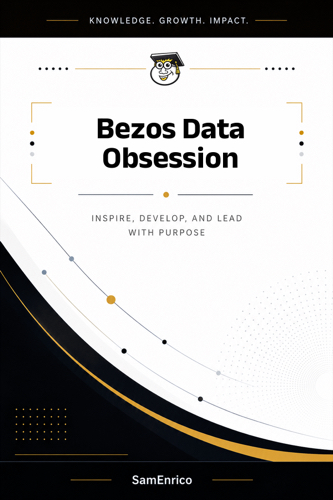
Bezos Data Obsession
Let metrics, not intuition, drive every strategic
by Mccune Kevin
Let metrics, not intuition, drive every strategic decision.
Formats
About this book
Free sample
Chapter 1: The War on Gut Feel...--–- On a rainy Tuesday afternoon in Seattle, 1997, Jeff Bezos stood before a room of skeptical investors and declared something that sounded like corporate suicide. “We will make decisions based on metrics, not intuition,” he said. “Even when the metrics contradict me.” A venture capitalist in the third row laughed out loud. “That’s not how leadership works,” he said. “CEOs are paid for their judgment.” Bezos didn’t argue.
He simply pointed to a chart showing that every “gut feel” feature Amazon had launched in the previous six months had underperformed against the A/B tested alternatives. The room went silent. That moment—a CEO publicly admitting that his own instincts were less reliable than a controlled experiment—became the origin story of Amazon’s data culture. But the real story started years earlier, on a trading floor in Manhattan, where a young Bezos watched quantitative models crush human intuition day after day. This chapter traces that genesis.
It explains why most companies remain addicted to Hi PPO (the Highest Paid Person’s Opinion), how Amazon declared war on that addiction, and why the 1997 Shareholder Letter was not a financial document but a manifesto for a new kind of organization—one where metrics replace myths, and where the loudest voice in the room is the data itself.The D.E. Shaw Laboratory: Where Obsession Was Born Before Amazon, before the Washington Post, before Blue Origin, there was D.E. Shaw & Co.—a quantitative hedge fund founded by a computer scientist named David Shaw. Bezos joined in 1990 as a vice president, and what he witnessed there changed him permanently. D.E.
Shaw did not trade on instinct. It did not care about a trader’s “twenty years of experience” or “feel for the market.” The firm built mathematical models that analyzed historical data, identified statistical anomalies, and executed trades automatically. If a model said buy, you bought. If it said sell, you sold. Your opinion was irrelevant.Bezos later described the experience as “a religious conversion.” He watched veteran traders—men who had made fortunes on…
This is the end of the free sample. Get the eBook to keep going. Buy now
Contents
- Chapter 1
- Chapter 2
- Chapter 3
- Chapter 4
- Chapter 5
- Chapter 6
- Chapter 7
- Chapter 8
- Chapter 9
- Chapter 10
- Chapter 11
- Chapter 12
Details
- Author
- Mccune Kevin
- Publisher
- SamEnrico
- Language
- English
- Genre
- Non-Fiction, Biography, Data Science
- Released
- 2026-06-10
- Pages (approx.)
- 133
- Available as
- eBook, Audiobook

Read better in the ZLOADR app
Your eBooks on your phone or tablet. Sign in with your SamEnrico account and start reading.
More by Mccune Kevin
 Meal Prep for Pickup FamiliesMccune Kevin$11.99
 Reichstag Flag Raiser 1945Mccune Kevin$11.99
 Apathy in Older AdultsMccune Kevin$11.99
 Bushy Haired Stranger TheoryMccune Kevin$11.99
 Imposter Syndrome Survival GuideMccune Kevin$11.99
 Vulnerability Disclosure TrendsMccune Kevin$11.99
 Rifaximin GuideMccune Kevin$11.99
 The Blood Oaths of Beirut: How the Sicilian Mafia Exported Violence to the Middle EastMccune Kevin$11.99
 The Witch Hunt Murders: New Zealand’s Modern-Day SalemMccune Kevin$11.99
 How to Start a Propelling or Sliding Pencils (wholesale) Business (Beginners Guide)Mccune Kevin$11.99
 How to Produce Routing ToolsMccune Kevin$11.99
 A Collector's Handbook to the Armstrong Siddeley Armstrong-siddeley 12Mccune Kevin$11.99