
Non-FictionFirst 30 DaysBeta TestingBusiness Brief
Beta Tester Recruitment Guide eBook
Find and onboard beta testers to review digital pr
Finds early users for product feedback.
Formats
Free sample
Chapter 1: The Empty Room...--The first time I watched a founder launch a product to absolute silence, I was sitting in a We Work conference room in Austin, Texas. His name was Marcus. He had spent eleven months building a beautiful project management tool for freelance designers. The code was clean. The onboarding was smooth.
The pricing page had been A/B tested within an inch of its life. He had done everything right—except one thing. He had never let a stranger touch his product before launch day.Marcus had done what most founders do. He had recruited four beta testers: his co-founder, his wife, his former college roommate, and a friendly designer he met at a meetup. All four had given him glowing feedback.
"This is amazing." "I would definitely pay for this." "No bugs on my end!" So Marcus launched on Product Hunt, Hacker News, and every Slack community he belonged to. The result? Forty-seven upvotes. Three signups. Zero paying customers.
And one email that simply said: "Your login button doesn't work on Firefox."Marcus had fallen victim to what I call the Empty Room Problem. He had built a product for an audience that didn't exist—or rather, for an audience he had never bothered to meet. His "beta test" had been a mirror, reflecting only what he wanted to see. When he finally stepped into a real room full of real users, the room was empty.This book exists because Marcus's story is not the exception. It is the rule.
After studying over two hundred product launches across Saa S, mobile apps, and digital tools, I have found that roughly eighty percent of founders recruit beta testers incorrectly. They treat beta testing as a checkbox—something you do because someone on Twitter said you should. They recruit friends who are too nice to tell the truth. They recruit strangers without screening them. Or worse, they recruit no one at all and launch straight into the void.The result is predictable: silence, followed by confusion, followed by the slow death of a product that might have succeeded if only someone had used it before launch day.But there is another way.
A way that turns beta testers into partners, critics, evangelists, and—eventually—paying customers. A way that fills that empty room with people who are not just willing to test your product, but eager to break it, improve it, and then tell the world about it.This chapter is the foundation for everything that follows. It will teach you why most founders get beta testing wrong, the three distinct types of beta tests you can run, and—most importantly—how to define what you are actually trying to learn before you recruit a single soul. Because if you do not know what success looks like, you will never recognize it when it arrives.The Social Proof Imperative Before we talk about recruiting testers, we have to talk about why testers matter at all. And the answer is not quality assurance—at least, not primarily.The real reason beta testers matter is social proof.Social proof is the psychological phenomenon where people copy the actions of others in an attempt to reflect correct behavior.
In the context of product launches, social proof is the difference between a buyer thinking "this might be good" and a buyer thinking "other people like me already use this, so it must be good."Here is a fact that most founders refuse to accept: your marketing copy is nearly useless without social proof. You can write the most persuasive landing page in the history of the internet, and a skeptical buyer will still trust a single mediocre testimonial over your carefully crafted headlines. This is not a bug in human psychology. It is a feature. We have evolved to trust the experiences of our peers more than the promises of strangers.Beta testers give you something that money cannot buy: third-party validation that existed before your product was public.
When you launch and immediately display a "Wall of Fame" with twenty tester testimonials, you are not just showing that people like your product. You are showing that people trusted you enough to test an unfinished version. That is a different kind of signal entirely. It signals confidence. It signals transparency.
It signals that you have nothing to hide.Consider two hypothetical landing pages. Page A says: "Join thousands of happy customers." Page B says: "Before our public launch, forty-two beta testers filed one hundred and seventy-three bug reports. We fixed every single one. Here are their names and their favorite features." Which page do you trust? If you are like most buyers, you trust Page B—not because the numbers are bigger, but because the story is more honest.
Page B admits imperfection. Page B shows work. Page B proves that real humans engaged with the product before you were asked to pay for it.This is the Social Proof Imperative: you cannot launch a digital product in 2026 without pre-existing social proof from beta testers, or you will launch to silence. The only question is whether you will build that social proof intentionally or discover its absence accidentally.The Three Types of Beta Tests (And Why You Must Choose One)Most founders think "beta test" is a single thing. It is not.
There are three fundamentally different types of beta tests, and each serves a different purpose, requires a different tester profile, and produces a different outcome.Type One: The Vault (Closed/Private Beta)The Vault is a controlled, confidential beta test conducted under a Non-Disclosure Agreement (NDA) or similar confidentiality agreement. The goal is not hype or marketing. The goal is security, core functionality, and strategic feedback from a trusted group.You use The Vault when your product contains trade secrets, when you are launching to enterprise clients who demand exclusivity, or when your first version is so unstable that showing it to the public would damage your brand. The Vault typically involves fewer than fifty testers, all of whom have been personally vetted. Communication happens in private channels—Slack, Discord, or email lists hidden behind authentication.The Vault has two major advantages.
First, you can be radically honest with your testers about what is broken, because they are bound by confidentiality. Second, the feedback you receive tends to be higher quality because testers know they have been chosen for a reason. The Vault's disadvantage is scale: you will never stress-test your infrastructure with fifty people. You will never know if your login system collapses at five thousand concurrent users.When to choose The Vault: Enterprise Saa S, security-focused products, legal tech, medical devices, or any product where a public leak would be catastrophic.When to avoid The Vault: Consumer apps, products that rely on network effects, or any launch where hype is a primary success metric.Type Two: The Thunderdome (Open Beta)The Thunderdome is a high-volume, often public beta test where anyone can participate. The goal is stress testing, infrastructure validation, and mass feedback collection.
The name is intentional: the Thunderdome is chaotic, noisy, and occasionally brutal. But it is also where you discover how your product behaves…
This is the end of the free sample. Get the eBook to keep going. Buy now
About this book
Details
- Author
- Curtin Rolanda
- Publisher
- SamEnrico
- Language
- English
- Genre
- Non-Fiction, First 30 Days, Beta Testing, Business Brief
- Released
- 2026-06-01
- Pages (approx.)
- 137
- Available as
- eBook, Audiobook

Read better in the ZLOADR app
Your eBooks on your phone or tablet. Sign in with your SamEnrico account and start reading.
More by Curtin Rolanda
 Legal Profession BurnoutCurtin Rolanda$11.99
 The Governor's War on OpioidsCurtin Rolanda$11.99
 The Ecommerce Lead FunnelCurtin Rolanda$11.99
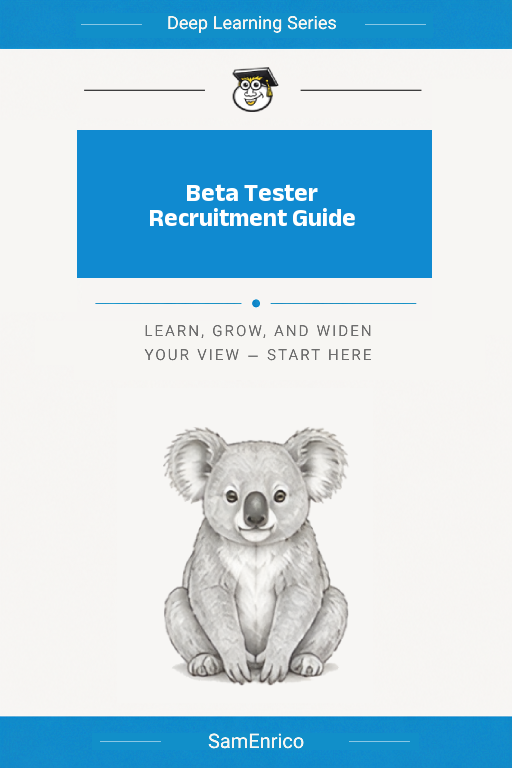 Beta Tester Recruitment GuideCurtin Rolanda$12.99
 IBS Bile Acid MalabsorptionCurtin Rolanda$11.99
 Feeling Rushed by Others TriggerCurtin Rolanda$11.99
 The Unseen Hand: How a 1964 Law Quietly Shaped the Internet AgeCurtin Rolanda$11.99
 The Ballot and the Bullet: The Unseen Rhetoric of the 1966 Howard University SpeechCurtin Rolanda$11.99
 Understanding Chronic Obstructive Pulmonary DiseaseCurtin Rolanda$17.99
 Director of ServiceCurtin Rolanda$11.99
 How to Start a Construction of Sewer Systems Business (Beginners Guide)Curtin Rolanda$11.99
 Financial Projections SpreadsheetCurtin Rolanda$12.99
You may also like
 Hong Kong Handover 1997Dunn Johnnie$11.99
 Zumba For Postnatal Recovery CourseNeal Christian$11.99
 Zumba for BeginnersLadner Nikia$11.99
 YouTube Comment Mining GuideHumes Pandora$12.99
 Worry Box MeditationCarlin Rudy$11.99
 Workplace Stress MeditationNguyen Lynn$11.99
 Workplace Stress and Sleep RepairHawley Ivory$11.99
 Workplace Perfectionism CureDelaney Jeffry$11.99
 Workplace Injustice Anger GuideWallen Isabelle$11.99
 Work Addiction and Burnout LinkGreenwood Ester$11.99
 Women in Yoga and WellnessBeattie Galina$11.99
 Women in Stand Up ComedyChun Evangeline$11.99