
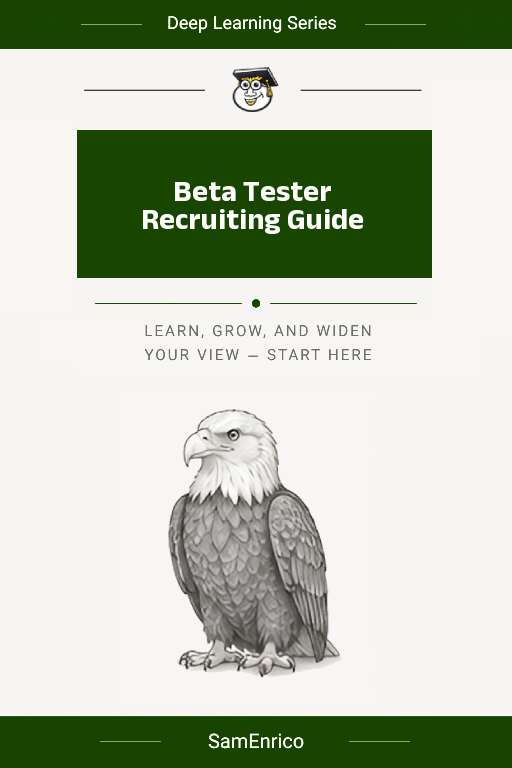
Non-FictionStartup GuideBeta TestingEarly Adopters
Beta Tester Recruiting Guide eBook
Find free beta testers from online communities who
Find free beta testers from online communities who will test your idea and give feedback without payment.
Formats
Free sample
Chapter 1: The Incentive Trap--–- Every first-time founder makes the same mistake. They launch a product, hold their breath, and wait for the world to care. When nobody shows up, they panic. And in that moment of panic, they reach for the only tool they think works: money. "I'll just pay people to try it," they tell themselves.
"A fifty-dollar gift card. A free coffee. A small cash incentive. What's the harm?"The harm is everything. And it starts the moment you attach a dollar sign to feedback.Let me tell you about Sarah.
She was a solo developer building a project management tool for small construction crews. She had worked on it for eighteen months, nights and weekends. When she finally released her beta, she posted on Reddit, Facebook groups, and Linked In. She offered a twenty-dollar Amazon gift card to anyone who signed up and completed a fifteen-minute survey.Forty-three people signed up. Thirty-seven took the gift card.
Three completed the survey. One gave feedback that wasn't "looks great" or "nice work." And that one piece of feedback was about a typo on the login page—something a spellchecker would have caught.Sarah spent over seven hundred dollars and got nothing usable. She told me she felt "scammed by her own testers." But the testers weren't the problem. The incentive was.This chapter dismantles the most expensive myth in product development: that you need to pay for quality feedback. But more importantly, it introduces a critical distinction that most books get wrong.
The distinction between monetary incentives and non-monetary value exchange. One corrupts. The other aligns. By the end of this chapter, you will understand why cash is the enemy of honest feedback, and how to build a tester recruiting engine that runs on something far more powerful: mutual self-interest.The Paid Actor Problem When you pay someone to test your product, you are not hiring a tester. You are hiring an actor.
And actors perform.The psychology is simple and brutal. A stranger clicks your link because they want the reward. They do not care about your problem. They do not care about your solution. They care about completing the task as quickly as possible so they can receive their incentive and move on with their day.
This is not malice. This is efficiency. You have incentivized speed and completion, not thoughtfulness or honesty.Here is what actually happens inside the mind of a paid tester:"I need that gift card. The faster I finish this survey, the faster I get it. They probably want positive feedback anyway—nobody pays to be told their product is bad.
I'll say it works great, click through, and collect my reward. Next."This is the Paid Actor Problem. It produces three specific types of corrupted feedback that are worse than useless—they are actively misleading.Type One: The Polite Lie The Polite Lie is the most common and the most dangerous. A paid tester encounters a confusing workflow. They cannot figure out how to complete a basic task.
But instead of reporting the confusion, they click randomly until something works. Then they write "easy to use" in the feedback box.Why? Because admitting confusion feels like admitting failure. And they want to deserve their reward. So they lie to you and to themselves.
You, the founder, read "easy to use" and think your onboarding is perfect. In reality, users are silently abandoning your product in droves. The Polite Lie has blinded you to the truth.Type Two: The Rush Job The Rush Job happens when testers are paid per task. They sprint through your product as fast as humanly possible, clicking buttons without reading labels, skipping instructions, and brute-forcing their way to the completion screen. They are not testing your product.
They are speed-running a video game where the prize is a gift card.The Rush Job produces feedback like "works great" and "no issues found." But you have no idea whether a real user would ever behave this way. Real users do not sprint. They read. They hesitate. They get confused.
The Rush Job tells you nothing about real user behavior.Type Three: The Angry Merchant The Angry Merchant is the opposite of the Polite Lie. This tester resents being paid. They feel that their time is worth more than the pittance you offered. So they punish you with exaggerated negativity. Every button is "confusing." Every feature is "pointless." They will find something—anything—to complain about to justify their resentment.The Angry Merchant produces feedback that is technically critical but practically useless.
"This whole app is garbage" is not actionable. It is emotional discharge. And you cannot build a roadmap from emotional discharge.The common thread across all three types is simple: monetary incentives decouple tester behavior from genuine user behavior. Paid testers perform for a reward. Real users behave based on need, curiosity, and frustration.
These are not the same thing. And treating them as interchangeable is the fastest way to build a product nobody wants.The Great Distinction: Monetary vs. Non-Monetary Value At this point, a sharp reader might object. "But you just said incentives corrupt feedback. Then in Chapter 8, you recommend offering free lifetime access.
Isn't that also an incentive?"This is the most important clarification in this entire book. And it is the one that most beta testing guides get wrong.There is a fundamental difference between monetary incentives and non-monetary value exchange.Monetary incentives are cash, gift cards, discounts on future purchases, free merchandise, or anything with a direct, transferable monetary value. These incentives corrupt because they create a transactional relationship. "I do X, you pay me Y." The tester's goal becomes completing X as efficiently as possible, not helping you improve your product.Non-monetary value exchange includes lifetime access, public credit in your product's changelog, voting rights on your feature roadmap, a "Founder's Club" badge, reciprocal testing (I test yours, you test mine), or early access to future features. These do not corrupt because they do not create a transactional escape hatch.
A tester cannot "cash out" and leave. Their continued access to the value you offer depends on the product actually being good.Here is the rule that governs everything in this book:Monetary incentives buy compliance. Non-monetary incentives buy partnership.A tester who receives lifetime access wants your product to succeed because they will use it forever. A tester who receives a twenty-dollar gift card wants to finish the survey and never see your product again. One is aligned with your success.
The other is indifferent.This distinction explains the counterintuitive finding from the case study we will explore in the next section. Developers who stopped offering cash and started offering lifetime access did not see a drop in tester applications. They saw a rise in feedback quality. Because the testers who applied for lifetime access actually wanted the product. The testers who applied for cash wanted cash.Case Study: The Credit-Exchange Revolution In 2022, a developer named Marcus launched a beta for his email automation tool.
He tried everything. Facebook ads. Reddit posts. Product Hunt. He offered fifty-dollar gift cards.
He offered hundred-dollar gift cards. He got testers, but they were ghosts. They signed up, clicked around for ninety seconds…
This is the end of the free sample. Get the eBook to keep going. Buy now
About this book
Details
- Author
- Scanlon Shondra
- Publisher
- SamEnrico
- Language
- English
- Genre
- Non-Fiction, Startup Guide, Beta Testing, Early Adopters
- Released
- 2026-06-01
- Pages (approx.)
- 133
- Available as
- eBook, Audiobook

Read better in the ZLOADR app
Your eBooks on your phone or tablet. Sign in with your SamEnrico account and start reading.
More by Scanlon Shondra
 Recovery From Work AddictionScanlon Shondra$11.99
 Czech Republic Green Savings GuideScanlon Shondra$11.99
 Bodyweight Recovery GuideScanlon Shondra$11.99
 The Bruxism Child GuideScanlon Shondra$11.99
 Workplace Stress Reduction for Recovering AddictsScanlon Shondra$11.99
 The Last Broadcast of Station XScanlon Shondra$11.99
 Brewing the Storm: The Lost Ale of the Viking LongshipsScanlon Shondra$11.99
 How to Become a BuyerScanlon Shondra$11.99
 Non Disclosure Agreement GuideScanlon Shondra$12.99Non Disclosure Agreement GuideScanlon Shondra$12.99Non Disclosure Agreement GuideScanlon Shondra$12.99Non Disclosure Agreement GuideScanlon Shondra$12.99
You may also like
 Hong Kong Handover 1997Dunn Johnnie$11.99
 Zumba For Postnatal Recovery CourseNeal Christian$11.99
 Zumba for BeginnersLadner Nikia$11.99
 YouTube Comment Mining GuideHumes Pandora$12.99
 Worry Box MeditationCarlin Rudy$11.99
 Workplace Stress MeditationNguyen Lynn$11.99
 Workplace Stress and Sleep RepairHawley Ivory$11.99
 Workplace Perfectionism CureDelaney Jeffry$11.99
 Workplace Injustice Anger GuideWallen Isabelle$11.99
 Work Addiction and Burnout LinkGreenwood Ester$11.99
 Women in Yoga and WellnessBeattie Galina$11.99
 Women in Stand Up ComedyChun Evangeline$11.99