
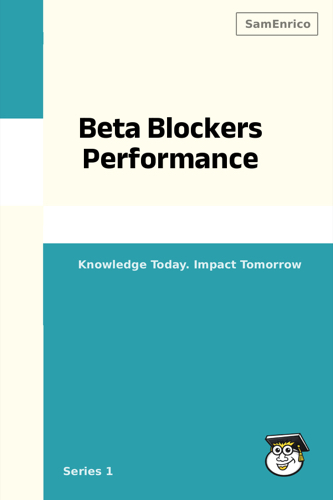
Non-FictionHealth & WellnessBeta Blocker
Beta Blockers Performance eBook
Teaches propranolol for public speaking and perfor
by Ness Birgit
Teaches propranolol for public speaking and performance anxiety.
Formats
Free sample
Chapter 1: The Smartest People Suffer Most--–- Margaret had prepared for three weeks. She knew her investor pitch cold—every slide, every transition, every rebuttal to every possible question. She had practiced in the mirror, in the shower, in her car, and in front of her patient husband who had heard it so many times he could recite it back to her. She was ready.Then she walked into the conference room.The air felt thick. Seven faces turned toward her.
The CEO sat at the head of the table, arms crossed, expression unreadable. Margaret opened her mouth. Nothing came out. Not because she had forgotten her words—they were still there, perfectly lined up in her memory like soldiers waiting for orders—but because her heart had launched itself into her throat, her palms had become waterfalls, and her voice, when it finally emerged, sounded like a frightened mouse being stepped on by a cat.She made it through. Barely.
She remembered fragments: a stumble here, a repeated phrase there, the look of pity on the VP's face. Afterwards, in the bathroom stall, she sat on the closed toilet lid and stared at her shaking hands. "I am smart," she whispered to herself. "I worked harder than anyone. Why does my body betray me?"Margaret has a Ph D in neuroscience.
She understands the brain better than almost anyone in that room. And that, paradoxically, is exactly why she suffered more than anyone else.The Cruel Irony of High Achievement Let us begin with a truth that most self-help books will not tell you: the more intelligent, conscientious, and high-achieving you are, the more likely you are to suffer from debilitating physical stage fright. This is not a guess. It is not motivational speaker wisdom. It is a documented phenomenon observed in clinical settings, performance psychology research, and the lived experience of millions of professionals who secretly wonder why their colleagues seem so calm while they themselves feel like they are dying.Why does this happen?
The answer lies in a neurological feature that evolution designed to keep you alive but that modern high-stakes performance has turned into a liability.The Hyper-Awareness Trap High-IQ individuals possess what neuroscientists call heightened cortical activity. In plain English, your brain is more active, more connected, and more sensitive to incoming information than the average person's. This is usually a gift. It allows you to notice patterns others miss, to anticipate problems before they arise, and to synthesize complex information rapidly. It is why you have succeeded in school, in your career, and in your life.But this same gift becomes a curse when you step onto a stage or into a conference room.
Because heightened cortical activity also means greater somatic awareness—the ability to notice what is happening inside your body. You feel every heartbeat. You notice every slight tremor in your fingers. You register the exact moment your mouth goes dry. Your average colleague, with a less active cortex, might feel a vague sense of nervousness but not the granular, terrifying details of their physiological response.You, on the other hand, are getting a high-definition, slow-motion, surround-sound broadcast of your own body's panic.
And that awareness creates a feedback loop: you notice your heart racing, you become anxious about your heart racing, your heart races faster, you notice that too. By the time you open your mouth, you are not just nervous. You are in a full-blown physiological cascade that your conscious mind cannot stop.Nervousness vs. Stage Fright: A Critical Distinction Before we go any further, we need to draw a line that most books blur. On one side of this line is nervousness.
On the other side is stage fright. They are not the same thing. They feel similar, but they have different origins, different mechanisms, and—most importantly—different solutions.Nervousness is cognitive. It lives in your thoughts. It sounds like: "What if I forget my lines?" "What if they think I am stupid?" "What if I say something wrong?" Nervousness is worry.
It is mental chatter. It is the voice in your head that second-guesses everything. Nervousness can be uncomfortable, but it does not typically cause visible physical symptoms. You can be nervous and still deliver a competent performance because your body is not fighting against you.Stage fright is physiological. It lives in your body.
It feels like: heart pounding so hard you can see your shirt move, hands shaking so badly you cannot hold note cards, voice cracking or disappearing entirely, sweating through your clothes, dry mouth that makes your tongue stick to your teeth, dizziness, nausea, and sometimes even vomiting. Stage fright is not worry. It is adrenaline. It is your sympathetic nervous system activating the fight-or-flight response as if a tiger had just walked into the room.Here is the crucial insight: you can have one without the other. There are people who feel mentally calm (no nervousness) but whose bodies still explode with stage fright the moment they step on stage.
There are also people who feel extremely nervous (mental chatter) but whose bodies remain steady—their hands do not shake, their voice does not crack. The first group needs a physiological intervention. The second group may benefit from cognitive techniques.Most books treat all anxiety as the same thing. They offer breathing exercises, positive affirmations, and visualization to everyone. For the second group (nervousness only), those techniques sometimes work.
For the first group (stage fright), they fail catastrophically. And because high-achievers tend to fall disproportionately into the first group—their heightened awareness makes them exquisitely sensitive to physiological changes—they are also the ones most likely to try "just breathing" and conclude that they are broken when it does not work.You are not broken. You have simply been applying the wrong solution to the wrong problem.The Sympathetic Nervous System: Your Ancient Alarm System To understand why stage fright happens and why it feels so overwhelming, we need to take a brief journey into your nervous system. Do not worry—this will not be a boring biology lecture. This is the key that unlocks everything else in this book.Your autonomic nervous system (the part that runs automatically, without your conscious control) has two main branches: the sympathetic and the parasympathetic.
Think of them as the accelerator and the brake on a car.The sympathetic nervous system is your "fight or flight" system. It evolved over millions of years to save your life when a predator threatened you. When activated, it releases adrenaline and noradrenaline into your bloodstream. Your heart rate increases. Your breathing quickens.
Blood shunts away from your digestive system (no time to digest when you are running from a lion) and toward your large muscles. Your pupils dilate. Your sweat glands activate (to cool you down for combat). Your mouth goes dry (salivation is not a priority when you are fleeing). Your fine motor control degrades—your body does not care if you can write a thank-you note; it wants you to punch or run.This system is ancient, powerful, and almost entirely outside your conscious control.
Once triggered, it runs its course like a freight train.The parasympathetic nervous system is your "rest and digest" system. It…
This is the end of the free sample. Get the eBook to keep going. Buy now
About this book
Details
- Author
- Ness Birgit
- Publisher
- SamEnrico
- Language
- English
- Genre
- Non-Fiction, Health & Wellness, Beta Blocker
- Released
- 2026-06-05
- Pages (approx.)
- 140
- Available as
- eBook, Audiobook

Read better in the ZLOADR app
Your eBooks on your phone or tablet. Sign in with your SamEnrico account and start reading.
More by Ness Birgit
 Breaking Free From Binge Eating DisorderNess Birgit$11.99
 Parkinson's Caregiving StoryNess Birgit$11.99
 The Marital Anger SolutionNess Birgit$11.99
 Small Talk for Co Parenting MeetingsNess Birgit$11.99
 Workaholic Leadership ChangeNess Birgit$11.99
 Titanic Grand Staircase ExcavationNess Birgit$11.99
 Talking To Children About DeathNess Birgit$11.99
 The Calculus of the Cosmos: Benjamin Banneker's Celestial EquationsNess Birgit$11.99
 The Last Speakers of the Arctic: Preserving the Voices of the NorthNess Birgit$11.99
 How to Produce Hockey Elbow PadsNess Birgit$11.99
 Mastering The Art of Traditional[edit]Ness Birgit$11.99
 A Collector's Handbook to the Ford 7w TenNess Birgit$11.99
You may also like
 Hong Kong Handover 1997Dunn Johnnie$11.99
 Zumba For Postnatal Recovery CourseNeal Christian$11.99
 Zumba for BeginnersLadner Nikia$11.99
 YouTube Comment Mining GuideHumes Pandora$12.99
 Worry Box MeditationCarlin Rudy$11.99
 Workplace Stress MeditationNguyen Lynn$11.99
 Workplace Stress and Sleep RepairHawley Ivory$11.99
 Workplace Perfectionism CureDelaney Jeffry$11.99
 Workplace Injustice Anger GuideWallen Isabelle$11.99
 Work Addiction and Burnout LinkGreenwood Ester$11.99
 Women in Yoga and WellnessBeattie Galina$11.99
 Women in Stand Up ComedyChun Evangeline$11.99