
Non-FictionHealth & WellnessControlled
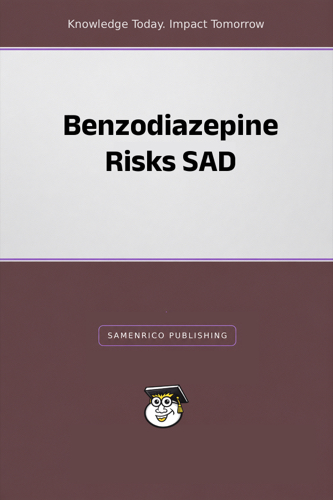
Benzodiazepine Risks SAD eBook
Warns about dependence for as needed social anxiet
by Colson Lyda
Warns about dependence for as needed social anxiety use.
Formats
Free sample
Chapter 1: The Little Bottle--Maya did not think of herself as an anxious person. This was her first mistake.At twenty-six, she had built a life that looked, from the outside, like a carefully curated success story. She graduated with honors from a respectable university, landed a junior graphic designer position at a mid-sized marketing firm in Portland, and shared a sunlit apartment with a golden retriever named Gus and a boyfriend who remembered to buy oat milk without being reminded. She ran five kilometers three times a week, posted infrequently but tastefully on Instagram, and had never missed a credit card payment. By every external metric, Maya was fine.
More than fine. She was the kind of person other people described as "having it together."But Maya knew something they did not. Behind the polished exterior, behind the organized spice rack and the matching workout sets, there was a counting clock. It started ticking exactly two hours before any social event that involved evaluation. Not casual gatherings with close friends—those were fine.
Not dinner with her boyfriend's parents—that was merely uncomfortable. No, the clock started ticking for the high-stakes events: the Monday morning team meeting where she had to present her design concepts, the client pitch where her work would be judged by strangers, the industry mixer where she would have to make small talk with people who might one day offer her a job.At the two-hour mark, something shifted in Maya's body. Her heart did not race so much as it seemed to drop, like an elevator whose cables had been cut, leaving her stomach somewhere around her knees. Her palms became damp. Her thoughts, normally linear and productive, began to spiral inward, looping on a single terrifying question: What if they can tell?
Not "what if I fail"—she knew her work was good. Not "what if I say something stupid"—she had prepared extensively. The fear was more primitive than that. It was the fear of being seen while anxious. The fear that her trembling hands, her flushed cheeks, her voice that sometimes cracked on the first syllable would betray her as someone who did not belong.
She was not afraid of the presentation. She was afraid of the audience noticing her fear.This was Social Anxiety Disorder (SAD), though Maya had no name for it yet. She had never said the words out loud. She had never googled them. She simply believed, with the quiet certainty of someone who had felt this way since high school, that she was uniquely broken in a way that other people were not.
Her colleagues presented with ease. Her boyfriend chatted with strangers at parties. Even her mother, who was prone to dramatic declarations, could order a complicated coffee drink without rehearsing it in her head six times first. Maya assumed she had drawn the genetic short straw—a nervous system that was simply too sensitive for the demands of adult professional life.The Fifteen-Minute Appointment The prescription came not from a psychiatrist or a therapist but from Dr. Harris, a tired-looking family physician with a framed photo of his golden retriever on his desk and a waiting room that smelled faintly of hand sanitizer and despair.
Maya had scheduled the appointment under a vague pretext—"anxiety, I guess? I don't know, I just feel like I'm not handling stress well"—because she did not know how to say the real thing: I am terrified of being perceived.The appointment lasted eleven minutes. Dr. Harris listened to her describe the two-hour countdown, the sweaty palms, the internal spiral. He nodded.
He typed. He asked three questions: "Do you ever feel like you're having a heart attack?" (No.) "Do you avoid social situations entirely?" (No, she went to everything, she just suffered.) "Any history of substance abuse?" (No.) Then he turned his screen toward her and said the words that would, in retrospect, mark the beginning of her long detour."I'm going to prescribe you a low dose of alprazolam. It's a benzodiazepine. You've probably heard of Xanax—that's the brand name. Take half a milligram as needed before anxiety-provoking events.
Don't take it more than three times a week, and try to limit it to short-term use. It works quickly and leaves your system quickly. Think of it as a safety net."Maya did not ask what "short-term use" meant. She did not ask what happened if she needed it more than three times a week. She did not ask about tolerance, dependence, withdrawal, or the difference between physical dependence and addiction because those words were not in her vocabulary yet.
She was not stupid. She was simply relieved. For the first time in a decade, someone had offered her a door out of the counting clock.She picked up the prescription that afternoon. The bottle was small and orange, the kind that looked like it should contain antibiotics or allergy pills, not something that would rearrange the architecture of her brain. The label said: Alprazolam 0.5mg.
Take one tablet by mouth as needed for anxiety. Do not drive or operate heavy machinery. No refills.Maya placed the bottle in her purse, next to her wallet and a loose tube of Burt's Bees lip balm. She felt, for the first time in months, something that resembled hope.The Anatomy of a Rescue The first time Maya took the pill, she followed the instructions to the letter. She had a client presentation scheduled for 2:00 PM on a Thursday.
At noon, exactly two hours before her internal clock would have begun its spiral, she swallowed half a milligram of alprazolam with a sip of cold brew.Nothing happened for twenty minutes. She sat at her desk, refreshing her slides, convinced the pill was a placebo, that she had been fooled, that of course a tiny orange tablet could not undo what her brain had been doing for fifteen years. Her palms began their familiar dampness. Her heart began its familiar drop.And then, at the thirty-minute mark, something shifted. It was not a high.
It was not euphoria. It was not the dramatic relief depicted in movies where the protagonist takes a pill and suddenly becomes charming. It was quieter than that. It was the feeling of a ceiling fan slowing down from high speed to low. The frantic oscillation of her thoughts—what if they can tell what if they can see what if I forget what if my voice cracks—did not disappear, but it lost its urgency.
The thoughts were still there, but Maya no longer felt compelled to chase them down the spiral. She could simply observe them, like watching cars pass from a safe sidewalk, rather than standing in the middle of the highway.When she stood up to walk to the conference room, her legs did not shake. When she opened her mouth to speak, her voice emerged steady. When a client asked a difficult question about typography choices, she answered without the usual internal collapse. She was not transformed into a different person.
She was simply herself, but calmer. More present. More competent.The presentation ended. The clients nodded. Her boss smiled.
Maya walked back to her desk, sat down, and felt something she had not felt after a social event since…
This is the end of the free sample. Get the eBook to keep going. Buy now
About this book
Details
- Author
- Colson Lyda
- Publisher
- SamEnrico
- Language
- English
- Genre
- Non-Fiction, Health & Wellness, Controlled
- Released
- 2026-06-07
- Pages (approx.)
- 131
- Available as
- eBook, Audiobook

Read better in the ZLOADR app
Your eBooks on your phone or tablet. Sign in with your SamEnrico account and start reading.
More by Colson Lyda
 Financial Ruin From CaregivingColson Lyda$11.99
 Titanic Hull Metallurgy StudyColson Lyda$11.99
 Small Talk for New RoommatesColson Lyda$11.99
 Sugar Addiction Recovery WorkbookColson Lyda$11.99
 The Gottman Anger ApproachColson Lyda$11.99
 Workaholic Career Pivot GuideColson Lyda$11.99
 Pet Euthanasia DiscussionColson Lyda$11.99
 The Tiger of Tsarskoye Selo: A Beast Unleashed in Imperial RussiaColson Lyda$11.99
 The Raven’s Lament: How Coyote Stole the SunColson Lyda$11.99
 How to Start a Electric Accumulators Including Parts Thereof Business (Beginners Guide)Colson Lyda$11.99
 How to Produce Hockey Fan AccessoriesColson Lyda$11.99
 Nutrition and Mood AdvisorColson Lyda$12.99
You may also like
 Hong Kong Handover 1997Dunn Johnnie$11.99
 Zumba For Postnatal Recovery CourseNeal Christian$11.99
 Zumba for BeginnersLadner Nikia$11.99
 YouTube Comment Mining GuideHumes Pandora$12.99
 Worry Box MeditationCarlin Rudy$11.99
 Workplace Stress MeditationNguyen Lynn$11.99
 Workplace Stress and Sleep RepairHawley Ivory$11.99
 Workplace Perfectionism CureDelaney Jeffry$11.99
 Workplace Injustice Anger GuideWallen Isabelle$11.99
 Work Addiction and Burnout LinkGreenwood Ester$11.99
 Women in Yoga and WellnessBeattie Galina$11.99
 Women in Stand Up ComedyChun Evangeline$11.99