
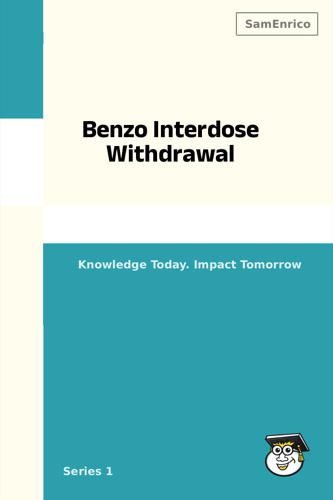
Non-FictionSelf-HelpWithdrawal
Benzo Interdose Withdrawal eBook
Manages symptoms between doses of short-acting ben
Manages symptoms between doses of short-acting benzodiazepines.
Formats
Free sample
Chapter 1: The Vanishing Hour...--Lisa’s alarm read 8:00 AM. She swallowed a small white pill—0.5 milligrams of Xanax, her ticket to feeling human for the next few hours. By 10:00 AM, she felt calm, almost normal. By 12:30 PM, a faint unease crept into her chest, like a radio playing static just out of reach. By 1:00 PM, her skin began to burn as if she had laid in the sun too long, though she had not left the house.
By 2:00 PM, the terror arrived—not the worried kind, not the “did I lock the door” kind, but a raw, objectless dread that made her want to crawl out of her own body. By 3:00 PM, she took another pill. Within thirty minutes, the burning stopped. The terror dissolved. She felt human again.Lisa was not crazy.
She was not suffering from a worsening anxiety disorder. She was not “relapsing.” She was experiencing interdose withdrawal—a predictable, pharmacological event caused by the short half-life of her medication. And she had no idea. Neither did her doctor.This chapter will give you a name for your suffering. It will teach you how to distinguish interdose withdrawal from tolerance and from the return of your original condition—three states that look similar but require completely different responses.
You will learn the simple pharmacokinetics of half-life and why short-acting benzodiazepines create a rollercoaster of peaks and valleys that make you sick between doses. By the end of this chapter, you will have a self-assessment tool to determine whether you are experiencing IDW, and a symptom diary to track your own patterns. Most importantly, you will understand that you are not becoming sicker. Your medication schedule is making you sick. And that is fixable.The Three Masks: Tolerance, Relapse, and Interdose Withdrawal Before we can solve a problem, we must name it correctly.
Patients taking benzodiazepines for weeks, months, or years often experience a worsening of their symptoms. The natural assumption—made by both the patient and the doctor—is that the underlying condition (anxiety, panic, insomnia) is getting worse. But this assumption is often wrong. In fact, it is catastrophically wrong, because it leads to the opposite of what is needed.There are three distinct states that produce similar symptoms. They are not the same.
They require different responses. Confusing them is the primary reason people suffer for years on escalating doses of benzodiazepines.Tolerance Tolerance occurs when the same dose of a drug produces a diminished effect over time. Your body adapts to the presence of the medication. The GABA receptors in your brain become less sensitive. The dose that once calmed you now barely takes the edge off.
You need more to achieve the same result.Tolerance is subtle. It does not announce itself with new or strange symptoms. Instead, you simply notice that your medication “does not work as well as it used to.” You might find yourself taking it more often, or secretly wishing your doctor would increase the dose. Tolerance is a pharmacological inevitability for most people taking benzodiazepines regularly. It is not a moral failing.
It is biology.The standard medical response to tolerance is to increase the dose or add another medication. This is a trap. Increasing the dose temporarily overcomes tolerance but accelerates the next round of tolerance. You enter a spiral of escalating doses with diminishing returns. The only true solution to tolerance—once you are already dependent—is not more medication but a slow, controlled reduction (tapering) to allow your receptors to recover.
But that is a discussion for Part IV of this book.Original Anxiety Relapse Relapse means the return of the symptoms you originally took the medication for. If you started benzodiazepines for panic disorder characterized by sudden episodes of heart-pounding terror with cognitive triggers (fear of flying, fear of public speaking), relapse would look like the same panic attacks returning. If you started for generalized anxiety disorder characterized by excessive worry about work, relationships, health, and finances, relapse would look like that same worry pattern returning.Relapse has content. It has a story. You can point to the fear and say, “I am afraid my child is sick,” or “I am afraid I will lose my job.” Relapse responds, at least partially, to psychological interventions like cognitive behavioral therapy, exposure therapy, and stress reduction.
Relapse is not typically time-locked to your medication schedule.Interdose Withdrawal (IDW)Interdose withdrawal is something else entirely. IDW occurs when the level of benzodiazepine in your blood falls below the threshold required to prevent withdrawal symptoms—but before your next dose is due. You are not “breaking through” with your original anxiety. You are experiencing a new set of symptoms caused by the absence of the drug.IDW is distinct in three ways:First, IDW is time-locked. Symptoms appear predictably a certain number of hours after your last dose.
If you take Xanax at 8:00 AM and feel terror at 1:00 PM, day after day, that is not random. That is the clock.Second, IDW symptoms are often qualitatively different from your original condition. People with IDW report sensations they never experienced before benzodiazepines: burning skin, electric shock sensations (“brain zaps”), a feeling of insects crawling under the skin (formication), inner restlessness so severe they cannot sit still (akathisia), and a sense of derealization where the world looks fake or like a movie set. These are not typical anxiety symptoms. They are neurological symptoms.Third, IDW symptoms vanish rapidly after taking the next dose—usually within thirty to sixty minutes.
This rapid relief is a hallmark sign. If your symptoms disappear like magic as soon as the pill dissolves, you are not witnessing a psychological calming. You are witnessing the chemical correction of a withdrawal state.The tragedy is that IDW looks like anxiety to the untrained eye. A patient with burning skin, racing heart, and dread walks into a doctor’s office. The doctor sees anxiety.
The doctor increases the dose. The patient gets worse. This is not malice. It is a failure of medical education. The average doctor receives less than one hour of training on benzodiazepine withdrawal in medical school.
They are taught that these drugs are safe and effective. They are not taught how to recognize interdose withdrawal. This book exists because of that gap.The Pharmacokinetics of Suffering: Half-Life and the Rollercoaster To understand why IDW happens, you need one simple concept: half-life. Half-life is the time it takes for your body to eliminate half of a dose of medication. It is not a measure of how long the drug “works” for you—that is duration of action, which is shorter than half-life.
But half-life determines how quickly the drug leaves your system and how stable your blood levels will be between doses.Think of half-life like water draining from a bathtub. If you fill the tub and pull the plug, the water level drops. Half-life is the time it takes for the water to drop to halfway. Then half of what remains drops in the next half-life, and so on. The drug never fully leaves until many half-lives have passed—typically five half-lives for complete elimination—but the effects change as the level drops.Benzodiazepines are classified as short-acting…
This is the end of the free sample. Get the eBook to keep going. Buy now
About this book
Details
- Author
- Creech Stormy
- Publisher
- SamEnrico
- Language
- English
- Genre
- Non-Fiction, Self-Help, Withdrawal
- Released
- 2026-06-06
- Pages (approx.)
- 145
- Available as
- eBook, Audiobook

Read better in the ZLOADR app
Your eBooks on your phone or tablet. Sign in with your SamEnrico account and start reading.
More by Creech Stormy
 Burnout Prevention for NonprofitsCreech Stormy$11.99
 Retail Dividend Investing GuideCreech Stormy$11.99
 Procrastination For New ParentsCreech Stormy$11.99
 Focus Music for Distraction ProneCreech Stormy$11.99
 Grief and Therapy After Child LossCreech Stormy$11.99
 Public Speaking Self Talk RewiringCreech Stormy$11.99
 Goal Deconstruction MethodCreech Stormy$11.99Burnout Prevention For NonprofitsCreech Stormy$11.99
 The Secret Songs of the North StarCreech Stormy$11.99
 The Pill Factory: How a Small Town Became Ground Zero for America's Opioid CrisisCreech Stormy$11.99
 How to Start a android Software Developing Business (Beginners Guide)Creech Stormy$11.99
 How to Produce Wires, Cables and Cable AssembliesCreech Stormy$11.99
You may also like
 Hong Kong Handover 1997Dunn Johnnie$11.99
 Zumba For Postnatal Recovery CourseNeal Christian$11.99
 Zumba for BeginnersLadner Nikia$11.99
 YouTube Comment Mining GuideHumes Pandora$12.99
 Worry Box MeditationCarlin Rudy$11.99
 Workplace Stress MeditationNguyen Lynn$11.99
 Workplace Stress and Sleep RepairHawley Ivory$11.99
 Workplace Perfectionism CureDelaney Jeffry$11.99
 Workplace Injustice Anger GuideWallen Isabelle$11.99
 Work Addiction and Burnout LinkGreenwood Ester$11.99
 Women in Yoga and WellnessBeattie Galina$11.99
 Women in Stand Up ComedyChun Evangeline$11.99