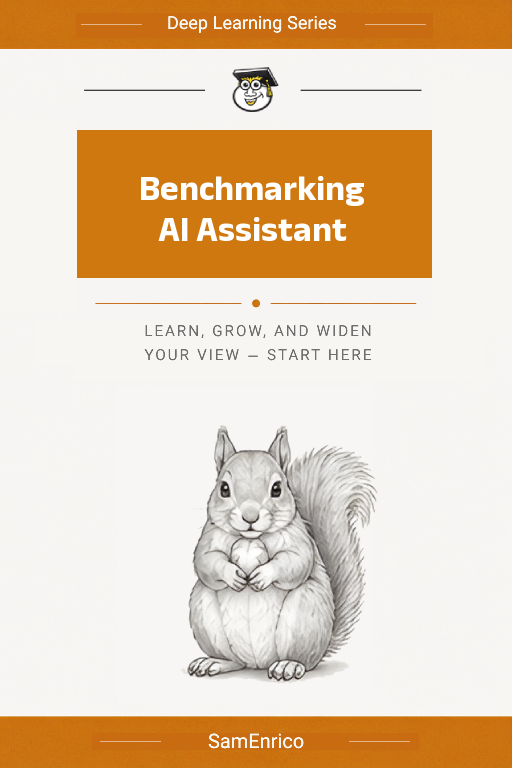
Benchmarking AI Assistant Audiobook
Compare your small business financial metrics agai
Compare your small business financial metrics against industry peers using AI benchmarking. Identify cost reduction opportunities and efficiency gaps.
Formats
Free sample
Chapter 1: The $44 Billion Blind Spot--–- On a Tuesday morning in March, Sarah Chen, who owned a moderately successful chain of three coffee roasting facilities in the Pacific Northwest, did something that she would later describe as “the most expensive thirty seconds of my career.” She opened her monthly profit and loss statement, scanned the bottom line, and celebrated a 4 percent increase in revenue over the previous month. Then she closed the file, approved payroll, and turned her attention to a new marketing campaign for cold brew products.What Sarah did not know was that her primary competitor, a roastery forty miles south with nearly identical revenue and employee count, had just finished a very different Tuesday morning ritual. That competitor had not looked at a thirty-day-old P&L. Instead, they had reviewed a live dashboard showing their cost of goods sold, inventory turnover, and labor efficiency compared against a peer set of twelve similar businesses. The dashboard had flagged a 7 percent anomaly in green coffee bean pricing that had appeared five days earlier.
Within twenty-four hours, that competitor renegotiated with their supplier. By the time Sarah celebrated her 4 percent revenue increase, the competitor had already locked in a cost reduction that would improve their gross margin by nearly double that amount.Sarah’s story is not unusual. It is, in fact, the rule. And the cost of that blindness is accumulating into what this book calls the $44 billion blind spot—the annual value that small and medium-sized businesses leave on the table because they cannot see how they truly compare against their competitors in real time.The Maturity Gap That Nobody Talks About Let us begin with a number that should unsettle you: 65 percent of small and medium-sized businesses report that they are using artificial intelligence tools in some capacity. That figure comes from a 2024 survey of over five thousand SMBs across retail, manufacturing, professional services, and hospitality.
On its face, this statistic suggests that AI adoption is widespread and accelerating. But there is a second number that tells a very different story: only 5 percent of those same businesses are what researchers call “AI-enabled.”The difference between using AI and being AI-enabled is not semantic. It is structural. A business that uses AI might ask Chat GPT to draft an email, generate social media copy, or summarize a long document. These are useful but shallow applications.
An AI-enabled business, by contrast, has integrated artificial intelligence into its core financial workflows. That means AI is reading bank…
This is the end of the free sample. Get the Audiobook to keep going. Buy now
About this book
Details
- Author
- Ackerman Kirby
- Publisher
- SamEnrico
- Language
- English
- Genre
- Non-Fiction, Business Brief, Competitive Analysis
- Released
- 2026-06-01
- Pages (approx.)
- 132
- Available as
- eBook, Audiobook

Listen in the VoxFlicks app
Audiobooks and audio dramas wherever you go. Sign in with your SamEnrico account and press play.
More by Ackerman Kirby
 The Self Reference EffectAckerman Kirby$11.99
 Elizabeth I Spymaster HandbookAckerman Kirby$11.99
 Caffeine Emotional RegulationAckerman Kirby$11.99
 Financial Stress and SleepAckerman Kirby$11.99
 The Dream Team's Secret Tour: NBA Legends and the Birth of Global Basketball (1992)Ackerman Kirby$11.99
 How to Become a Stock PatcherAckerman Kirby$11.99
 Client DirectorAckerman Kirby$11.99