
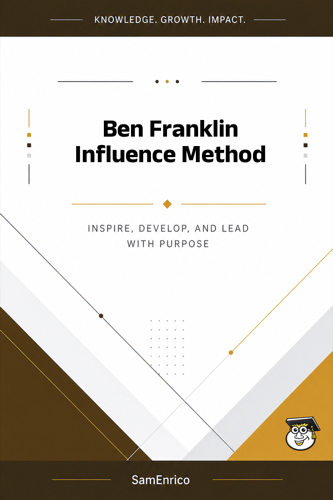
Non-FictionSelf-HelpBen FranklinFavor
Ben Franklin Influence Method eBook
Ask a favor to increase liking and future complian
by Kolb Rutha
Ask a favor to increase liking and future compliance from others.
Formats
Free sample
Chapter 1: The Borrowed Book--–- In the autumn of 1737, a young printer named Benjamin Franklin did something that should have destroyed his political career. Instead, it saved it. And in doing so, he stumbled upon a psychological truth so counterintuitive that most people, nearly three hundred years later, still get it exactly backwards.The story begins with an enemy.Franklin had been elected clerk of the Pennsylvania Assembly the previous year. He was thirty-one years old, ambitious, well-liked by his allies, and quietly despised by a powerful new legislator who had just been seated. This man—whose name Franklin deliberately left out of his autobiography, referring to him only as “a gentleman of fortune and education”—stood up during his first week in office and delivered a passionate, venomous speech against Franklin’s reelection.
He accused the young printer of incompetence, political opportunism, and lacking the character required for the position. He lobbied other members. He made calls. He wrote letters.Franklin should have been finished.In eighteenth-century Philadelphia politics, an enemy with wealth and influence could end a career with a single speech. The normal response was obvious: fight back publicly, flatter the man’s allies, do favors for his friends, and try to outspend him.
That was how politics worked. That was how influence worked. Give to get. Scratch my back, I’ll scratch yours.Franklin did none of those things.Instead, he heard through a mutual acquaintance that this enemy owned a rare, obscure book—a volume Franklin had been trying to find for years. The book was not expensive.
It was not particularly famous. But it was personally valuable to the legislator, who had acquired it during his travels in Europe. Franklin wrote a brief, polite note. He did not mention the speech. He did not mention politics.
He simply asked: could he borrow the book for a few days?The man sent it immediately.Franklin kept it for exactly one week. He did not damage it. He did not annotate it. He did not copy it without permission. He returned it clean, on time, with a warm, handwritten thank-you note that mentioned nothing about their political disagreement.
He simply expressed genuine gratitude for the loan.Then he waited.The next time the Assembly met, the man approached Franklin. Not coldly. Not cautiously. He approached him civilly, then warmly. He began speaking to Franklin before meetings.
He began speaking up for Franklin during debates. Within months, the man who had tried to destroy Franklin’s career became one of his most loyal friends and political allies—for the rest of their lives.Franklin wrote about the incident decades later in his autobiography, and he offered a theory for why it worked:“He that has once done you a kindness will be more ready to do you another than he whom you yourself have obliged.”Read that sentence again. It is the most misunderstood sentence in the history of persuasion.Most people read it and think: “Ah, so if I do a favor for someone, they’ll owe me one. Reciprocity.” That is not what Franklin wrote. He wrote the opposite.
He wrote that the person who has done you a kindness will be more ready to do you another than the person you have obliged. In other words: asking for a favor makes someone more likely to help you again than doing a favor for them does.The person who gives owes nothing. The person who receives, oddly, wins everything.The Mistake We All Make If this story feels strange to you, that is because it contradicts nearly every piece of conventional wisdom about winning people over. We are raised to believe that the path to being liked is giving. Buy coffee for your coworkers.
Hold the door for strangers. Stay late to help your boss. Volunteer for the committee. Donate to the fundraiser. Give, give, give.And giving feels good.
That is the trap.When you do something nice for someone, your brain releases dopamine. You feel generous. You feel kind. You feel like a good person. And because it feels good, you assume it works.
You assume the other person feels the same warmth toward you that you feel toward yourself.But they don’t.In fact, decades of psychological research have shown that doing favors for others often backfires in three specific ways. First, when you constantly do things for people, they begin to expect it. What started as generosity becomes the baseline. They stop noticing. They stop thanking.
They simply assume you will continue. Second, when you eventually stop—because you are exhausted, because you are resentful, because you realize they never reciprocate—they blame you. You are not the generous person who ran out of energy. You are the inconsistent person who let them down. Third, and most damaging, the people you help begin to avoid you.
Not because they dislike you. Because they owe you.Reciprocity is heavy. When someone does you a favor, you feel an uncomfortable obligation to return it. That discomfort is not trivial. It is a low-grade anxiety that follows you every time you see that person.
And human beings are wired to resolve anxiety by removing the cause. They do not pay you back. They avoid you.Franklin discovered the opposite path. By asking for a small, genuine favor, he made himself vulnerable. He admitted a need.
He signaled respect for the other person’s resources. And then, crucially, he closed the loop with gratitude rather than payment. The legislator did not feel that he owed Franklin anything. He felt that he had helped someone. That feeling—competence, generosity, value—released dopamine in his brain.
And because it felt good, he wanted to feel it again. So he helped again. And again.The person who does the favor ends up liking the person they helped.That is the Ben Franklin Influence Method.The Benjamin Franklin Divide Let me introduce a distinction that will run through every chapter of this book. I call it the Benjamin Franklin Divide. On one side, you have Transactional Favor-Doing.
On the other, Psychological Favor-Asking.Transactional Favor-Doing is what most of us do most of the time. I buy you coffee. You owe me a coffee. I stay late to help you with your project. You owe me an hour.
I introduce you to my contact. You owe me an introduction. This is the world of quid pro quo. It is logical. It is fair.
And it is exhausting. Every favor creates a debt. Every debt creates pressure. Every pressure creates avoidance.Psychological Favor-Asking is what Franklin did. I ask you for a small, genuine favor.
You help me. You feel good about yourself. Your brain, seeking consistency, concludes: “I helped this person. Therefore, I must like this person.” No debt is created because I did not give you anything. I only received.
And by receiving with gratitude rather than payment, I leave you feeling competent and generous rather than obligated and anxious.The difference is not in the size of the favor. The difference is in who initiates and who closes.In Transactional Favor-Doing, you initiate (by giving) and you close (by…
This is the end of the free sample. Get the eBook to keep going. Buy now
About this book
Details
- Author
- Kolb Rutha
- Publisher
- SamEnrico
- Language
- English
- Genre
- Non-Fiction, Self-Help, Ben Franklin, Favor
- Released
- 2026-06-07
- Pages (approx.)
- 125
- Available as
- eBook, Audiobook

Read better in the ZLOADR app
Your eBooks on your phone or tablet. Sign in with your SamEnrico account and start reading.
More by Kolb Rutha
 Pinterest Perfect Life FallacyKolb Rutha$11.99
 Influencer Disclosure For FashionKolb Rutha$11.99
 Self Talk for Anger ManagementKolb Rutha$11.99
 Menopause Nutrition for Bone HealthKolb Rutha$11.99
 The Djinn’s Veiled Heart: A Love Forged in Smoke and SandKolb Rutha$11.99
 Understanding Job SyndromeKolb Rutha$17.99
 ADHD Workspace Design GuideKolb Rutha$12.99
 Venture Capital Regional GuideKolb Rutha$12.99
 Loan Documentation SpecialistKolb Rutha$11.99
 How to Become a Noodle-press OperatorKolb Rutha$11.99
You may also like
 Hong Kong Handover 1997Dunn Johnnie$11.99
 Zumba For Postnatal Recovery CourseNeal Christian$11.99
 Zumba for BeginnersLadner Nikia$11.99
 YouTube Comment Mining GuideHumes Pandora$12.99
 Worry Box MeditationCarlin Rudy$11.99
 Workplace Stress MeditationNguyen Lynn$11.99
 Workplace Stress and Sleep RepairHawley Ivory$11.99
 Workplace Perfectionism CureDelaney Jeffry$11.99
 Workplace Injustice Anger GuideWallen Isabelle$11.99
 Work Addiction and Burnout LinkGreenwood Ester$11.99
 Women in Yoga and WellnessBeattie Galina$11.99
 Women in Stand Up ComedyChun Evangeline$11.99