
Non-FictionTrue CrimeSmuggling
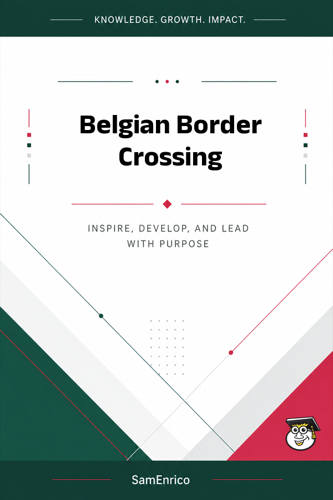
Belgian Border Crossing eBook
How the thieves smuggled diamonds out of country.
by Lytle Perry
How the thieves smuggled diamonds out of country.
Formats
Free sample
Chapter 1: The Square Mile of Ice...--–- The Hoveniersstraat is not a street you stumble upon. It is a street you are invited into, or you are not. On a cold Tuesday morning in November, the cobblestones glisten with a thin film of frost, and the men who walk them wear black hats, black coats, and the closed expressions of those who have spent centuries learning not to trust strangers. They do not make eye contact with tourists. They do not stop for photographs.
They walk quickly, heads down, hands in pockets, moving from one unmarked doorway to another like ghosts who happen to cast shadows. And yet, behind those unmarked doorways, sitting in fluorescent-lit back rooms guarded by retinal scanners and armed security, are small paper envelopes containing stones worth more than most people will earn in a lifetime. This is the Diamond District of Antwerp. It is one square mile of ice.The district’s formal name is the Hoveniersstraat, though locals simply call it "the Square Mile of Ice." It handles, by conservative estimates, eighty-five percent of the world’s rough diamonds and fifty percent of all polished diamonds. That is not an exaggeration or a marketing slogan.
It is a logistical fact. Every year, approximately fifty billion dollars’ worth of diamonds pass through this single cobblestone artery. To put that number in context: the entire annual GDP of Iceland is roughly twenty-five billion dollars. The Diamond District moves twice that much money every year, often on handshake deals with no written contract, no lawyers, and no receipts.The history of this place is written in blood and profit. For five hundred years—since the late fifteenth century, when Flemish diamond cutters first established Antwerp as a trading post—the city has been the world’s capital of diamonds.
The industry survived the Spanish Inquisition, two World Wars, the Nazi occupation of Belgium, and the collapse of the Soviet Union. Each crisis scattered the diamond traders to London, New York, Tel Aviv, and Mumbai. And each time, they came back. The Hoveniersstraat has a gravitational pull that transcends economics. It is a matter of bloodlines.
The families who trade diamonds here today are the same families who traded diamonds here five generations ago. They marry within the community. They pray together. They bury their dead in the same cemeteries. And they do not speak to outsiders about what happens behind those unmarked doors.The Architecture of Trust To understand how the Diamond District works, you must first forget everything you think you know about how business is conducted.
There are no glass skyscrapers here. No blinking tickers. No aggressive salesmen in cheap suits. The Hoveniersstraat looks, at first glance, like a slightly neglected European shopping street: modest storefronts, a few coffee shops, the occasional security camera glaring down from a discreet perch. But those storefronts are largely facades.
The real business happens on the upper floors, in rented offices no larger than a suburban bedroom, where two men sit across a wooden desk and negotiate a million-euro deal in whispered Flemish, Yiddish, Gujarati, or Russian.The diamond trade operates on a medieval system of trust that would seem insane to any modern corporate lawyer. There are no written contracts. No escrow accounts. No due diligence teams. A buyer and a seller agree on a price, shake hands, and the diamonds change hands based entirely on reputation.
If a trader cheats, word spreads through the district within hours, and that trader is finished. No court case. No arbitration. Just exile. The system works because the community is small enough that everyone knows everyone, and the stakes are high enough that no one dares risk banishment.This system is called mazel—the Yiddish word for luck, but in the diamond trade, it means something closer to "a deal sealed by trust." When two traders shake hands and say mazel, the deal is done.
There is no backing out. There is no fine print. There is just the handshake and the memory of it, carried forward by generations. A Hasidic Jewish trader in his seventies might sell a million-dollar stone to a Jain diamond merchant from Mumbai on nothing more than a nod. The Jain will transfer the money within the hour, sight unseen, because his grandfather did business with the Hasid’s grandfather, and honor is the only currency that matters.But trust is a double-edged sword.
The same system that makes the Diamond District efficient also makes it vulnerable. The handshake deal relies on familiarity, and familiarity breeds complacency. The guards at the vault entrances stop checking ID badges after a while. The security cameras capture the same faces every day. The cleaning crews know which offices to skip and which to polish.
And into this ecosystem of trust walks the predator who knows how to mimic the prey.The Shadow Economy Beneath the legitimate diamond trade—the billion-dollar deals, the handshake agreements, the Orthodox traders in black hats—there runs a parallel economy of stolen stones, fenced jewels, and laundered cash. This shadow economy is not separate from the legitimate one. It is woven into it, thread by thread, shop by shop. Police estimates, drawn from undercover operations and wiretap evidence over the past decade, suggest that as many as twenty-five percent of jewelry shops in the Hoveniersstraat are involved in fencing stolen goods. That is not a typo.
One in four storefronts.The numbers are shocking, but they should not be surprising. The same features that make Antwerp the world’s diamond capital—dense networks of traders, minimal oversight, a culture of secrecy, and the absence of written records—also make it the world’s capital for moving stolen diamonds. A thief who steals a fifty-carat stone in Paris can have it in an Antwerp back room within four hours. Within twenty-four hours, that stone can be recut, relabeled, and sold to a legitimate buyer who has no idea—or pretends to have no idea—that the diamond was stolen. The fence is not a shadowy figure in a back alley.
The fence is often the shop next door to the legitimate jeweler, operating with the same storefront, the same clientele, and the same handshake deals.The rise of the Georgian jewelers in the 1990s accelerated this shadow economy. After the collapse of the Soviet Union, thousands of Georgian jewelry craftsmen emigrated to Antwerp, bringing centuries of skill in cutting, setting, and smelting. They opened shops. They joined the diamond traders’ associations. They learned the handshake system.
And some of them brought something else: connections to Eastern European organized crime networks that specialized in high-end theft. By the early 2000s, the Georgian jewelers had become the preferred fences for stolen diamonds across Western Europe. A robbery in Paris, a heist in Zurich, a smash-and-grab in London—the stones all flowed to the same destination: the Hoveniersstraat.The Contradiction Here is the contradiction that lies at the heart of this book, and at the heart of the Diamond District itself. Antwerp is simultaneously the easiest place in the world to sell a stolen diamond and the hardest place in the world to steal one. The ease comes from…
This is the end of the free sample. Get the eBook to keep going. Buy now
About this book
Details
- Author
- Lytle Perry
- Publisher
- SamEnrico
- Language
- English
- Genre
- Non-Fiction, True Crime, Smuggling
- Released
- 2026-06-08
- Pages (approx.)
- 141
- Available as
- eBook, Audiobook

Read better in the ZLOADR app
Your eBooks on your phone or tablet. Sign in with your SamEnrico account and start reading.
More by Lytle Perry
 Mind Reading Anger DistortionLytle Perry$11.99
 Digital Tools for Time BlockingLytle Perry$11.99
 Body Scan Mindfulness for TeensLytle Perry$11.99
 Jamaican Nurse In London TrustLytle Perry$11.99
 Lisdexamfetamine GuideLytle Perry$11.99
 Atomic Habits For Habit GroupLytle Perry$11.99
 Unidentified Remains Fingerprint Cold HitsLytle Perry$11.99
 The Last Whisper of the Great Green WallLytle Perry$11.99
 The Gridiron Gladiators: How African Designers Styled NFL Legends (1960s-1970s)Lytle Perry$11.99
 How to Start a Passenger Transport By Inter-urban Railways (other Than Inter-city Service) BusinessLytle Perry$11.99
 Growing CalochortusLytle Perry$11.99
 A Collector's Handbook to the Simca SpecialLytle Perry$11.99
You may also like
 Hong Kong Handover 1997Dunn Johnnie$11.99
 Zumba For Postnatal Recovery CourseNeal Christian$11.99
 Zumba for BeginnersLadner Nikia$11.99
 YouTube Comment Mining GuideHumes Pandora$12.99
 Worry Box MeditationCarlin Rudy$11.99
 Workplace Stress MeditationNguyen Lynn$11.99
 Workplace Stress and Sleep RepairHawley Ivory$11.99
 Workplace Perfectionism CureDelaney Jeffry$11.99
 Workplace Injustice Anger GuideWallen Isabelle$11.99
 Work Addiction and Burnout LinkGreenwood Ester$11.99
 Women in Yoga and WellnessBeattie Galina$11.99
 Women in Stand Up ComedyChun Evangeline$11.99