
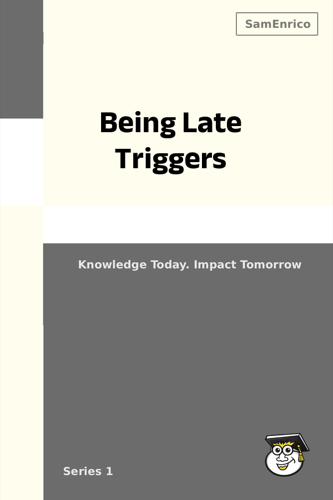
Non-FictionSelf-HelpPunctuality
Being Late Triggers eBook
Identify how other people's lateness sparks your a
Identify how other people's lateness sparks your anger.
Formats
Free sample
Chapter 1: The Psychological Contract--Anger is not the enemy. Uninvestigated anger is.You are sitting in a coffee shop. Your coffee has gone cold. You have checked your phone seventeen times. The person across from you—the empty chair, the unworn napkin, the second cup you ordered fifteen minutes ago that now sits sweating and untouched—is not here.
They are late. Five minutes passed, and you felt patient. Ten minutes passed, and you felt curious. Fifteen minutes passed, and something shifted in your chest. By minute twenty, you are no longer waiting for a person.
You are rehearsing a speech. You are compiling evidence. You are imagining the exact moment they walk through that door and what you will say, what you will not say, how you will hold your face, whether you will stand up or stay seated, whether you will accept their excuse or meet it with silence.This is not about coffee. This is not about twenty minutes. This is about something far deeper than time.Every single time you wait for someone who is late, you are experiencing a violation—not of a clock, but of a contract.
A psychological contract. An invisible, unwritten, unspoken agreement that formed the moment the two of you decided on a time and place. That agreement said: I will be there. You will be there. We will begin together.
When they are not there, the contract is broken. And your anger is not a tantrum. It is a legitimate response to a breach of trust.The problem is not that you get angry. The problem is that you do not understand why you get angry, and therefore you cannot do anything useful with that anger except feel it, suppress it, or explode with it. This chapter is the first step in changing that.
We are going to dismantle the psychological machinery of lateness—what it represents, why it cuts so deep, and why your brain treats a fifteen-minute delay as if it were a threat to your survival. By the end of this chapter, you will understand that your anger is not a personality flaw. It is a physiological, psychological, and relational signal. And signals can be read.The Invisible Agreement Every human interaction that involves a shared expectation creates a contract. Most of these contracts are never spoken aloud.
You do not sit down with a friend and say, "I hereby agree that if we say 7 PM, I will arrive at 7 PM, and you will arrive at 7 PM, and if either of us does not, the other has the right to feel frustration." And yet, that contract exists. It exists as surely as a signed lease or a marriage license. It exists in the space between you.Psychologists call this a psychological contract. It is the set of unwritten, implicit expectations that govern relationships. When both parties honor the contract, the relationship feels safe, predictable, and respectful.
When one party breaks the contract—even accidentally—the other party feels a specific kind of distress. Not just inconvenience. Distress. Because a broken psychological contract is not a scheduling error. It is a miniature betrayal.Consider what actually happens when you agree to meet someone at 7 PM.
You do not simply note the time. You rearrange your afternoon. You finish work earlier than you might have. You leave your house with a specific departure time in mind. You calculate traffic, parking, walking time.
You might skip an errand or rush through a task to make sure you are not the one keeping someone waiting. You arrive at 6:55, or 7:00 exactly, or 7:02 with a text already sent apologizing for the two minutes. You have invested energy, attention, and care into honoring that invisible contract.Now imagine the other person. They left their house later. They did not check traffic.
They stopped to answer a non-urgent text. They assumed ten minutes would be enough for a twenty-minute drive. They arrive at 7:20. From their perspective, they lost track of time. From your perspective, they stole twenty minutes of your life and sent a message: My time is more valuable than yours.That last sentence is the core of the wound.
And it is both true and false simultaneously. It is true that their behavior communicated a lack of regard for your time. It is false that they intended to communicate that. And this gap—between what was intended and what was received—is where most of the suffering lives.Why Waiting Hurts More Than Doing There is a reason that waiting for a late person feels worse than almost any other kind of delay. When you are stuck in traffic, you are frustrated, but you are doing something—driving, navigating, deciding.
When you are waiting in a grocery line, you are standing still, but you are in a queue with a predictable endpoint. When you are waiting for a late person, you are suspended. You cannot fully commit to another task because they might walk through the door at any moment. You cannot relax because your nervous system is in a state of alert. You are trapped in a limbo that has no clear end.Neuroscience explains why this specific kind of waiting is so agonizing.
Your brain has two modes of perceiving time: active time and passive time. When you are engaged in a task—even a tedious one—your brain's attention is distributed. You are not constantly monitoring the passage of seconds because your cognitive resources are occupied. Time feels compressed. An hour of active work can feel like twenty minutes.Passive time is different.
When you are waiting with nothing to do but wait, your brain has no task to consume its attention. It defaults to monitoring. And the thing it monitors most obsessively is the passage of time. Every second is registered. Every minute is felt.
Ten minutes of passive waiting can feel like thirty. This is not your imagination. This is the fundamental asymmetry of waiting: the late person experiences the same ten minutes as ten minutes—they were driving, or finishing a task, or scrolling their phone. You experience those ten minutes as an eternity because your brain had nothing to do except count them.This asymmetry creates a profound empathy gap. The late person genuinely does not understand why you are so upset.
In their mind, they were only ten minutes late. Ten minutes is nothing. In your mind, you waited an eternity. Both of you are right, from your own perceptual vantage points. And neither of you understands why the other cannot see reality clearly.The Amygdala Hijack Now we arrive at the physiological core of lateness anger.
Your brain is not designed to distinguish between social threats and physical threats. The same neural circuitry that activates when you see a predator activates when you feel disrespected. This is not a design flaw. It is an evolutionary inheritance. For your ancestors, being rejected by the tribe was a death sentence.
Social exclusion meant no protection, no food sharing, no mating opportunities. Your brain evolved to treat social rejection as a survival threat.When someone is late, your brain's threat-detection system—a small, almond-shaped cluster of neurons called the amygdala—scans…
This is the end of the free sample. Get the eBook to keep going. Buy now
About this book
Details
- Author
- Levesque Arnulfo
- Publisher
- SamEnrico
- Language
- English
- Genre
- Non-Fiction, Self-Help, Punctuality
- Released
- 2026-06-10
- Pages (approx.)
- 126
- Available as
- eBook, Audiobook

Read better in the ZLOADR app
Your eBooks on your phone or tablet. Sign in with your SamEnrico account and start reading.
More by Levesque Arnulfo
 Rejection Sensitivity Love GuideLevesque Arnulfo$11.99
 The Everyday ImposterLevesque Arnulfo$11.99
 Child Nightmare GuideLevesque Arnulfo$11.99
 Teen Adoption Identity GuideLevesque Arnulfo$11.99
 Sabbatical Programs ImpactLevesque Arnulfo$11.99
 Pet Loss Poetry AnthologyLevesque Arnulfo$11.99
 Fibromyalgia and CostochondritisLevesque Arnulfo$11.99
 Condoleezza Rice PianoLevesque Arnulfo$11.99
 The Celestial Cartographers: How 15th-Century Southeast Asians Charted the MoonLevesque Arnulfo$11.99
 The Bone-Eater of the Andes: The Curse of the YacumamaLevesque Arnulfo$11.99
 Silent Saboteurs: The Betrayal of the Tuskegee AirmenLevesque Arnulfo$11.99
 Polish Sick Leave Reimbursement GuideLevesque Arnulfo$12.99
You may also like
 Hong Kong Handover 1997Dunn Johnnie$11.99
 Zumba For Postnatal Recovery CourseNeal Christian$11.99
 Zumba for BeginnersLadner Nikia$11.99
 YouTube Comment Mining GuideHumes Pandora$12.99
 Worry Box MeditationCarlin Rudy$11.99
 Workplace Stress MeditationNguyen Lynn$11.99
 Workplace Stress and Sleep RepairHawley Ivory$11.99
 Workplace Perfectionism CureDelaney Jeffry$11.99
 Workplace Injustice Anger GuideWallen Isabelle$11.99
 Work Addiction and Burnout LinkGreenwood Ester$11.99
 Women in Yoga and WellnessBeattie Galina$11.99
 Women in Stand Up ComedyChun Evangeline$11.99