
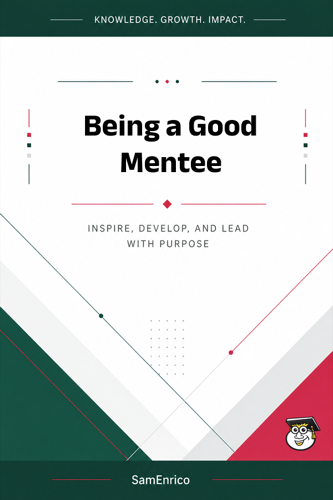
Non-FictionSelf-HelpMentee Skills
Being a Good Mentee eBook
Respect mentor time and show progress.
by Bowens Lilia
Respect mentor time and show progress.
Formats
Free sample
Chapter 1: Owning the Wheel--The most dangerous belief you can bring into a mentorship relationship is that your mentor will save you.It sounds dramatic, but let me be direct: waiting for a mentor to assign homework, check in on your progress, or drive the agenda is not humility—it is a subtle form of disrespect. And it is the single fastest way to turn a potentially transformative relationship into a disappointing, low-value obligation for both parties.I have seen this pattern play out hundreds of times. A junior professional gets paired with a senior leader. The mentee is thrilled. The mentor is genuinely willing to help.
And then… nothing happens. The mentee waits for the mentor to schedule the first meeting. The mentor waits for the mentee to send an agenda. Both assume the other will take the lead. Weeks pass.
When they finally meet, the conversation is vague, meandering, and forgettable. The mentee leaves feeling unsupported. The mentor leaves feeling like they wasted an hour. The relationship never recovers.This chapter is about dismantling that passive "student" mentality at the root. It is about claiming your role as the driver of the mentorship—not because you are arrogant, but because you respect the mentor's time enough to not waste it on directionless conversation.
Research from Dartmouth's Center for Professional Development and UC Davis's Mentorship Effectiveness Study shows that mentees who actively set the agenda report three times higher value from their mentorship relationships compared to those who wait for direction. Three times. Not ten percent. Three hundred percent.The difference between a good mentee and a passive one is not intelligence, experience, or connections. It is ownership.The Hidden Cost of Passivity Let me describe a scene that happens in offices every single day.Sarah, a talented marketing associate, has been assigned a mentor: David, a senior director.
Sarah is nervous but excited. David is busy—always busy—but he has agreed to mentor her. Their first meeting arrives. Sarah walks in without a plan. She thinks, "David will know what to ask me.
He's the mentor."David looks up from his laptop. "So," he says, "what do you want to talk about?"Sarah freezes. "I don't know. I guess… career growth?"David nods, asks a few generic questions about her role, offers some general advice about "taking initiative" and "building visibility," and the meeting ends twenty minutes early. Sarah feels like she didn't get anything useful.
David feels like he just performed a shallow duty. Neither schedules the next meeting. The mentorship dies not with a fight, but with a whimper.What went wrong? Sarah assumed that passivity was politeness. She thought she was being respectful by letting David lead.
In reality, she was asking David to do her work for her. David cannot read her mind. He does not know which specific skills she wants to build, which projects she is struggling with, or which stakeholders she needs to influence. Without that information, even the most skilled mentor can only offer generic platitudes.Passivity is not humility. Passivity is a failure of preparation.
And it is the number one reason mentorships fail.Contrast Sarah's story with James. James is a junior product manager assigned to a senior product leader named Elena. Before their first meeting, James sends Elena a short email. "Here are three specific topics I'd love your perspective on. My main goal for the next ninety days is to improve my stakeholder presentation skills so I can lead the Q3 client review.
I've attached a one-page roadmap of what I'm trying to accomplish. Please let me know if any of these topics are outside your expertise or if you'd recommend I focus elsewhere first."Elena reads that email in ninety seconds. She knows exactly what James wants. She knows he has done his homework. She knows this will not be a waste of her time.
She replies, "Great prep. Let's focus on the presentation skills—that's right in my wheelhouse. See you Tuesday."James did not ask Elena to drive. He handed her the keys and said, "I know where I want to go. Can you help me navigate?" That is ownership.
And it changes everything.The Identity Shift: From Student to Partner The first and most important transformation this book requires is an identity shift. You must stop thinking of yourself as a student receiving wisdom from a master and start thinking of yourself as a partner in a strategic alliance.This is not semantic wordplay. The student-mentor model carries implicit assumptions that are actively harmful. A student waits for homework. A student expects the teacher to set the curriculum.
A student assumes that showing up is enough. A student believes that the teacher is responsible for the student's success.None of those assumptions belong in a professional mentorship.A strategic partner, by contrast, arrives with a point of view. A strategic partner has done the pre-work. A strategic partner knows that the relationship exists to solve specific problems and achieve specific outcomes. A strategic partner takes responsibility for their own success and views the mentor as an accelerator, not a driver.Let me be clear about what this does not mean.
It does not mean you should be aggressive, demanding, or dismissive of your mentor's expertise. It does not mean you should ignore their guidance or refuse to listen. Ownership is not arrogance. Ownership is the recognition that you are the only person who will ever be fully accountable for your career. Your mentor is a powerful ally, but they are not responsible for you.
You are.This distinction matters because it changes every behavior that follows. A passive mentee asks, "What should I do?" An owning mentee says, "Here is what I am planning to do. Here is why. What am I missing?" A passive mentee waits for the mentor to schedule the next meeting. An owning mentee sends the calendar invite.
A passive mentee hopes the mentor remembers their goals. An owning mentee writes them down, shares them, and tracks progress against them.The passive mentee treats the mentor as a resource to be consumed. The owning mentee treats the mentor as a partner to be respected.The Two-Part Ownership Protocol This book will give you many frameworks, templates, and scripts across the twelve chapters that follow. But the foundation—the non-negotiable starting point—is the Ownership Protocol. It has only two parts.
Master these two behaviors, and you will be in the top ten percent of mentees immediately.Part One: Bring the Destination Before They Ask Before every single interaction with your mentor—whether it is a scheduled meeting, a quick email, or a hallway conversation—you must be able to answer one question: "What specific outcome am I seeking from this interaction?"This sounds simple. It is not. Most people walk into meetings with a vague sense of what they want to discuss but no clear articulation of what success looks like. "I want to talk about my career" is not a destination. "I want to get feedback on whether I should apply for the senior analyst role now or wait six more months" is a destination.
"I want to get better at leadership" is not a destination. "I want to practice my opening statement for the…
This is the end of the free sample. Get the eBook to keep going. Buy now
About this book
Details
- Author
- Bowens Lilia
- Publisher
- SamEnrico
- Language
- English
- Genre
- Non-Fiction, Self-Help, Mentee Skills
- Released
- 2026-06-07
- Pages (approx.)
- 137
- Available as
- eBook, Audiobook

Read better in the ZLOADR app
Your eBooks on your phone or tablet. Sign in with your SamEnrico account and start reading.
More by Bowens Lilia
 Voice Actor Union SecretsBowens Lilia$11.99
 Forgiveness for Parenting MistakesBowens Lilia$11.99
 Video Poker Addiction HelpBowens Lilia$11.99
 Teenage Self Esteem WorkbookBowens Lilia$11.99
 Sarcasm and Passive AggressionBowens Lilia$11.99
 Oncologist Burnout GuideBowens Lilia$11.99
 Fostering After Pet LossBowens Lilia$11.99
 The Immortals' Last Stand: Thermopylae's Forgotten Siege (480 BC)Bowens Lilia$11.99
 Pelé’s Golden Thread: The Fashion Revolution of 1970Bowens Lilia$11.99
 How to Produce Model RocketryBowens Lilia$11.99
 Pop Up Post Activation GuideBowens Lilia$12.99
 US City Minimum Wage TrackerBowens Lilia$12.99
You may also like
 Hong Kong Handover 1997Dunn Johnnie$11.99
 Zumba For Postnatal Recovery CourseNeal Christian$11.99
 Zumba for BeginnersLadner Nikia$11.99
 YouTube Comment Mining GuideHumes Pandora$12.99
 Worry Box MeditationCarlin Rudy$11.99
 Workplace Stress MeditationNguyen Lynn$11.99
 Workplace Stress and Sleep RepairHawley Ivory$11.99
 Workplace Perfectionism CureDelaney Jeffry$11.99
 Workplace Injustice Anger GuideWallen Isabelle$11.99
 Work Addiction and Burnout LinkGreenwood Ester$11.99
 Women in Yoga and WellnessBeattie Galina$11.99
 Women in Stand Up ComedyChun Evangeline$11.99