
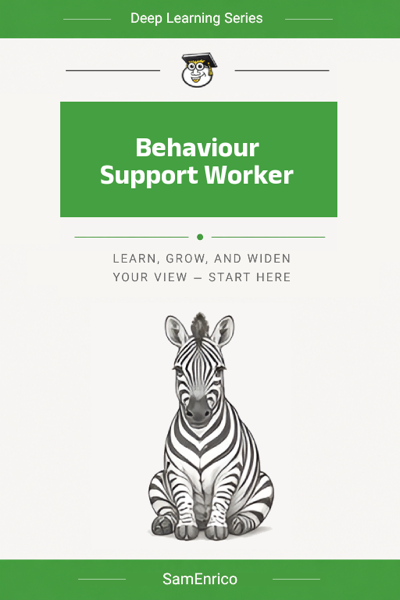
Non-FictionInformativeEducational
Behaviour Support Worker eBook
A Coursebook on Behaviour Support Worker
by Babb Kaylee
A Coursebook on Behaviour Support Worker
Formats
Free sample
Chapter 1: The Mirror Test--–- The first time a client looked at me and said, “You’re just like the last one,” I felt my stomach drop. I had spent six weeks trying to build rapport, using every strategy from my training—active listening, positive reinforcement, consistent boundaries. None of it mattered. In that single sentence, a fourteen-year-old boy named Marcus had named the fear I had been avoiding since my first day as a Behaviour Support Worker: that despite my best intentions, I was replicating the very systems of control I had sworn to dismantle.This chapter is not about techniques. It is about identity.
Before you learn a single strategy for collecting data, writing a plan, or de-escalating a crisis, you must first answer a more fundamental question: Who are you in this room? Are you a warden who controls behaviour through coercion, bribes, and punishment? Or are you a supporter who teaches skills, redesigns environments, and builds genuine relationships? The answer determines everything that follows—not just your effectiveness, but your safety, your longevity in the field, and most importantly, the dignity of the people you support.The behaviour support field is littered with burnt-out workers who entered with compassion and left with cynicism. They started with good hearts but lacked a clear professional identity.
When their natural empathy failed to stop a client from hitting them, they defaulted to what they had seen other workers do: threats, restraint, sarcasm, or the silent treatment. These are not failures of character. They are failures of training. No one taught them a different way. This book is that different way.
But it begins not with a tool, but with a mirror.The Wardens and the Supporters Every behaviour support worker eventually faces a choice, whether they recognise it or not. You can be a warden or you can be a supporter. There is no neutral ground.The warden views challenging behaviour as a violation of rules that must be punished or extinguished. The warden’s primary tools are consequences—time-out, loss of privileges, restraint, seclusion, verbal reprimands, and bribes offered before the behaviour (“If you stop screaming, you can have a sticker”). The warden sees their job as enforcing compliance.
They measure success by the absence of negative behaviour, regardless of whether the person has learned anything or improved their quality of life. The warden often burns out quickly because their methods only work when they are present and watching; the moment they leave, the behaviour returns. Or worse, the behaviour does stop, but the person becomes anxious, withdrawn, and depressed—a quiet compliance that looks like success but is actually a trauma response.The supporter views challenging behaviour as communication. When a person hits, screams, or self-injures, the supporter asks not “What rule did they break?” but “What are they trying to tell me?” and “What skill are they missing?” The supporter’s primary tools are environmental design, skill teaching, data collection, and relationship building. They measure success not by the absence of negative behaviour alone, but by the presence of positive skills—requesting a break, waiting patiently, tolerating a delay, using words instead of fists.
The supporter lasts longer in the field because their methods teach lasting skills that travel with the person across settings and staff.Consider two workers supporting the same client, a young woman named Priya who screams and throws objects when asked to transition from her favourite activity (watching videos on her tablet) to a non-preferred task (washing dishes).The warden says: “Priya, if you throw that tablet, you lose it for the rest of the day.” Priya screams louder and throws a cup. The warden confiscates the tablet and places Priya in a time-out. Priya cries for twenty minutes. The next day, the same sequence occurs. Nothing has changed except that Priya now associates the warden with loss and isolation.The supporter says: “Priya, I can see you are enjoying your video.
In two minutes, we will wash dishes. Do you want to set a timer?” The supporter shows Priya a visual schedule with “videos” followed by “dishes.” When the timer goes off, the supporter says, “Thank you for watching the timer. First dishes, then more videos. Do you want the blue sponge or the green sponge?” Priya protests briefly but follows. The supporter praises her: “Great transition, Priya.
You kept your hands calm.” Over time, Priya learns the sequence and no longer protests.The difference is not magic. It is not about being “nicer.” It is about understanding that behaviour is predictable, lawful, and teachable. The warden assumes Priya is “being difficult.” The supporter assumes Priya lacks the skill to transition smoothly and designs an environment that teaches that skill.The Four Core Identities of a Behaviour Support Worker In the twenty-first century, the Behaviour Support Worker (BSW) is not a single thing. You must wear four distinct hats, often switching between them in the space of a single interaction. Each identity is essential.
Neglect any one, and your practice becomes unbalanced.Identity One: Educator Your primary job is to teach missing skills. Most challenging behaviour exists because the person lacks a more effective way to get their needs met. A child who hits when they want a toy does not need punishment; they need to learn to ask, wait, or trade. An adult who self-injures when overwhelmed does not need restraint; they need to learn to recognise their early warning signs and request a break. As an educator, you break skills down into tiny steps, demonstrate them, provide practice opportunities, and reinforce approximations.
You are not a behaviour manager. You are a skill-builder.Identity Two: Data-Collector You cannot teach what you cannot see. Data is not paperwork for your manager; it is your eyes when you are not in the room and your memory when you are exhausted. You collect information on what happens before a behaviour (the antecedent), the behaviour itself, and what happens after (the consequence). You track frequency, duration, and latency.
You notice patterns across days and times. Without data, you are guessing. With data, you are diagnosing. Chapter 4 will teach you exactly how to collect useful data without spending hours on paperwork.Identity Three: Advocate The people you support are among the most marginalised in society. They are often excluded from schools, workplaces, and community spaces.
They may have had their choices taken away by well-meaning staff who prioritised convenience over dignity. As an advocate, you do not speak for the person unless necessary; you speak with them. You ensure their preferences are documented and respected. You challenge restrictive practices that have outlived their necessity. You report abuse and neglect, even when the perpetrator is a colleague.
Advocacy is uncomfortable. It creates conflict. It is also non-negotiable.Identity Four: Relationship-Builder Nothing works without trust. Every strategy in this book—every visual schedule, every data sheet, every de-escalation script—depends on a foundation of genuine relationship. The person you support must know that you are safe, predictable, and on their side.
Relationship-building is not “being soft.” It is strategic. Research consistently shows that the quality of the therapeutic alliance is one of the strongest predictors of positive…
This is the end of the free sample. Get the eBook to keep going. Buy now
About this book
Details
- Author
- Babb Kaylee
- Publisher
- SamEnrico
- Language
- English
- Genre
- Non-Fiction, Informative, Educational
- Released
- 2026-05-18
- Pages (approx.)
- 149
- Available as
- eBook, Audiobook

Read better in the ZLOADR app
Your eBooks on your phone or tablet. Sign in with your SamEnrico account and start reading.
More by Babb Kaylee
 The Body Language for Public SpeakingBabb Kaylee$11.99
 Hypnotic Susceptibility TestBabb Kaylee$11.99
 Parking Spot Rage GuideBabb Kaylee$11.99
 Dressing for Confidence GuideBabb Kaylee$11.99
 The Ark Survival Evolved Time SinkBabb Kaylee$11.99
 Logistics Tech Capital GuideBabb Kaylee$12.99
 The Visionaries of the New World: L'Enfant and the Birth of Washington, D.C.Babb Kaylee$11.99
 Understanding Midline Defects Autosomal TypeBabb Kaylee$17.99Logistics Tech Capital GuideBabb Kaylee$12.99
 Due Diligence Document ReviewBabb Kaylee$12.99
 How to Start a Bullion Broking on Behalf of others Business (Beginners Guide)Babb Kaylee$11.99
You may also like
 Hong Kong Handover 1997Dunn Johnnie$11.99
 Zumba For Postnatal Recovery CourseNeal Christian$11.99
 Zumba for BeginnersLadner Nikia$11.99
 YouTube Comment Mining GuideHumes Pandora$12.99
 Worry Box MeditationCarlin Rudy$11.99
 Workplace Stress MeditationNguyen Lynn$11.99
 Workplace Stress and Sleep RepairHawley Ivory$11.99
 Workplace Perfectionism CureDelaney Jeffry$11.99
 Workplace Injustice Anger GuideWallen Isabelle$11.99
 Work Addiction and Burnout LinkGreenwood Ester$11.99
 Women in Yoga and WellnessBeattie Galina$11.99
 Women in Stand Up ComedyChun Evangeline$11.99