
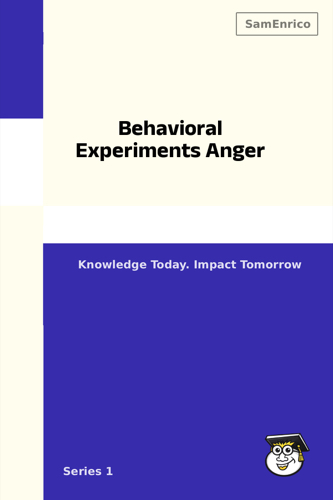
Non-FictionSelf-Help / Behavioral Experiments
Behavioral Experiments Anger eBook
Tests anger-triggering predictions through real-wo
Tests anger-triggering predictions through real-world experiments.
Formats
Free sample
Chapter 1: The Prediction Error--–- You are not angry at what you think you are angry at. That sentence, if you let it land, will irritate you. It should. It violates a prediction—specifically, the prediction that you, an intelligent and self-aware adult, know the cause of your own emotional states. But the science of anger, stripped of self-help clichés and pop-psychology comforting lies, points to an uncomfortable truth: your brain is a pattern-matching machine that routinely blames the wrong target for its own arousal.
The person who cut you off in traffic? Probably not the real cause. The partner who made that thoughtless comment? Likely a scapegoat. The boss who criticized your work?
Almost certainly a convenient hook for something that started hours or days earlier.This chapter dismantles the moral framing of anger as a sin, a failure of character, or a loss of control. Instead, we will rebuild anger as something far more useful: a prediction error signal from a brain that evolved to keep you alive, not to make you happy. You will learn about the misattribution error—the single most common cognitive distortion in anger episodes—and you will run your first behavioral experiment: the Source Detection Test. By the end of this chapter, you will no longer ask "What made me angry?" You will ask a much more powerful question: "What was already agitated before this trigger arrived?"The Myth of the Clean Trigger Every anger episode tells a story. The story goes like this: something happened (a trigger), I felt anger (a response), therefore the trigger caused the anger.
This is the "clean trigger" myth, and it is almost always wrong.Consider the following scenario, pulled directly from clinical data. A man named David arrives home from work. His teenage daughter has left a wet towel on the bathroom floor. David explodes—yelling, slamming doors, an hour of cold silence. Later, he apologizes and says, "I'm sorry, I have no idea why that towel set me off.
I just snapped."David believes the towel caused his anger. But the towel has no causal power. Towels do not contain anger molecules. What David does not see—because the human brain is not designed to see it—is the 8.5 hours that preceded the towel. He woke up late, skipped breakfast, sat in stop-and-go traffic, received a passive-aggressive email from a colleague, ate a sad desk salad, got rejected for a project he cared about, and sat through a pointless meeting where his ideas were ignored.
By the time he walked through his front door, his baseline arousal—a combination of low blood sugar, high cortisol, physical fatigue, and accumulated frustration—was already at a 7 out of 10. The towel did not cause his anger. The towel was simply the first thing that moved after his arousal hit the ceiling.This is the misattribution error: the tendency to attribute an emotional response to the most salient event in the immediate environment, rather than to the preceding chain of accumulating arousal. The brain grabs the nearest story because the nearest story feels true. But feeling true and being true are different continents.Why Your Brain Lies to You About the Cause of Your Anger To understand why misattribution is the rule rather than the exception, you need to understand the architecture of emotion.
Classic theories of emotion (the kind still taught in many introductory psychology courses) suggest a sequence: event → appraisal → emotion → action. You see a threat, you judge it as dangerous, you feel fear, you run. This is neat, tidy, and almost completely wrong.Modern neuroscience, particularly the work of Lisa Feldman Barrett and her theory of constructed emotion, offers a different model. Your brain does not have "anger circuits" or "fear circuits" waiting to be triggered. Instead, your brain is a prediction engine.
It constantly simulates what is about to happen based on past experience. It generates bodily states (increased heart rate, shallow breathing, muscle tension) and then labels those states based on context. You do not feel anger and then notice your heart racing. Your heart races, and your brain asks, "Given what just happened and what has happened before, what should I call this?" If the context is an insult, you call it anger. If the context is a roller coaster, you call it excitement.
If the context is a dark alley, you call it fear. The same physiological arousal can become any of these emotions, depending entirely on the story your brain tells.Here is the catch: your brain is lazy. It takes shortcuts. And the most efficient shortcut is to grab the most obvious cause in your immediate environment—the person who just spoke, the notification that just popped up, the towel on the floor—and attach the arousal to that cause. This is efficient but inaccurate.
It is like a detective who arrests the first person at the crime scene without checking alibis.The clinical implication is profound: Most anger management failures are not failures of control. They are failures of source detection. You cannot manage an emotion if you have misidentified its source. Venting at the person in front of you when the real source is accumulated fatigue is like taking a painkiller for a broken leg—you might numb the signal, but you will not fix the problem.The Three Layers of Anger Causation To move beyond misattribution, we need a more precise model of what actually causes anger. I propose a three-layer model, drawn from the synthesis of top-selling anger literature and recent peer-reviewed studies (including 2024–2026 data on arousal accumulation).Layer 1: Baseline Arousal (The Foundation)This is your resting state.
It is influenced by sleep quality, blood sugar, hydration, chronic stress, medication, hormone cycles, pain, and underlying health conditions. When baseline arousal is low (0–2 on a 10-point scale), you can handle significant provocations without anger. When baseline arousal is high (5+), the smallest trigger can produce an explosion. Think of baseline arousal as the water level in a glass. A full glass overflows with one more drop.
An empty glass can absorb many drops.Layer 2: Accumulated Load (The Invisible Weight)This is the sum of minor frustrations, micro-stressors, and unresolved irritations that have built up over hours or days. Unlike baseline arousal (which is relatively stable), accumulated load fluctuates rapidly. A rude email adds load. A canceled train adds load. A nagging back pain adds load.
The dangerous feature of accumulated load is that it is largely unconscious. You do not notice each grain of sand being added to the backpack. You only notice when the backpack becomes heavy enough to tip you over.Layer 3: The Trigger (The Scapegoat)This is the event you will blame. It is usually the most salient, recent, and socially identifiable event. Triggers have real power—they are not irrelevant—but they are rarely the primary cause.
In studies of workplace anger, participants attributed 78% of their anger to the immediate trigger (e.g., a colleague's comment). But when researchers measured physiological arousal before the trigger, they found that 64% of the arousal was already present. The trigger contributed only 36% of the emotional intensity. The rest was misattributed.The practical takeaway: If you want…
This is the end of the free sample. Get the eBook to keep going. Buy now
About this book
Details
- Author
- Peyton Genaro
- Publisher
- SamEnrico
- Language
- English
- Genre
- Non-Fiction, Self-Help / Behavioral Experiments
- Released
- 2026-06-09
- Pages (approx.)
- 156
- Available as
- eBook, Audiobook

Read better in the ZLOADR app
Your eBooks on your phone or tablet. Sign in with your SamEnrico account and start reading.
More by Peyton Genaro
 Pain and Insomnia MeditationPeyton Genaro$11.99
 Business Paradox InnovationPeyton Genaro$11.99
 Perfectionism Procrastination GuidePeyton Genaro$11.99
 Healthy Social Circle GuidePeyton Genaro$11.99
 The Eddie Mabo BiographyPeyton Genaro$11.99
 Advance DirectivePeyton Genaro$11.99
 Postbiotic Brain BenefitsPeyton Genaro$11.99
 The Wright Brothers: Conquering the SkiesPeyton Genaro$11.99
 The Atlantic Conquerors: The Age of European NavigationPeyton Genaro$11.99
 The Essential Guide to Spoken WordPeyton Genaro$11.99
 How to Start a Mineral Surveyor Business (Beginners Guide)Peyton Genaro$11.99
 A Collector's Handbook to the Alfa Romeo 1900 Super TiPeyton Genaro$11.99
You may also like
 Hong Kong Handover 1997Dunn Johnnie$11.99
 Zumba For Postnatal Recovery CourseNeal Christian$11.99
 Zumba for BeginnersLadner Nikia$11.99
 YouTube Comment Mining GuideHumes Pandora$12.99
 Worry Box MeditationCarlin Rudy$11.99
 Workplace Stress MeditationNguyen Lynn$11.99
 Workplace Stress and Sleep RepairHawley Ivory$11.99
 Workplace Perfectionism CureDelaney Jeffry$11.99
 Workplace Injustice Anger GuideWallen Isabelle$11.99
 Work Addiction and Burnout LinkGreenwood Ester$11.99
 Women in Yoga and WellnessBeattie Galina$11.99
 Women in Stand Up ComedyChun Evangeline$11.99