
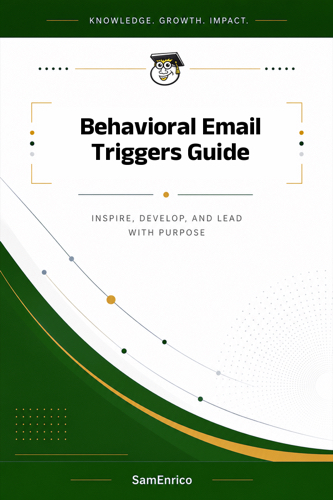
Non-FictionBusiness BriefBehavioral Triggers
Behavioral Email Triggers Guide eBook
Automates based on website activity and purchases.
Automates based on website activity and purchases.
Formats
Free sample
Chapter 1: The Invisible Conveyor Belt--–- Imagine a factory where thousands of products roll down a single conveyor belt every morning at 9:00 AM. Mattresses land next to baby bottles. Running shoes tumble against gourmet coffee beans. A worker stands at the end, frantically sorting items, handing each to the nearest customer who happens to be standing there. That factory would go bankrupt in a week.
Yet this is exactly how most businesses still do email marketing.Every Monday morning, marketing teams around the world upload their weekly newsletter to an email service provider. They hit send. The same message goes to everyone: the first-time visitor who downloaded a white paper three years ago, the loyal customer who buys every month, the person who just abandoned a cart ten minutes ago, and the subscriber who hasn't opened an email in six months. One message. One conveyor belt.
Everyone gets the same thing.This approach is not merely inefficient. It is actively destructive. Batch-and-blast email marketing trains your audience to ignore you. It teaches your best customers that you do not see them. It tells your least engaged subscribers that you have nothing new to offer.
The data is unambiguous: the average open rate for bulk marketing emails hovers around 20 percent. The average click-through rate struggles to reach 2.5 percent. Meanwhile, abandoned cart emails—a single type of behavioral trigger—regularly achieve 40 to 50 percent open rates and 10 to 15 percent conversion rates. The difference is not luck. It is architecture.This book exists because the era of batch email is over.
Consumers have voted with their attention spans, their inbox habits, and their wallets. They no longer tolerate irrelevance. They expect brands to remember what they looked at, what they bought, and what they abandoned. They expect the convenience of Amazon combined with the personal touch of a local shop. And they expect it all to happen automatically, without forms to fill out or preferences to restate every time they visit.Behavioral email triggers are the answer.
They are the invisible conveyor belt that routes the right message to the right person at the exact moment of interest. They fire when a user takes an action—views a product, adds to cart, makes a purchase, reads a blog post, hits a scroll depth, or even stays silent for too long. Each trigger is a decision tree: If this happens, then send that email. If that email gets opened, then send the next one. If the user buys, then stop all abandonment emails immediately.
This is not science fiction. This is logic executed at scale.The Death of the Batch Mindset The batch mindset is a hangover from the early days of email marketing, when sending a message to a thousand people required manual effort and cost real money. Marketers conserved their sends. They saved up news, offers, and announcements for a weekly or monthly digest. Subscribers tolerated this because they had few alternatives.
Every brand operated the same way.That world no longer exists. Email service providers now charge pennies per thousand sends. Automation platforms allow unlimited triggered sequences at negligible marginal cost. Consumers receive hundreds of emails per week from dozens of brands. The scarce resource is no longer the cost of sending—it is the attention of the recipient.
Batch emails demand attention without earning it. Triggered emails earn attention by showing up exactly when the user has demonstrated interest.Consider the difference between walking into a clothing store and having a salesperson immediately approach you with a generic "Can I help you find something?" versus having that same salesperson notice you lingering near the jackets, then quietly bring over a selection in your size and preferred color. The first interaction is push. The second is pull. The first feels like an interruption.
The second feels like service. Behavioral triggers are the automated equivalent of that attentive salesperson. They wait. They watch. They act only when signaled.The batch mindset also creates a dangerous incentive structure inside marketing teams.
When the only way to reach customers is through a weekly newsletter, every message becomes a negotiation. The product team wants to push new features. The sales team wants to promote discounts. The content team wants to share blog posts. The result is a bloated, unfocused email that tries to do everything and accomplishes nothing.
Behavioral triggers dissolve this tension. Each trigger has a single job. Abandoned cart emails recover lost sales. Welcome emails onboard new users. Post-purchase emails drive repeat business.
Re-engagement emails win back dormant subscribers. No single email bears the weight of the entire marketing calendar.The Five-Second Attention Span Neuroscience research consistently shows that humans make rapid, subconscious decisions about whether to engage with incoming information. For email, that decision happens in under five seconds. The recipient glances at the sender name, the subject line, and the preview text. If nothing catches their attention, the email is archived or deleted.
If something feels relevant, they open it. If nothing feels familiar, they unsubscribe.Behavioral triggers exploit this five-second window by making relevance immediately obvious. When a customer receives an abandoned cart email with the subject line "Did you forget something?" they recognize the product images, the price, and the urgency. There is no confusion about why the email arrived. There is no mystery about what action to take.
The cognitive load is near zero. Compare this to a weekly newsletter with the subject line "Your weekly update" that contains ten different products, three blog posts, and a discount code. The recipient must scan, filter, and decide what matters. Most simply delete.The five-second rule also explains why triggered emails achieve such high mobile open rates. More than 60 percent of email opens now occur on smartphones, where the screen is small and the attention span is shorter.
A triggered email that shows a single product with a clear image and a one-tap call to action performs beautifully on mobile. A batch newsletter with multiple columns, tiny text, and competing calls to action performs poorly. The medium favors simplicity. Triggers deliver simplicity by design.The Amazon Effect In 2003, Amazon introduced "customers who bought this item also bought that item." It was a simple collaborative filtering algorithm, but it fundamentally changed consumer expectations. For the first time, a major retailer used behavioral data to make recommendations in real time.
Customers did not find this creepy. They found it helpful. They bought more. And they began to expect every other retailer to do the same.Twenty years later, the Amazon effect has become the baseline standard. When a customer looks at a pair of running shoes on your website and then receives an email about running socks the next day, they are not surprised.
They are disappointed if you don't send that email. The absence of behavioral relevance now signals incompetence rather than restraint. Consumers have been trained to expect that brands track their behavior, remember their preferences, and act on their signals.This expectation creates both a challenge and an opportunity. The challenge is technical: you must build the tracking infrastructure, the trigger logic, and the email sequences to deliver on this expectation. The opportunity is competitive: most brands still rely on batch…
This is the end of the free sample. Get the eBook to keep going. Buy now
About this book
Details
- Author
- Pemberton Michel
- Publisher
- SamEnrico
- Language
- English
- Genre
- Non-Fiction, Business Brief, Behavioral Triggers
- Released
- 2026-06-10
- Pages (approx.)
- 126
- Available as
- eBook, Audiobook

Read better in the ZLOADR app
Your eBooks on your phone or tablet. Sign in with your SamEnrico account and start reading.
More by Pemberton Michel
 Vitamin C Mastery CoursePemberton Michel$11.99
 Self Hypnosis For Chemotherapy Support CoursePemberton Michel$11.99
 Recurring Dream Resolution CoursePemberton Michel$11.99
 Fear of Abandonment Relationship GuidePemberton Michel$11.99
 The Frozen Enigma: Unraveling Franklin's Lost Expedition in the AntarcticPemberton Michel$11.99
 Clockwork Genesis: The Forgotten Android of LeonardoPemberton Michel$11.99
 How to Become a Dice MakerPemberton Michel$11.99
 Laser TagPemberton Michel$11.99
 House Sitting Home SecurityPemberton Michel$12.99
 Mentoring Across Communication StylesPemberton Michel$12.99
 Understanding Epiphyseal Dysplasia Hearing Loss DysmorphismPemberton Michel$17.99
You may also like
 Hong Kong Handover 1997Dunn Johnnie$11.99
 Zumba For Postnatal Recovery CourseNeal Christian$11.99
 Zumba for BeginnersLadner Nikia$11.99
 YouTube Comment Mining GuideHumes Pandora$12.99
 Worry Box MeditationCarlin Rudy$11.99
 Workplace Stress MeditationNguyen Lynn$11.99
 Workplace Stress and Sleep RepairHawley Ivory$11.99
 Workplace Perfectionism CureDelaney Jeffry$11.99
 Workplace Injustice Anger GuideWallen Isabelle$11.99
 Work Addiction and Burnout LinkGreenwood Ester$11.99
 Women in Yoga and WellnessBeattie Galina$11.99
 Women in Stand Up ComedyChun Evangeline$11.99