
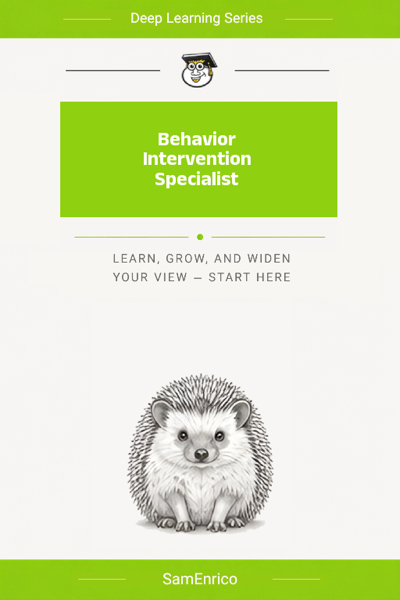
Non-FictionInformativeEducational
Behavior Intervention Specialist eBook
A Coursebook on Behavior Intervention Specialist
by Rider Efrain
A Coursebook on Behavior Intervention Specialist
Formats
Free sample
Chapter 1: Beyond Behavior Charts--–- Every behavior tells a story. The student who throws a chair when presented with a math worksheet is not simply “acting out.” The adult who yells during a team meeting is not merely “difficult.” The child who hides under a desk when a peer approaches is not just “shy.” Behind every behavior that challenges us lies a hidden narrative—one of unmet needs, undeveloped skills, misunderstood environments, or unhealed wounds. The Behavior Intervention Specialist (BIS) is the person trained to read that narrative, decode its meaning, and rewrite the conditions that make challenging behavior necessary. This chapter introduces you to that role, its landscapes, its competencies, and its ethical core. By the time you finish, you will understand why behavior charts and sticker systems so often fail—and what actually works.The Moment Everything Changed Three years ago, I walked into a self-contained classroom where a seven-year-old named Marcus was pinned to the floor by two staff members.
He had bitten one aide and scratched another. His IEP listed “aggression” as a primary concern. The behavior plan on the wall read: “When Marcus shows signs of agitation, redirect to a preferred activity. If aggression occurs, remove from classroom and call for support.” I asked the staff what happened before the aggression. They looked at me blankly.
“Nothing,” the teacher said. “He just snapped.”I spent the next two hours watching Marcus from behind a one-way mirror. What I saw changed how I understand behavior forever. Before each aggressive episode, Marcus was given a worksheet with twelve long-division problems. He could not do long division.
He had never been taught. Each time, he would stare at the paper for forty-five seconds, begin tapping his foot, then start humming, then bite his hand, then—if still not helped—bite someone else. His behavior was not random aggression. It was a sophisticated, if dangerous, communication: “I cannot do this task. I need help.
No one is listening.”The staff had labeled Marcus as violent. They had never once assessed whether he had the skills to comply with the demand. This is the fundamental error that behavior intervention must correct: assuming that challenging behavior is a choice rather than a cry for competence.Defining the Behavior Intervention Specialist A Behavior Intervention Specialist is a professional who applies the principles of applied behavior analysis (ABA), trauma-informed care, and positive behavior supports to assess, prevent, and remediate challenging behavior. Unlike a teacher who manages a classroom of diverse learners, a BIS focuses intensely on the functional relationship between environment and behavior for specific individuals. Unlike a mental health counselor who explores internal states and past traumas, a BIS designs immediate, measurable changes to antecedents and consequences.
Unlike a behavior technician who implements plans written by others, a BIS conducts assessments and leads teams.The title “Behavior Intervention Specialist” appears across multiple settings—schools, clinics, homes, and residential facilities—but the core of the role remains constant. You are a detective, a strategist, a trainer, and a systems analyst. You answer three questions for every challenging behavior: What triggers it? What maintains it? What skill does the person need instead?The Four Settings of Practice Your strategies as a BIS will vary depending on where you work.
Each setting has its own culture, constraints, and opportunities.Public Schools: Where Law and Learning Intersect In public schools, BISs typically support students with Individualized Education Programs (IEPs) or Section 504 plans. The Individuals with Disabilities Education Act (IDEA) requires schools to address behavior that impedes learning—and to do so in the Least Restrictive Environment (LRE). This means you cannot simply remove a student to a self-contained classroom without data showing that less restrictive supports have failed.School-based BISs face unique challenges: large caseloads, limited time (you may cover multiple buildings), and the need to train teachers who are already overwhelmed. Success requires building trust. When you walk into a classroom, you are not there to critique.
You are there to ask: “What is hard about this student’s behavior? Let me collect some data and bring you options.”Clinical Settings: Precision and Intensity ABA clinics and mental health agencies offer a different environment. Here, intervention is often intensive (twenty to forty hours per week), data collection is rigorous, and supervision from Board Certified Behavior Analysts (BCBAs) is typically available. The BIS in a clinical setting may implement skill acquisition plans, run preference assessments, and graph data daily.The challenge is maintaining treatment fidelity across multiple technicians while preventing burnout. You will also need to ensure that clinical gains generalize to the home and school—because behavior that only improves in the clinic has not truly improved.In-Home Services: The Uncontrolled Laboratory Walking into someone’s home as a behavior professional requires a different mindset.
You have no control over lighting, noise, siblings, or the television. The family may have experienced multiple failed interventions. In-home BISs focus on family-centered intervention: teaching parents to implement behavior plans during meals, bedtimes, and transitions.The greatest skill here is not technical fluency but relational humility. You must distinguish between challenging behavior and culturally normative parenting practices. You must listen more than you prescribe.
The best in-home BISs leave families feeling empowered—not pathologized.Residential Facilities: Crisis and Consistency Group homes, behavioral health units, and juvenile justice facilities represent the highest intensity setting. Residents may have significant disabilities, trauma histories, and a pattern of crisis-level behavior. The BIS here works alongside direct care staff who rotate shifts and may have minimal training.Your focus is on antecedent interventions (preventing crises before they start) and staff training (ensuring every shift follows the same response protocol). You will also be involved in post-crisis debriefing, helping staff process incidents without blame while identifying environmental changes to reduce future risk.The Five Core Competencies of a BISAcross all four settings, effective BISs share five observable, teachable skills.Competency One: Conducting Functional Assessments Before you change a behavior, you must understand it. Functional assessment is the process of gathering information about antecedents (what happens before), behavior (what the person does), and consequences (what happens after).
You will learn indirect methods (interviews with caregivers, rating scales like the FAST and QABF) and direct methods (ABC recording, scatterplots). A full functional analysis—experimentally testing hypotheses about behavior function—is typically reserved for BCBAs due to the risk of evoking dangerous behavior. However, as a BIS, you will conduct the foundational assessments that drive all subsequent intervention. (Chapter 4 provides the complete step-by-step process.)Competency Two: Designing Function-Based Interventions Once you understand why a behavior occurs, you design interventions that address that reason. If a student throws work to escape difficult tasks, your plan should not focus on consequences after the throw—it should focus on making the task easier (antecedent modification) and teaching the student to request a break (replacement behavior).
Generic plans that ignore function are not just ineffective; they can make behavior worse. (You will learn these strategies in Chapters 6 through 8.)Competency Three: Collecting and Analyzing Behavioral Data Data is how you know whether your intervention is working. You will learn five primary measurement systems: event recording (frequency), duration, latency, interval recording, and momentary…
This is the end of the free sample. Get the eBook to keep going. Buy now
About this book
Details
- Author
- Rider Efrain
- Publisher
- SamEnrico
- Language
- English
- Genre
- Non-Fiction, Informative, Educational
- Released
- 2026-05-04
- Pages (approx.)
- 153
- Available as
- eBook, Audiobook

Read better in the ZLOADR app
Your eBooks on your phone or tablet. Sign in with your SamEnrico account and start reading.
More by Rider Efrain
 Voice Controlled Device Distraction CourseRider Efrain$11.99
 Anger Management for Healthcare WorkersRider Efrain$11.99
 Jamaican Recruitment Pipeline PlanRider Efrain$11.99
 International Relations PromptsRider Efrain$11.99
 The Akiva the Scholar MartyrRider Efrain$11.99
 The Silent Custody Wars: When Mothers Kill for Their ChildrenRider Efrain$11.99
 How to Start a Optical Density Measuring Equipment (non-electronic) Business (Beginners Guide)Rider Efrain$11.99
 YouTube SEO for Brand ChannelsRider Efrain$12.99
 HVAC Manufacturing M&ARider Efrain$12.99
 Understanding Poikiloderma Hereditary Acrokeratotic Weary TypeRider Efrain$17.99
You may also like
 Hong Kong Handover 1997Dunn Johnnie$11.99
 Zumba For Postnatal Recovery CourseNeal Christian$11.99
 Zumba for BeginnersLadner Nikia$11.99
 YouTube Comment Mining GuideHumes Pandora$12.99
 Worry Box MeditationCarlin Rudy$11.99
 Workplace Stress MeditationNguyen Lynn$11.99
 Workplace Stress and Sleep RepairHawley Ivory$11.99
 Workplace Perfectionism CureDelaney Jeffry$11.99
 Workplace Injustice Anger GuideWallen Isabelle$11.99
 Work Addiction and Burnout LinkGreenwood Ester$11.99
 Women in Yoga and WellnessBeattie Galina$11.99
 Women in Stand Up ComedyChun Evangeline$11.99