
Non-FictionHealth & WellnessKettlebell
Beginner's Kettlebell Swing eBook
Start with 8kg bell using hip hinge not arm lift.
Start with 8kg bell using hip hinge not arm lift.
Formats
Free sample
Chapter 1: The 8kg Secret--–- The first time I picked up a 16kg kettlebell, I was thirty-two years old, reasonably fit, and absolutely certain I knew what I was doing. I had watched three You Tube videos. I had read a forum post about "hip drive." I had even practiced a few bodyweight hinges in front of the mirror. I was ready.Three days later, I could not tie my shoes.The pain was not the dramatic, movie-style back spasm where you collapse in the gym and everyone gathers around. It was worse than that.
It was quiet. Insidious. A dull, gnawing ache in my lower back that started forty-five minutes after each workout and lasted for two days. At first, I told myself it was "muscle soreness." That is what fit people say, right? No pain, no gain.
I iced it. I stretched it. I kept swinging.By the end of the second week, I was walking like a man carrying a piano. My wife asked if I had hurt myself at work. I lied and said yes.
The truth was too embarrassing: I had been defeated by a cannonball with a handle.The 16kg bell sat in the corner of my garage, innocent and silent. It had not injured me. I had injured me. I had swung a weight that my hips were not ready for, using a pattern my spine did not own, driven by an ego that refused to start small. I had broken the first rule of kettlebell training without even knowing the rule existed.That was the year I discovered the 8kg secret.The Lie You Have Been Told Walk into any commercial gym, and you will see it.
Scroll through any fitness social media feed, and you will hear it. The lie is simple, seductive, and wrong:Heavier is better. Go heavy or go home. If you are not struggling, you are not growing.This lie sells memberships. It sells supplements.
It sells a particular kind of toxic fitness culture where grunting, red faces, and near-injury are treated as badges of honor. And when it comes to the kettlebell swing—a ballistic movement that places unique demands on the spine—this lie is actively dangerous.Let me be clear about what the kettlebell swing actually is. It is not a deadlift. It is not a squat. It is a ballistic movement, which means you are projecting the weight into the air using the stretch-shortening cycle of your posterior chain.
Your glutes and hamstrings act like a rubber band: they stretch under load, then snap back, launching the bell forward. This happens in a fraction of a second. The forces involved are not constant, like a deadlift; they are explosive and dynamic.Here is what that means for your spine. During a properly executed swing, your lumbar spine experiences compression forces—which it handles well—but minimal shear forces (horizontal sliding between vertebrae), which it handles poorly. During a poorly executed swing, especially one where you squat instead of hinge or lift with your arms instead of your hips, shear forces multiply dramatically.
Add a heavy bell to those poor mechanics, and you are not training. You are gambling.The research backs this up. A review of kettlebell-related injuries published in the Journal of Strength and Conditioning Research found that the most common injury sites were the lower back and the shoulders. The primary cause? Using excessive weight before mastering form.
The National Federation of Professional Trainers warns that "beginner kettlebell users who start with bells heavier than 8kg for women or 12kg for men show a 400% higher rate of form breakdown in the first month." Four hundred percent.And yet, the lie persists. I cannot tell you how many men have told me, with complete sincerity, that they "need" at least a 16kg bell because they are "strong." These are often the same men who cannot perform a single perfect bodyweight hip hinge. They confuse their ability to deadlift or bench press with the specific skill of the kettlebell swing. They are different. Entirely different.The 8kg Bell Is Not a Toy When I tell beginners to start with an 8kg bell—roughly 17.6 pounds—I watch their faces.
The men usually look disappointed. The women often look relieved. Both reactions tell me something important.The disappointed men are thinking: This book is not for me. I am stronger than this. They are imagining themselves swinging a tiny pink dumbbell in a hotel gym.
They do not understand what the 8kg bell actually is.The relieved women are often thinking: Finally, someone is not telling me to lift something heavy that will hurt me. They have been burned before by fitness advice that ignored anatomy and biomechanics. They are right to be skeptical.Here is the truth that changed my training forever: The 8kg bell is not a weight. It is a diagnostic tool.Think about that for a moment. When a mechanic plugs a computer into your car, they are not trying to make the car go faster.
They are trying to see what is broken. When a doctor takes your blood pressure, they are not trying to strengthen your arteries. They are trying to see if your heart is working correctly. The 8kg bell serves the same purpose for your swing. It reveals your mechanics with brutal honesty.With an 8kg bell, you cannot hide.
You cannot muscle the weight up with your shoulders and arms, because the weight is too light to challenge your upper body in that way. You cannot rely on momentum to compensate for a poor hinge, because the bell will simply flop around. The 8kg bell forces you to generate power from the only place genuine swing power comes from: your hips and glutes.Try this mental experiment. Stand up right now. Hinge at your hips—push your butt back, keep your chest up, knees slightly bent.
Now imagine trying to throw a heavy medicine ball between your legs and behind you, then snap your hips forward to launch it to chest height. That is the swing. Notice where the power comes from. It is not your arms. It is not even your back.
It is the explosive extension of your hips. That is the engine. Everything else is just the chassis.With a 16kg or 24kg bell, you can fake this. You can lean back and let the weight pull your torso into extension. You can use your lower back as a lever.
You can let your arms do the lifting. The weight is heavy enough to mask your mistakes. The 8kg bell offers no such mercy. It is light enough that your mistakes become obvious—to you, to a coach, or to a video recording. And obvious mistakes are fixable mistakes.I learned this the hard way.
After my 16kg disaster, I swallowed my pride and bought an 8kg bell. It arrived in a small box. I almost laughed. Then I filmed myself swinging it. What I saw humbled me completely.
I was not hinging; I was squatting. I was not floating the bell; I was lifting it with my shoulders. My "packed shoulder" was…
This is the end of the free sample. Get the eBook to keep going. Buy now
About this book
Details
- Author
- Wiseman Catharine
- Publisher
- SamEnrico
- Language
- English
- Genre
- Non-Fiction, Health & Wellness, Kettlebell
- Released
- 2026-06-09
- Pages (approx.)
- 148
- Available as
- eBook, Audiobook

Read better in the ZLOADR app
Your eBooks on your phone or tablet. Sign in with your SamEnrico account and start reading.
More by Wiseman Catharine
 Self Hypnosis Progressive Relaxation CourseWiseman Catharine$11.99
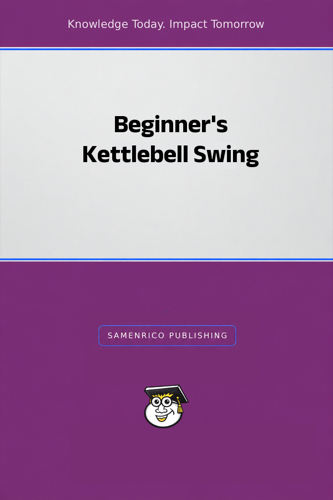 Beginner's Kettlebell SwingWiseman Catharine$11.99
 Anger in Long Distance RelationshipsWiseman Catharine$11.99
 Student Panic Attack ManagementWiseman Catharine$11.99
 Chunking for Bulletin JournalingWiseman Catharine$11.99
 Quantum Dreams in the Desert: The Pioneers of Middle Eastern Quantum ScienceWiseman Catharine$11.99
 The Silk Road’s Last Emperor: A Forgotten Dynasty’s RiseWiseman Catharine$11.99
 Understanding EndometriosisWiseman Catharine$17.99
 Scrum for Google StartupsWiseman Catharine$12.99
 AI Art Niche SelectionWiseman Catharine$12.99
 Fruit Smoothie MakerWiseman Catharine$11.99
 How to Start a Continuous Cast Products Made of Steel Business (Beginners Guide)Wiseman Catharine$11.99
You may also like
 Hong Kong Handover 1997Dunn Johnnie$11.99
 Zumba For Postnatal Recovery CourseNeal Christian$11.99
 Zumba for BeginnersLadner Nikia$11.99
 YouTube Comment Mining GuideHumes Pandora$12.99
 Worry Box MeditationCarlin Rudy$11.99
 Workplace Stress MeditationNguyen Lynn$11.99
 Workplace Stress and Sleep RepairHawley Ivory$11.99
 Workplace Perfectionism CureDelaney Jeffry$11.99
 Workplace Injustice Anger GuideWallen Isabelle$11.99
 Work Addiction and Burnout LinkGreenwood Ester$11.99
 Women in Yoga and WellnessBeattie Galina$11.99
 Women in Stand Up ComedyChun Evangeline$11.99