
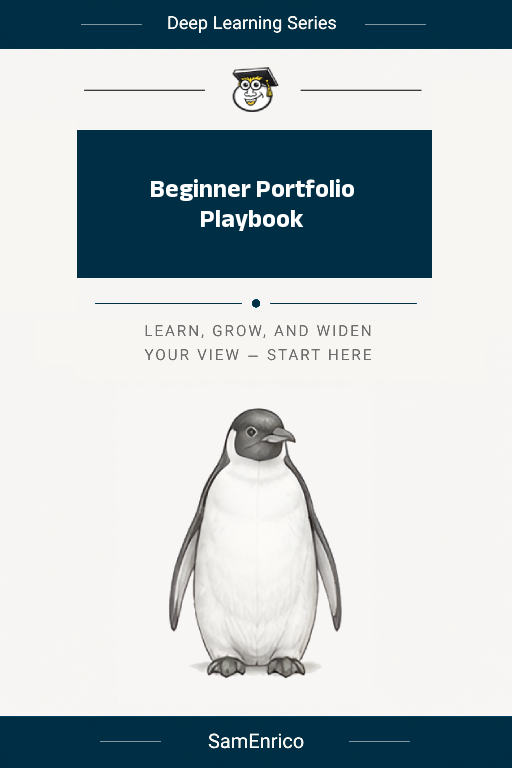
Non-FictionZero-to-One CreatorPlaybook
Beginner Portfolio Playbook eBook
Execute a proven playbook for building portfolio p
by Utley Isaias
Execute a proven playbook for building portfolio pieces that get noticed. This action guide includes project templates, presentation scripts, and recruiter psychology insights.
Formats
Free sample
Chapter 1: The Eight-Second Graveyard...--You have approximately eight seconds.That is not a metaphor. That is not an exaggeration to make you feel urgent. That is the median time a recruiter spends looking at a portfolio before deciding whether you are a "maybe" or a "no." Eight seconds. Less time than it takes to tie your shoes. Less time than it takes to microwave a cup of coffee that is still too hot to drink.In eight seconds, someone you have never met will scan your name, your headline, your first project thumbnail, and the first line of your "About Me" section.
They will not read your thoughtful case study. They will not admire your color palette. They will not appreciate the three weeks you spent perfecting that micro-interaction. They will pattern-match, judge, and move on.The cruel truth is that most portfolios are not rejected. They are simply never seen.
They are glanced at, categorized as "generic," and buried under the next candidate's link. The recruiter does not close the tab with malice. They close it with indifference. And indifference is worse than rejection because rejection at least means you were noticed.This chapter is about understanding the brain of the person on the other side of the screen. Not the idealized recruiter you imagine—the one who reads every word, appreciates every detail, and gives you the benefit of the doubt.
That recruiter does not exist. The real recruiter is overwhelmed, under pressure, and terrified of making a bad hire. Your portfolio is not competing against other portfolios. It is competing against their desire to close tabs and clear their inbox.If you understand their psychology, you can stop being a "maybe" and start being the obvious, low-risk, high-confidence answer. But first, you have to accept that your eight seconds started the moment they opened your link.
And the clock is already ticking.The Pattern-Matching Machine Recruiters are not art critics. They are risk-reduction engines.Every hiring decision carries personal consequences for the recruiter. If they recommend you and you fail, their judgment is questioned. Their boss asks why they missed the red flags. Their team resents them for wasting everyone's time.
The cost of a bad hire is not just salary—it is morale, productivity, and the recruiter's own reputation. So they are not looking for reasons to say yes. They are looking for reasons to say no quickly and move on to the next candidate.This is called risk aversion, and it is the single most important psychological force shaping how portfolios are evaluated.When a recruiter opens your portfolio, they are asking three silent questions in rapid succession:Do you understand the kind of problem we are trying to solve? (This tests relevance.)Have you solved similar problems before? (This tests authority.)Would someone else vouch for you?
(This tests social proof.)Notice what is not on that list. They are not asking: "Is this design beautiful?" "Is this code elegant?" "Is this writing clever?" Those questions come later—if you survive the first eight seconds. But survival requires that you answer the three risk questions immediately, without requiring the recruiter to hunt for answers.Here is what happens inside a recruiter's brain during those eight seconds, broken down by milliseconds:0–2 seconds: They register your name and the first visual element. If your name is small or your headline is generic ("Designer," "Writer," "Creative"), they already suspect you are a beginner. Beginners use generic titles.
Professionals claim specific domains.2–4 seconds: Their eyes move to the first project. They are not reading. They are scanning for a number. A percentage. A dollar sign.
A time-saving metric. If they do not see a number in the first two seconds of scanning, they assume you do not track results. And if you do not track results, you are a hobbyist, not a hire.4–6 seconds: Their eyes find your "About Me" section or headline. They are looking for two things: a specific claim of expertise ("I specialize in e-commerce checkout flows") and a signal that others trust you ("Featured in," "Worked with," "Rated 4.9/5"). Without both, you are unproven.6–8 seconds: They make a decision.
"Maybe" means they scroll slightly or click into one project. "No" means they close the tab. Most portfolios get "No."This is not cruelty. This is efficiency. A recruiter at a competitive company might receive five hundred portfolios a week.
If they spent sixty seconds on each, that would be eight hours a day just on initial screening. They cannot afford that. So they build heuristics—mental shortcuts—that filter out 90% of candidates in the first minute. Your job is not to be "interesting." Your job is to survive the heuristics.The Two Psychological Levers That Actually Work Robert Cialdini spent decades studying the psychology of persuasion. His book Influence identified six principles that drive human decision-making, but two of them are disproportionately powerful in the context of hiring: Authority and Social Proof.These are not abstract concepts.
They are levers you can pull in the first eight seconds of a recruiter's attention.Authority: The "I Have Solved This Before" Signal Authority works because humans are cognitive misers. We do not want to evaluate every claim from scratch. We want to defer to someone who has already done the work. When a recruiter sees evidence that you have solved a problem similar to theirs, their brain releases the need to fully vet you. They think: "If they did it there, they can probably do it here."Authority in a portfolio looks like specificity.
Compare these two headlines:Weak: "Creative designer passionate about visual communication."Strong: "E-commerce designer who reduced cart abandonment by 20% for a $50M brand."The weak headline says nothing about what you have actually done. It is a mission statement, not a credential. The strong headline names the domain (e-commerce), the problem (cart abandonment), the metric (20%), and the scale ($50M). In eight seconds, the recruiter learns everything they need to know to say "maybe."Authority can also come from:The names of companies you have worked with (even small ones, if they are recognizable in your niche)Specific technical skills that are hard to fake ("Migrated 10,000 SKUs from Shopify to custom React")Results that are independently verifiable ("Increased organic traffic 140% in six months")Notice that all of these are specific. Vague authority is not authority.
"Experienced professional" is not authority. "Proven track record" is not authority. Authority requires a claim that can be tested. If you cannot make a specific claim, you do not yet have authority in that domain—and you should not lead with that domain.Social Proof: The "Others Trust Me" Signal Authority proves you can do the work. Social Proof proves that other people believe you can do the work.
These are different muscles, and you need both.Social proof works because humans are herd animals. If three other people hired you, the recruiter feels safer hiring you. If you have testimonials, endorsements, or recognizable logos on your portfolio, the recruiter thinks: "They passed someone else's test. I do not need to run my own from scratch."In the first eight seconds, social proof appears in:Logos of past clients or employers (placed…
This is the end of the free sample. Get the eBook to keep going. Buy now
About this book
Details
- Author
- Utley Isaias
- Publisher
- SamEnrico
- Language
- English
- Genre
- Non-Fiction, Zero-to-One Creator, Playbook
- Released
- 2026-06-01
- Pages (approx.)
- 118
- Available as
- eBook, Audiobook

Read better in the ZLOADR app
Your eBooks on your phone or tablet. Sign in with your SamEnrico account and start reading.
More by Utley Isaias
 Sarcoma Survivor MemoirUtley Isaias$11.99
 Migraine and Bright Light SensitivityUtley Isaias$11.99
 Refocus Speed TrainingUtley Isaias$11.99
 The Stress and Fibromyalgia GuideUtley Isaias$11.99
 Vitamin C Immune Boosting GuideUtley Isaias$11.99
 NVC for Graduate StudentsUtley Isaias$11.99
 Justin Timberlake FutureUtley Isaias$11.99
 Food Addiction and PregnancyUtley Isaias$11.99
 Blue Zone Manual ToolsUtley Isaias$11.99
 Paper Son: The Forgotten Children of Angel IslandUtley Isaias$11.99
 The Poet Who Defied Kings: The Life and Legacy of Al-MutanabbiUtley Isaias$11.99
 Tangaroa's Wrath: The Great Wave That Swallowed IslandsUtley Isaias$11.99
You may also like
 Hong Kong Handover 1997Dunn Johnnie$11.99
 Zumba For Postnatal Recovery CourseNeal Christian$11.99
 Zumba for BeginnersLadner Nikia$11.99
 YouTube Comment Mining GuideHumes Pandora$12.99
 Worry Box MeditationCarlin Rudy$11.99
 Workplace Stress MeditationNguyen Lynn$11.99
 Workplace Stress and Sleep RepairHawley Ivory$11.99
 Workplace Perfectionism CureDelaney Jeffry$11.99
 Workplace Injustice Anger GuideWallen Isabelle$11.99
 Work Addiction and Burnout LinkGreenwood Ester$11.99
 Women in Yoga and WellnessBeattie Galina$11.99
 Women in Stand Up ComedyChun Evangeline$11.99