
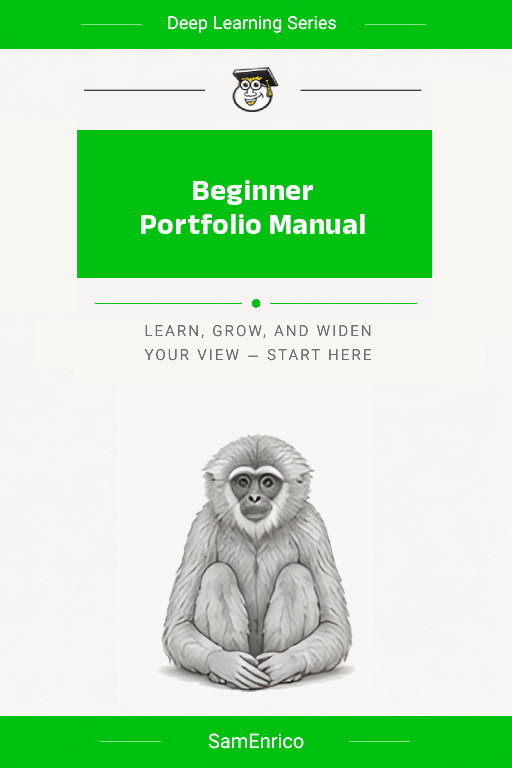
Non-FictionZero-to-One CreatorStep-by-Step Manual
Beginner Portfolio Manual eBook
Open this manual and follow the exact steps to bui
Open this manual and follow the exact steps to build your first portfolio. Includes project timelines, quality standards, and presentation templates for complete novices.
Formats
Free sample
Chapter 1: The Curator’s Secret--–- Most beginners believe a portfolio is a collection of their best work. That is wrong. A portfolio is not a museum of your favorites. It is a persuasion machine with one job: to make a specific person take a specific next step. Hire you.
Contract you. Admit you. Nothing else. If your portfolio does not accomplish that single objective, it does not matter how beautiful your work is, how many projects you include, or how many compliments your mother gave you. The portfolio failed.This chapter reveals the Curator’s Secret, the uncomfortable truth that professional portfolios are not built by showing everything you can do.
They are built by aggressively excluding almost everything you can do. The word “portfolio” comes from the Italian portare (to carry) and foglio (leaf or sheet). Historically, artists carried a case of loose papers to show patrons. They did not carry every sketch they had ever made. They selected a small number of pieces that told a coherent story.
That selection process — curation — is the difference between looking like a hobbyist and looking like a professional.If you open this book feeling anxious that you have “nothing to show,” you are in the right place. If you open this book feeling overwhelmed because you have “too much to show,” you are also in the right place. Both problems stem from the same misunderstanding: you do not yet know how to curate. Curation is not about having more or less. Curation is about having the right pieces for the right audience.
A curator at a museum does not hang every painting in the basement. They select seven pieces that whisper the same message. Your portfolio needs to whisper one message, not shout twenty.By the end of this chapter, you will write a single sentence that defines your entire portfolio. You will name the specific person you are trying to convince. You will choose a deadline that matches your life.
And you will walk away with a worksheet that forces you to say no to good work so you can say yes to great work. This is the hardest chapter in the book because it asks you to make decisions before you have anything to show. That is also why it is the most important chapter. Clarity before content. Always.The Museum Problem: Why More Is Actually Less Imagine walking into an art museum where every wall is covered floor to ceiling with paintings.
There are no empty spaces. Every frame touches the next. You cannot tell where one painting ends and another begins. After thirty seconds, you leave. Your brain cannot process the overload.
Now imagine a different museum. You enter a quiet room with seven paintings evenly spaced on white walls. Each one gets your full attention. You remember three of them a week later. That second museum is a professional portfolio.
The first is a scrapbook.Most beginners build scrapbooks. They include everything they have ever made because they are afraid of leaving something out. “What if the recruiter likes that one sketch I did in 2022?” “What if they want to see my range?” “What if they think I cannot do photography if I only show logos?” These fears are rational but wrong. Hiring managers, freelance clients, and admissions officers do not want to see your range. They want to see that you can solve their specific problem.
A graphic design recruiter looking for a brand identity designer does not care about your pet photography. An art school admissions officer does not need to see your Power Point templates. Every piece that does not directly support your primary message dilutes every piece that does.The research backs this up. In a study of portfolio reviewers conducted by the Design Management Institute, reviewers spent an average of forty-nine seconds on a portfolio before making an initial judgment. Forty-nine seconds.
In that time, they looked at three things: the first project, the last project, and the about page. If the first project did not immediately match the job description, they closed the portfolio. They did not scroll. They did not give you a chance. They moved to the next applicant.This is not cruelty.
This is efficiency. A recruiter at a marketing agency might review eighty portfolios in a single morning. They are looking for a reason to say no to seventy-nine of them so they can interview one. Your job is not to be interesting. Your job is to be impossible to dismiss in the first ten seconds.
That requires a single, clear, unmistakable theme. A curator does not hope the viewer understands. A curator makes misunderstanding impossible.The Portfolio Goal Statement: Your One Sentence Contract Before you open any software, before you write a single case study, before you resize a single image, you will write one sentence. This sentence is your Portfolio Goal Statement. It is a contract between you and this book.
Every decision you make from Chapter 2 through Chapter 12 will be measured against this sentence. If a project does not serve this goal, it does not go in the portfolio. If a design choice distracts from this goal, you undo it. If a piece of text confuses this goal, you rewrite it.Here is the exact formula. Write it down now:“This portfolio will help me get [specific opportunity] from [specific audience] by showing them [one proof point].”That is it.
Three blanks. But the blanks are brutal because they force you to choose.Let us break each blank down.Blank one: specific opportunity. You cannot say “a job.” You cannot say “more freelance work.” You cannot say “into a good school.” Those are wishes, not goals. A specific opportunity sounds like: “a junior graphic designer role at a mid-sized marketing agency in Chicago.” Or: “my first three paid freelance web design clients within sixty days.” Or: “admission to the MFA in Interactive Design at Savannah College of Art and Design.” Notice how each of these includes a role, a context, and often a timeline or location. Vagueness is the enemy of curation.
When you know exactly what you are aiming for, you know exactly what to include.Blank two: specific audience. You cannot say “recruiters” or “clients” or “admissions committees.” Those are categories, not people. A specific audience sounds like: “the creative director at a marketing agency who has eighty portfolios to review before lunch.” Or: “a small business owner who has been burned by a bad freelancer before and needs proof of reliability.” Or: “the portfolio reviewer at an art school who is looking for conceptual thinking, not polished execution.” Each of these audiences has different fears, different priorities, and different definitions of quality. You cannot serve all of them with the same portfolio. Pick one.Blank three: one proof point.
This is the hardest blank because it asks you to predict what will convince your audience. You cannot say “my skills” or “my creativity” or “my passion.” Those are not proof. Proof is specific and verifiable. A proof point sounds like: “three complete brand identity projects with before/after metrics showing client growth.” Or: “a case study of a website redesign…
This is the end of the free sample. Get the eBook to keep going. Buy now
About this book
Details
- Author
- Pickard Waneta
- Publisher
- SamEnrico
- Language
- English
- Genre
- Non-Fiction, Zero-to-One Creator, Step-by-Step Manual
- Released
- 2026-06-01
- Pages (approx.)
- 152
- Available as
- eBook, Audiobook

Read better in the ZLOADR app
Your eBooks on your phone or tablet. Sign in with your SamEnrico account and start reading.
More by Pickard Waneta
 Empathy for Teens GuidePickard Waneta$11.99
 Childhood Cancer ParentPickard Waneta$11.99
 NVC for Community ManagementPickard Waneta$11.99
 Virtual Meeting Body LanguagePickard Waneta$11.99
 Developer Focus ShieldPickard Waneta$11.99
 Chloride Fluid Balance GuidePickard Waneta$11.99
 Persuasive Nonprofit AppealPickard Waneta$11.99
 Death Dream Symbol JungianPickard Waneta$11.99
 Elle Fanning NeonPickard Waneta$11.99
 Bloodlines: The Bushes’ Unseen War for PowerPickard Waneta$11.99
 The Bronze Masters of Ife: Sculpting the Divine in Ancient YorubaPickard Waneta$11.99
 How to Start a Advocate of The Scottish Bar Business (Beginners Guide)Pickard Waneta$11.99
You may also like
 Hong Kong Handover 1997Dunn Johnnie$11.99
 Zumba For Postnatal Recovery CourseNeal Christian$11.99
 Zumba for BeginnersLadner Nikia$11.99
 YouTube Comment Mining GuideHumes Pandora$12.99
 Worry Box MeditationCarlin Rudy$11.99
 Workplace Stress MeditationNguyen Lynn$11.99
 Workplace Stress and Sleep RepairHawley Ivory$11.99
 Workplace Perfectionism CureDelaney Jeffry$11.99
 Workplace Injustice Anger GuideWallen Isabelle$11.99
 Work Addiction and Burnout LinkGreenwood Ester$11.99
 Women in Yoga and WellnessBeattie Galina$11.99
 Women in Stand Up ComedyChun Evangeline$11.99